HVAC Maintenance: Complete Homeowner Guide

Introduction
Your HVAC system works every single day. In summer it battles the heat. In winter it fights the cold. It runs through humidity, dust, pollen, and everything else the seasons throw at it, quietly keeping your home comfortable while you go about your life.
That kind of continuous, demanding operation does not happen without cost. Components wear. Filters clog. Coils accumulate dirt. Drains develop blockages. When these issues go unaddressed, the system works harder than it should, uses more energy than necessary, and eventually fails, sometimes at the worst possible time.
Regular HVAC maintenance is the single most effective way to prevent that outcome. It keeps your heating and cooling system running efficiently, extends its operational lifespan, maintains the indoor air quality your family breathes, and prevents the expensive emergency repairs that follow years of neglect.
Some HVAC maintenance tasks are well within any homeowner’s capability. Replacing air filters, keeping the outdoor unit clear, flushing the condensate drain, and basic visual inspection are all things you can and should handle yourself. Other tasks, including anything involving refrigerant, gas components, high-voltage electrical connections, or complex mechanical work, require a licensed HVAC professional. This guide clearly distinguishes between the two throughout.
Whether you are new to home ownership or looking to build a more disciplined maintenance routine, this guide gives you everything you need to care for your HVAC system intelligently throughout the year.
What Is HVAC Maintenance?
HVAC stands for heating, ventilation, and air conditioning. An HVAC system encompasses all the equipment responsible for heating your home, cooling it, controlling humidity, and circulating and filtering the air throughout your living spaces.
Depending on your home, that might be a central forced-air system with a furnace and air conditioner sharing ductwork. It might be a heat pump that handles both heating and cooling. It could include a ductless mini-split system, a boiler with radiators, or a combination of these.
HVAC maintenance is the ongoing program of inspection, cleaning, testing, and servicing that keeps every component of that system operating within its design specifications. It includes both routine owner tasks performed throughout the year and professional service visits that address the technical elements beyond homeowner access.
Why HVAC Maintenance Is Important
HVAC systems fail in predictable patterns. The failures that cause the most disruption and expense are almost always the result of deferred maintenance that allowed small problems to develop into major ones.
A clogged filter restricts airflow. Restricted airflow makes the system run longer to reach the set temperature. Extended runtime increases wear on the compressor and blower motor. Eventually, an overworked compressor fails. What started as a five-dollar filter change becomes a compressor replacement costing several thousand dollars.
The U.S. Department of Energy notes that heating and cooling account for approximately 43 percent of a typical American home’s energy bill. A well-maintained HVAC system operates at or near its rated efficiency. A neglected one may use significantly more energy to produce the same comfort, with the gap widening as maintenance falls further behind.
Beyond cost and efficiency, HVAC maintenance is a health issue. Dirty air filters, mold in drain pans, and contaminated ductwork degrade indoor air quality in ways that affect everyone in the home. For households with asthma, allergies, or respiratory conditions, a poorly maintained HVAC system actively worsens the environment it was designed to improve.
Benefits of Regular HVAC Maintenance
Consistent HVAC maintenance delivers benefits that accumulate across every season the system operates.
- Maintains peak heating and cooling efficiency, reducing monthly energy costs
- Extends system lifespan by reducing component wear from overwork and neglect
- Prevents the majority of common mid-season breakdowns through early detection
- Improves indoor air quality by keeping filters, coils, and drain systems clean
- Maintains manufacturer warranty compliance, which typically requires documented service
- Reduces compressor and heat exchanger stress by ensuring proper airflow and refrigerant charge
- Provides a documented maintenance history that supports insurance claims and resale value
- Gives you advance notice of components approaching end of service life, allowing planned replacement rather than emergency response
How Often Should HVAC Maintenance Be Done?
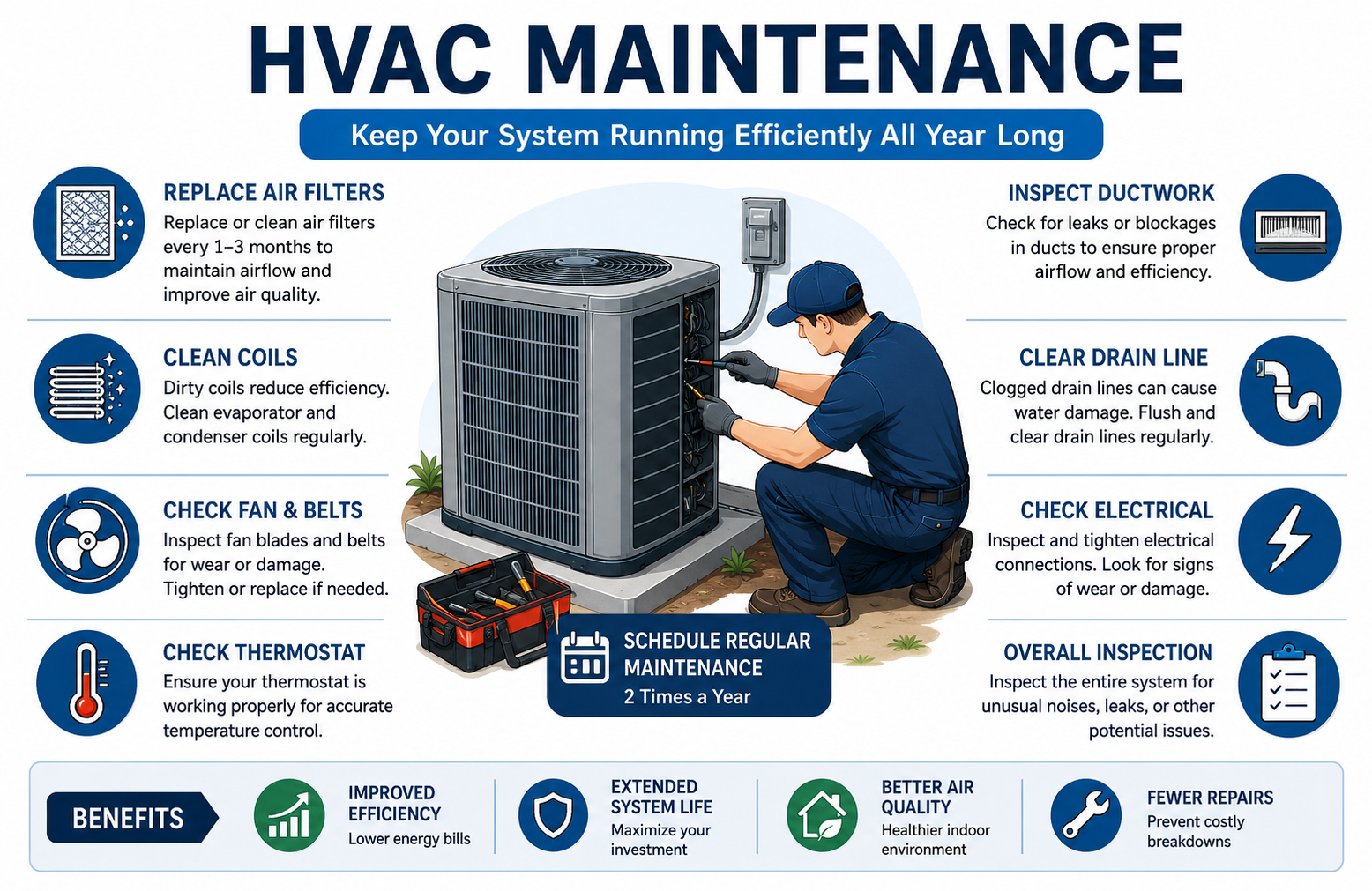
The baseline recommendation for residential HVAC systems is professional service twice per year. Once in spring before the cooling season, and once in fall before the heating season. Each visit focuses on the system being prepared for the demanding period ahead.
Owner-performed maintenance tasks follow a more frequent schedule throughout the year. Air filter checks should happen monthly during periods of heavy use. Condensate drain maintenance should occur monthly during the cooling season. Visual inspection of the outdoor unit should happen quarterly.
The exact frequency for your home may vary based on system age, household size, pet ownership, local air quality, and how heavily the system runs. Homes with multiple pets or in dusty environments need more frequent filter changes. Systems approaching end of service life benefit from more attentive monitoring.
Building HVAC maintenance into a comprehensive home care schedule ensures it receives consistent attention. The Monthly Home Maintenance Checklist provides a practical framework for integrating filter checks and basic HVAC tasks into your regular monthly routine alongside other home maintenance priorities.
HVAC Maintenance Checklist
Check and Replace the Air Filter
The air filter is the most important routine maintenance item in any HVAC system. It protects the system’s internal components from dust and debris accumulation while contributing to the quality of the air circulating through your home.
Check the filter monthly during heavy use periods. Hold it up to a light source. If you cannot see light clearly through the filter media, it needs replacement. Do not wait for a scheduled date if the filter is visibly loaded.
For a complete guide covering filter types, MERV ratings, replacement technique, and how to choose the right filter for your system, the How to Replace an HVAC Filter article walks through every aspect of this critical task in detail.
Inspect the Thermostat
Test the thermostat at the beginning of each heating and cooling season. Set it five degrees below room temperature in cooling mode and confirm the system engages promptly. Set it five degrees above room temperature in heating mode and confirm the heat comes on.
If your thermostat uses batteries, replace them annually. Smart thermostats should have their firmware updated when available. A thermostat that reads incorrectly, responds sluggishly, or fails to maintain the set temperature wastes energy and compromises comfort regardless of how well the rest of the system is maintained.
Check Air Vents and Registers
Walk through every room and confirm that all supply and return air registers are open and unobstructed. Furniture, rugs, curtains, and stored items placed over or directly against registers disrupt airflow balance throughout the system.
Vacuum register covers as part of your regular cleaning routine to prevent accumulated dust from restricting airflow at the vent level. Check that supply and return registers are not both present in the same small space in a way that short-circuits airflow before it reaches the room.
Inspect the Outdoor HVAC Unit
The outdoor condenser unit requires regular attention to maintain its heat rejection performance. Inspect it monthly during the cooling season and before startup in spring.
Check for debris accumulation on and around the unit: leaves, grass clippings, cottonwood seeds, and dirt all restrict airflow through the coil fins. Maintain at least two feet of clear space on all sides. Trim any vegetation that has grown into the clearance zone since the last inspection.
Clean Around the Condenser
After disconnecting power at the outdoor disconnect, use a garden hose with a gentle spray nozzle to rinse the condenser coil fins from inside the unit outward. This flushes debris out rather than compressing it deeper into the coil.
Never use a pressure washer on condenser fins. The delicate aluminum fins bend easily under high-pressure water, creating permanent airflow restriction. Low to moderate garden hose pressure is adequate for routine cleaning. For heavily soiled coils with compacted debris, professional coil cleaning using appropriate equipment and chemical cleaners provides better results.
Inspect Refrigerant Lines
The insulated refrigerant lines connecting the outdoor unit to the indoor air handler should be inspected annually. Look for damaged, cracked, or missing insulation on the suction line, which is the larger of the two lines.
Deteriorated insulation allows heat gain and condensation that reduce system efficiency. Replace any damaged sections with appropriately sized foam pipe insulation. If you observe oily residue on or near line connections, this may indicate a refrigerant leak, which requires immediate professional evaluation. Refrigerant inspection, testing, and handling are strictly regulated and must be performed by EPA Section 608 certified technicians.
Check the Condensate Drain
The condensate drain line removes moisture extracted from the air during the cooling process. It is one of the most overlooked maintenance points in residential HVAC and one of the most common sources of water damage.
During the cooling season, flush the drain monthly by pouring a cup of diluted white vinegar into the drain pan access port. This inhibits algae and mold growth that cause blockages. If the drain is actively blocked and water is overflowing the pan, use a wet-dry vacuum at the outdoor drain exit to pull the clog clear before flushing with water.
Inspect Evaporator and Condenser Coils
Both coils accumulate dirt over time even with a functioning filter. A dirty evaporator coil cannot absorb heat efficiently. A dirty condenser coil cannot reject heat efficiently. Both conditions force the compressor to work harder and reduce system capacity.
Visually inspect the evaporator coil when accessible during filter changes. If you see visible dust buildup on the coil fins, apply a no-rinse evaporator coil cleaner spray available at HVAC supply stores. Heavily soiled coils or coils in difficult access locations should be cleaned by a professional as part of the annual service visit.
Check Electrical Connections
Inspect accessible electrical connections at the air handler and outdoor unit for corrosion, discoloration, and visible damage. Loose or corroded connections create electrical resistance that generates heat, which accelerates insulation breakdown and can cause connection failure.
Important safety note: capacitors in the outdoor unit store dangerous electrical charge even after the power is disconnected. Never open the electrical panel on the outdoor unit or touch internal electrical components unless you are a trained professional with proper equipment. Include electrical connection testing as part of your annual professional service.
Inspect Ductwork
Inspect accessible ductwork in the attic, basement, or crawl space for disconnected sections, physical damage, and gaps where conditioned air is escaping into unconditioned spaces. Duct air leakage is one of the most significant energy efficiency problems in residential buildings.
Seal accessible gaps with mastic duct sealant or metal-backed tape. Never use standard cloth duct tape on HVAC ductwork, as it fails quickly under the temperature cycling and humidity conditions inside duct systems. For comprehensive duct system assessment including leakage quantification, professional duct testing provides the measurement data needed to evaluate whether duct sealing or replacement is warranted.
Check Blower Components
The indoor blower motor circulates air through the entire system. Inspect the blower wheel visually for dust and debris accumulation during annual service. A dirty blower wheel creates imbalance that produces noise and accelerates motor bearing wear.
Listen to the blower during operation for bearing noise, which sounds like a grinding or scraping sound and suggests the motor is approaching the end of its service life. Blower motor replacement requires professional service for proper sizing and installation.
Inspect Insulation
Confirm that insulation on accessible refrigerant lines and any ductwork in unconditioned spaces is intact and in good condition. Inspect insulation around the air handler unit in attic locations to ensure proper thermal separation.
Replace any refrigerant line insulation that is cracked, brittle, or missing. Address any duct insulation that shows signs of moisture damage, which reduces its thermal performance and can promote mold growth inside the duct cavity.
Check System Airflow
Measure the temperature differential between supply air and return air to assess system performance. Insert a thermometer into a supply register and compare the reading to the temperature at the return air grille.
A properly functioning air conditioning system should produce supply air fifteen to twenty-two degrees Fahrenheit cooler than the return air temperature. A heating system should produce supply air significantly warmer than the return. Results outside these ranges indicate reduced system performance that warrants further investigation.
Listen for Unusual Noises
Run the system through a complete heating or cooling cycle and listen carefully throughout. The system should operate with predictable, consistent sounds appropriate to its type.
Any new sound warrants investigation. Squealing suggests bearing wear. Rattling suggests loose components or debris. Grinding indicates serious mechanical wear. Clicking at startup or shutdown beyond the normal brief clicks of the contactor engaging may indicate an electrical relay problem. Report new sounds to your service technician at the next visit or sooner if they are persistent or severe.
Look for Unusual Odors
Odors from an HVAC system are diagnostic signals. A musty or mildew smell indicates biological growth on the evaporator coil or in the drain pan. A burning smell suggests overheating components or accumulated dust burning off at the beginning of the heating season. A rotten egg or sulfur smell near gas equipment requires immediate action: leave the home, avoid operating electrical switches, and contact your gas utility from outside.
Never dismiss unusual odors as something that will clear up on its own. Each represents a condition that needs identification and correction.
Check for Water Leaks
Inspect around the indoor air handler unit and condensate drain pan for any signs of water accumulation or staining. Even minor water around the air handler represents a drainage issue that can cause significant damage to the surrounding structure if allowed to continue.
Check for water around the outdoor unit as well. Some condensation on the refrigerant lines and drain from the unit is normal during cooling operation. Standing water or active dripping from locations other than the designated drain outlet warrants inspection.
Test Heating and Cooling Performance
At the beginning of each season, run the system for a complete cycle and evaluate its performance. Note how long it takes to reach the set temperature, whether it achieves the set temperature at all, and whether all areas of the home receive adequate conditioned air.
Document your observations. Changes in performance from one season to the next are often the earliest detectable sign of a developing problem. Catching a performance decline early allows scheduled professional attention before it becomes a system failure.
Seasonal HVAC Maintenance
Spring HVAC Maintenance
Spring is the most important HVAC maintenance window of the year because it prepares both the cooling system and the overall HVAC system for the coming high-demand season.
Key spring tasks:
- Schedule professional air conditioning tune-up before cooling season demand peaks
- Replace or inspect the air filter
- Clear the outdoor condenser of winter debris and rinse coil fins
- Test the thermostat in cooling mode
- Check the condensate drain and clear any accumulated blockage
- Inspect refrigerant line insulation
- Confirm all registers are open and unobstructed
- Test the system through a complete cooling cycle
The Spring Home Maintenance Checklist provides a comprehensive seasonal framework that integrates HVAC startup alongside all other spring home preparation priorities.
Summer HVAC Maintenance
Summer maintenance focuses on keeping the system performing reliably under peak cooling loads during the most demanding operating period.
Key summer tasks:
- Check and replace the air filter monthly
- Flush the condensate drain monthly with diluted vinegar
- Keep the outdoor unit clear of vegetation and debris
- Monitor system performance and note any changes
- Check thermostat settings and consider programming adjustments for energy management
- Listen and watch for any developing symptoms during the hottest periods
Fall HVAC Maintenance
Fall preparation focuses on transitioning from cooling to heating and ensuring the heating system is ready for the cold season. This is an equally critical service window to spring.
Key fall tasks:
- Schedule professional heating system tune-up before heating season demand peaks
- Replace the air filter
- Test the thermostat in heating mode
- Inspect the heat exchanger for cracks (professional task for gas furnaces)
- Check and clean the humidifier if integrated with the HVAC system
- Inspect ductwork in unconditioned spaces before cold weather makes access uncomfortable
- Test carbon monoxide detectors and confirm they are functioning
The Fall Home Maintenance Checklist covers HVAC heating season preparation as part of a complete fall home readiness program.
Winter HVAC Maintenance
Winter maintenance keeps the heating system performing reliably through the most demanding heating conditions while monitoring for any developing problems.
Key winter tasks:
- Check and replace the air filter monthly during heavy heating use
- Monitor the outdoor heat pump unit for ice accumulation that prevents proper defrost operation
- Keep outdoor heat pump units clear of snow accumulation that can restrict airflow
- Listen for unusual sounds from the furnace or air handler during startup
- Watch for cold spots in the home that indicate duct, damper, or zone control issues
For comprehensive winter home preparation that includes HVAC readiness, the Winter Home Maintenance Checklist provides a complete seasonal framework.
HVAC Maintenance Tasks Homeowners Can Do
Many HVAC maintenance tasks are well within homeowner capability and should be performed regularly between professional service visits.
- Air filter inspection and replacement
- Thermostat testing, battery replacement, and basic programming
- Clearing debris from around the outdoor unit
- Rinsing the outdoor condenser coil with a garden hose (low pressure, power disconnected)
- Flushing the condensate drain monthly with diluted vinegar
- Checking and clearing condensate drain blockages with a wet-dry vacuum
- Inspecting visible refrigerant line insulation and replacing deteriorated sections
- Checking and sealing accessible duct gaps with appropriate mastic or metal-backed tape
- Opening and unblocking supply and return air registers
- Monitoring system performance through each season
- Documenting observations and maintenance dates
HVAC Maintenance Tasks That Require a Professional
Certain HVAC maintenance tasks involve safety risks, regulatory requirements, or technical complexity that place them firmly outside homeowner capability.
- Refrigerant inspection, testing, and recharge (requires EPA Section 608 certification)
- Refrigerant leak detection and repair
- Heat exchanger inspection for gas furnaces (cracks can allow carbon monoxide into living spaces)
- Gas valve, igniter, and burner inspection and service
- Electrical panel testing and connection service at the unit level
- Capacitor and contactor testing and replacement
- Blower motor and fan blade service
- Comprehensive coil cleaning with chemical cleaners
- Duct leakage testing and professional sealing
- Refrigerant line connections and repairs
- Complete system performance testing with manifold gauges and measurement equipment
- Any work inside the electrical section of the outdoor unit
DIY vs Professional HVAC Maintenance
| Task | DIY Appropriate | Professional Required | Notes |
|---|---|---|---|
| Air filter replacement | Yes | No | Most important routine DIY task |
| Thermostat check and battery replacement | Yes | No | Basic homeowner task |
| Outdoor unit debris clearing | Yes | No | Simple, high-impact task |
| Condensate drain monthly flush | Yes | No | Diluted vinegar, monthly during cooling |
| Condenser coil rinse (garden hose) | Yes | Optional | Low pressure only, power disconnected |
| Condensate drain blockage clearing | Yes | Optional | Wet-dry vacuum at exterior exit |
| Refrigerant line insulation replacement | Yes (accessible sections) | Yes for complex routing | Match foam insulation to line diameter |
| Accessible duct gap sealing | Yes | Optional | Mastic or metal-backed tape |
| Register cleaning and unblocking | Yes | No | Basic maintenance task |
| Refrigerant inspection and recharge | No | Yes | EPA 608 certification required |
| Heat exchanger inspection | No | Yes | Critical safety task for gas systems |
| Gas component inspection | No | Yes | Safety and code requirement |
| Electrical connection testing | No | Yes | Capacitors retain dangerous charge |
| Capacitor and contactor replacement | No | Yes | High-voltage components |
| Blower motor service | No | Yes | Requires sizing and installation expertise |
| Coil chemical cleaning | Optional (basic spray) | Yes for comprehensive | Professional equipment for deep cleaning |
| Duct leakage testing | No | Yes | Requires blower door equipment |
| Annual professional tune-up | N/A | Yes (twice yearly) | Spring and fall |
HVAC Maintenance Schedule
| Task | Monthly | Quarterly | Seasonally | Annually |
|---|---|---|---|---|
| Air filter inspection and replacement | Required | Required | Required | Required |
| Condensate drain flush | During cooling season | N/A | N/A | N/A |
| Outdoor unit visual check | During cooling season | Required | Required | Required |
| Thermostat test and calibration | Optional | Optional | Required (each season) | Required |
| Register check and cleaning | Optional | Required | Required | Required |
| Condenser coil rinse | N/A | Optional | Required (spring) | Required |
| Refrigerant line insulation check | N/A | N/A | Required (spring/fall) | Required |
| Duct visual inspection | N/A | N/A | Required (spring/fall) | Required |
| System performance testing | Listen/observe | Optional | Required (each season) | Required |
| Carbon monoxide detector test | Required | Required | Required | Required |
| Professional spring tune-up (cooling) | N/A | N/A | Required (spring) | Required |
| Professional fall tune-up (heating) | N/A | N/A | Required (fall) | Required |
| Humidifier service | N/A | N/A | Required (fall) | Required |
| Blower inspection (visual) | N/A | N/A | N/A | Professional service |
| Coil professional cleaning | N/A | N/A | N/A | Professional service |
| Electrical connection inspection | N/A | N/A | N/A | Professional service |
Essential HVAC Maintenance Tools
| Tool | Purpose | Recommended Use | Estimated Cost |
|---|---|---|---|
| Digital thermometer | Measuring supply and return air temperature differential | Seasonal performance check | $10 – $30 |
| Replacement air filters | Maintaining airflow and air quality | Monthly to quarterly | $5 – $60 per filter |
| Garden hose with spray nozzle | Rinsing outdoor condenser fins | Pre-season cleaning | $20 – $60 |
| Wet-dry vacuum | Clearing condensate drain blockages | As needed during cooling season | $30 – $150 |
| Flashlight or headlamp | Inspecting air handler, ducts, and tight spaces | Every inspection | $15 – $60 |
| Foam pipe insulation | Replacing deteriorated refrigerant line insulation | As needed | $5 – $20 |
| Mastic duct sealant | Sealing accessible duct leaks | As needed | $10 – $25 |
| Metal-backed HVAC tape | Sealing duct gaps at hard-to-reach seams | As needed | $10 – $25 |
| No-rinse coil cleaner spray | Cleaning evaporator coil surface | Annually or as needed | $10 – $25 |
| Condensate drain treatment tablets | Preventing algae in drain line | Monthly during cooling season | $8 – $20 |
| Non-contact voltage tester | Confirming power is off before any electrical area access | Every maintenance session near electrical | $15 – $40 |
| Screwdrivers (flat and Phillips) | Accessing air handler and outdoor unit panels | Every maintenance session | $10 – $30 |
For a complete overview of tools every homeowner should have on hand for home maintenance tasks across all systems, the Home Maintenance Tools Every Homeowner Needs article covers both HVAC-specific and general maintenance tool recommendations.
Common HVAC Problems Caused by Poor Maintenance
Poor Airflow
Restricted airflow is the most common consequence of neglected HVAC maintenance. The primary cause is a loaded air filter that has not been replaced. Secondary causes include dirty blower wheels, obstructed registers, and collapsed duct sections. Poor airflow reduces system capacity, forces longer runtimes, and creates uneven temperature distribution throughout the home.
Dirty Filters
A filter loaded beyond its capacity does not just restrict airflow. It fails to capture particles that then accumulate on the evaporator coil, in the blower wheel, and throughout the duct system. That accumulated contamination is far more difficult and expensive to remove than the filter change that would have prevented it. Never let a filter reach the point of visible gray or brown loading without replacement.
Frozen Coils
Evaporator coil freezing occurs when airflow is insufficient to prevent the coil from dropping below freezing temperature during the refrigeration cycle. The primary causes are a blocked air filter, closed registers reducing system airflow, and low refrigerant charge that causes abnormal pressure and temperature behavior in the refrigerant circuit. A frozen coil cannot function and must be thawed completely before the underlying cause can be diagnosed and corrected.
Clogged Drain Lines
An algae or debris blockage in the condensate drain line causes water to back up in the drain pan and overflow onto the surrounding structure. This is among the most preventable water damage causes in residential homes and one of the easiest to address through monthly drain maintenance during the cooling season.
Uneven Heating or Cooling
Rooms that are consistently warmer or cooler than the rest of the home indicate airflow distribution problems. Common causes include duct leakage delivering conditioned air to unconditioned spaces, damaged zone dampers in zoned systems, or imbalanced airflow from incorrectly positioned registers. Professional duct testing and balancing can quantify and address distribution problems that simple adjustment cannot resolve.
Higher Energy Bills
An unexplained increase in energy costs during a consistent usage period is one of the most reliable early indicators of declining HVAC system efficiency. The increase may result from a dirty coil reducing heat transfer, a low refrigerant charge forcing the compressor to run longer, a clogged filter restricting airflow, or duct leakage sending conditioned air to the wrong places. ENERGY STAR notes that properly maintained HVAC equipment can significantly reduce energy consumption compared to neglected systems of the same age and type.
Frequent Cycling
Short cycling, where the system turns on and off more frequently than normal, indicates the system is not completing a full cooling or heating cycle before reaching the set temperature and shutting off, or that something is causing premature shutdown on a safety control. Causes include an oversized system for the home, a refrigerant problem, a dirty or iced evaporator coil, or a failing thermostat. Short cycling accelerates compressor wear significantly and requires professional diagnosis.
Unusual Noises
Noises from an HVAC system almost always indicate a developing mechanical problem. Squealing or screeching suggests bearing wear in the blower motor or an outdoor fan motor. Rattling suggests loose panels, debris inside the unit, or failing mounts. Banging at startup suggests a delayed ignition in a gas furnace that requires immediate professional evaluation. Never dismiss unusual sounds as acceptable. They are the system communicating a developing problem.
Water Leaks
Water around the indoor air handler results from drain line blockage, a cracked or overflowing drain pan, or frozen evaporator coils that melt and overwhelm the drainage capacity. Any active water leakage from HVAC equipment should be addressed immediately. Water reaching electrical components, subfloor structures, or wall cavities causes damage far exceeding the cost of resolving the underlying HVAC problem.
Reduced System Performance
A gradual decline in the system’s ability to reach and maintain the set temperature is often the first detectable sign of refrigerant loss, coil degradation, or compressor wear. Because this decline is gradual, many homeowners adapt to it without recognizing it as a problem. Comparing current performance to documented baseline performance from previous seasons is the most reliable way to detect this type of developing issue.
Common HVAC Maintenance Mistakes
Even motivated homeowners fall into patterns that undermine their maintenance efforts.
Using too high a MERV rating filter. Filters rated MERV 13 and above offer excellent particle capture but also restrict airflow more than many residential systems can handle. Always match filter MERV rating to your system’s specification. A filter that is too restrictive causes the same airflow problems as a clogged filter.
Closing supply registers in unused rooms. This seems logical but increases static pressure in the duct system, restricts system airflow, and can cause evaporator coil freezing. Leave all registers open. If you want to manage temperatures in unused spaces, consult an HVAC professional about zone control options.
Skipping professional service. Many homeowners perform DIY maintenance faithfully but defer professional service year after year. Professional technicians assess refrigerant charge, electrical component condition, heat exchanger integrity, and system performance parameters that cannot be evaluated with homeowner tools. Annual professional service is not optional.
Ignoring the condensate drain until it overflows. Monthly prevention with a simple vinegar flush costs nothing and takes minutes. Emergency response to an overflowed drain pan affecting flooring and ceiling materials can cost thousands.
Not replacing filters on schedule. The single most documented and consequential HVAC maintenance failure is filter neglect. There is no substitute for a clean filter, and no other maintenance task has more consistent impact on system performance, efficiency, and longevity.
How to Improve HVAC Efficiency
Efficiency improvements compound over time. Small changes in how you operate and maintain your system deliver measurable energy cost reductions throughout the year.
- Program your thermostat to reduce heating and cooling when the home is unoccupied or occupants are sleeping
- Seal air leaks around windows, doors, and utility penetrations that force the HVAC system to condition more outdoor air
- Ensure attic insulation meets the recommended R-value for your climate zone, reducing the thermal load the HVAC system must overcome
- Use ceiling fans to improve the perceived comfort at higher thermostat settings in summer and lower settings in winter
- Keep interior doors open to allow proper airflow distribution between rooms
- Shade the outdoor condenser unit with plantings or a structure that does not obstruct the two-foot clearance requirement
- Replace aging equipment with ENERGY STAR certified replacements that operate at significantly higher efficiency ratings than the systems they replace
How to Extend the Life of an HVAC System
The operational lifespan of HVAC equipment varies considerably based on equipment quality, climate, usage patterns, and most importantly, maintenance consistency.
- Never skip the air filter. This single practice has more impact on system longevity than any other homeowner action.
- Schedule professional service every spring and fall without exception. Early detection of developing problems prevents them from causing catastrophic component failures.
- Address unusual sounds, odors, or performance changes at the first observation rather than waiting for a scheduled service visit.
- Keep the outdoor unit clear of vegetation, debris, and encroachment year-round.
- Do not operate the cooling system when outdoor ambient temperatures fall below the equipment’s rated minimum operating temperature, typically around 60 degrees Fahrenheit for standard residential equipment.
- Keep the system’s refrigerant charge correct by ensuring any refrigerant loss is promptly found, the leak repaired, and the charge restored by a licensed technician.
- Protect the system from power surges with a whole-house surge protector or HVAC-specific surge protection device.
Building your complete HVAC care into a structured annual home maintenance plan ensures the system receives consistent attention every year. The Annual Home Maintenance Checklist and the Ultimate Home Maintenance Checklist for Every Season both provide comprehensive frameworks that connect HVAC maintenance to every other system your home depends on.
HVAC Maintenance Costs
Actual HVAC maintenance costs vary based on location, system type, equipment condition, and service provider. The estimates below are general ranges for planning purposes. Always obtain written quotes from licensed contractors for your specific system and situation.
| Service or Task | DIY Cost | Professional Cost | Notes |
|---|---|---|---|
| Air filter (standard 1-inch) | $5 – $30 | N/A (DIY) | Replace every 1 to 3 months |
| Air filter (4 to 5 inch media filter) | $20 – $60 | N/A (DIY) | Replace every 6 to 12 months |
| Condensate drain treatment | $0 – $20 | N/A (DIY) | Monthly vinegar flush or drain tablets |
| Condenser coil rinse | $0 (garden hose) | $80 – $200 | Professional for chemical cleaning |
| No-rinse evaporator coil spray | $10 – $25 | Included in service | DIY for accessible coils |
| Professional spring AC tune-up | N/A | $75 – $200 | Central system, includes inspection |
| Professional fall heating tune-up | N/A | $75 – $200 | Furnace or heat pump inspection |
| Refrigerant recharge (with leak repair) | N/A | $200 – $600+ | Cost varies by refrigerant type and quantity |
| Capacitor replacement | N/A | $100 – $350 | Common outdoor unit repair |
| Contactor replacement | N/A | $100 – $300 | Common outdoor unit repair |
| Blower motor replacement | N/A | $300 – $800 | Parts and labor |
| Duct sealing (professional) | $10 – $30 (accessible DIY) | $300 – $1,500+ | Depends on duct system size |
| Thermostat replacement | $20 – $250 | $150 – $400 | Smart thermostat installed |
| Furnace heat exchanger replacement | N/A | $500 – $1,500+ | Major repair |
| Estimated Annual Total | $50 – $200 | $300 – $700 | Combined DIY and professional |
When to Call an HVAC Professional
Some conditions require professional evaluation promptly rather than waiting for the next scheduled service window.
Call a licensed HVAC professional when:
- The system stops heating or cooling entirely
- You smell gas, sulfur, or rotten egg odors near any gas equipment
- Carbon monoxide detectors alarm
- You see ice forming on refrigerant lines or the outdoor unit during cooling operation
- Active water leakage is occurring from the air handler or drain pan
- Unusual sounds develop suddenly or are persistent
- The circuit breaker for the HVAC system trips repeatedly
- The system runs continuously without reaching the set temperature
- Energy bills increase significantly without a corresponding change in usage
- You observe burning smells from any HVAC component
For gas-fired equipment specifically, any concern about combustion performance, heat exchanger integrity, or venting should be treated as a safety matter and evaluated by a professional without delay.
Expert Recommendations
After working with HVAC systems across a wide range of ages, conditions, and climates, a few practices consistently produce the best outcomes for homeowners.
Never negotiate with the air filter. Of all the factors that determine how a residential HVAC system performs and how long it lasts, filter maintenance has the most consistent and direct impact. Check it monthly. Replace it when it needs replacement. Keep spare filters on hand so there is no excuse for delay. Every day of operation with a loaded filter is a day of unnecessary system wear and reduced efficiency.
Schedule professional service in spring and fall, not when something goes wrong. The homeowners who spend the least on HVAC over the life of their system are those who invest in professional prevention. An annual professional tune-up catches developing problems, maintains system efficiency, and keeps warranty coverage intact.
Take indoor air quality seriously as part of HVAC maintenance. Clean coils, clean drains, and appropriate filter MERV ratings are not just about system performance. They directly determine the quality of the air everyone in your home breathes every day. An HVAC system that is not maintained is not just inefficient. It is actively degrading the indoor environment it was installed to improve.
Document every maintenance action. Record filter change dates, professional service visits, any repairs made, and any observations about system performance. This record is valuable for warranty claims, for informing service technicians, and for identifying trends in system performance over time.
Connect HVAC maintenance to your complete home care plan. Treating your heating and cooling system in isolation from the rest of your home’s maintenance needs leads to inconsistent service. The Home Maintenance Checklist by Month and the seasonal checklists referenced throughout this guide provide the integrated framework that ensures HVAC care gets consistent attention alongside every other system your home depends on. For an expanded look at what comprehensive air conditioning maintenance involves specifically, the Air Conditioner Maintenance Guide provides detailed coverage of every aspect of cooling system care.
Frequently Asked Questions
What is the most important HVAC maintenance task a homeowner can do?
Replacing the air filter on a consistent schedule is the single most impactful maintenance task available to any homeowner. It costs very little, takes minutes to complete, and has direct positive effects on system efficiency, airflow performance, component lifespan, and indoor air quality. All other HVAC maintenance efforts are built on the foundation of a clean filter. A system with a loaded filter will underperform regardless of how well every other component is maintained. Check monthly during heavy use periods and replace the filter whenever it shows visible loading rather than waiting for a calendar date.
How do I know if my HVAC system needs professional service between scheduled visits?
Several symptoms indicate a condition that should not wait for the next scheduled professional service visit. These include: the system failing to reach or maintain the set temperature during normal conditions, unusual sounds developing during operation, active water leakage from any system component, burning or chemical odors from vents or equipment, the system circuit breaker tripping repeatedly, ice forming on refrigerant lines or outdoor equipment during cooling operation, and any gas odor near furnace or gas-fired equipment. Any of these situations warrants a professional evaluation promptly rather than continued operation or waiting for a scheduled appointment.
How long should a properly maintained HVAC system last?
Equipment lifespan varies significantly based on the type of equipment, installation quality, local climate, usage intensity, and maintenance history. General industry expectations suggest central air conditioners and heat pumps have average service lives in the range of fifteen to twenty years, while gas furnaces may last somewhat longer under favorable conditions. These are averages, not guarantees. Systems that receive consistent professional service and careful owner maintenance regularly exceed average expectations. Systems that receive minimal maintenance often fail well before average lifespan. The best predictor of your specific system’s lifespan is the consistency of its maintenance history combined with its current condition as assessed by a qualified technician.
Is it worth getting an HVAC service contract?
HVAC service contracts or maintenance agreements offered by HVAC contractors vary considerably in what they include and how they are priced. The basic value proposition is reliable, scheduled preventive service performed by technicians who know your system, sometimes with priority scheduling and discounted repair rates during the contract period. For homeowners who value convenience and consistent professional attention, service contracts can be worthwhile. For those who are disciplined about scheduling service independently, the cost may exceed the benefit. Evaluate what any proposed contract actually includes, compare its cost to what the same services would cost individually, and assess whether the additional benefits justify the price.
Can I use a higher MERV filter for better air quality?
Using a higher MERV filter improves particle capture but increases airflow resistance through the filter media. Most residential HVAC systems are designed and calibrated to operate with filters in the MERV 8 to 11 range. Installing a MERV 13 or higher filter in a system designed for lower ratings can restrict airflow enough to cause evaporator coil freezing, increased blower motor stress, and reduced system efficiency, exactly the problems that filter maintenance is supposed to prevent. If you want better particle filtration, consult your HVAC professional about whether your system can handle a higher MERV rating or whether a system modification would be needed to accommodate it safely.
What does an HVAC professional check during a tune-up?
A professional HVAC tune-up covers both the tasks homeowners cannot perform and a comprehensive review of what homeowners can. A technician will measure refrigerant pressure using manifold gauges to confirm the system is charged correctly, test electrical components including capacitors and contactors for proper operation, inspect the heat exchanger for cracks in gas furnaces, clean coils with appropriate equipment, check gas valve and ignition system operation, measure system airflow, verify thermostat calibration, inspect the condensate system, check all safety controls, lubricate components with oil ports if present, and document all findings. The value of professional service is both the tasks performed and the trained assessment of system condition that experienced eyes and proper instruments provide.
Why does my HVAC system smell musty when it first turns on?
A musty or mildew smell when the HVAC system starts indicates biological growth on the evaporator coil, in the condensate drain pan, or in the ductwork near the air handler. Moisture that collects in these locations during cooling operation creates an environment where mold and bacteria thrive. This is a maintenance issue that should be addressed rather than tolerated. In mild cases, cleaning accessible evaporator coil surfaces with a no-rinse coil cleaner and flushing the condensate drain line addresses the source. Persistent or strong odors that return quickly after cleaning indicate more extensive biological contamination in the coil or duct system that requires professional cleaning.
Should I turn off my HVAC system when I go on vacation?
Complete shutdown of your HVAC system during vacation is not recommended, particularly in extreme temperatures. In summer, an interior that reaches very high temperatures due to solar gain can stress building materials, damage electronics, and create conditions where heat accumulates in enclosed spaces. In winter, a completely shut-off heating system risks frozen pipes in colder climates. A better approach is to set the thermostat to a reduced but maintained temperature range. Seventy-eight to eighty degrees in summer and fifty-five to sixty degrees in winter maintains acceptable conditions while minimizing runtime. Smart thermostats allow vacation mode programming and remote adjustment if conditions change unexpectedly.
How do I know if my ductwork is leaking?
Duct leakage produces several observable symptoms that homeowners can recognize without specialized equipment. Rooms that are consistently warmer or cooler than the rest of the home despite open registers suggest air is being lost before reaching those areas. Dusty conditions near supply registers can indicate air bypassing the filter through duct leaks near the air handler. Visible disconnected or separated duct sections in the attic or basement are obvious leakage points. Unusually high energy bills relative to usage are consistent with significant duct leakage. For quantified leakage measurement, professional duct leakage testing with specialized pressurization equipment provides the precise information needed to evaluate repair options.
How does HVAC maintenance connect to the overall home maintenance program?
HVAC maintenance works best when it is integrated into a comprehensive home care routine rather than treated as an isolated concern. Your heating and cooling system interacts with your home’s insulation, windows, ductwork, plumbing, and electrical infrastructure in ways that make whole-home maintenance perspective valuable. For example, sealing air leaks in the building envelope reduces the HVAC system’s workload. Maintaining proper attic insulation reduces both summer cooling and winter heating demand. Ensuring the home is weathertight improves every measure of HVAC efficiency and comfort. Building HVAC maintenance into the broader home care calendar through resources like the DIY Home Inspection Checklist ensures your heating and cooling system is assessed as part of the complete home rather than separately from it.
Conclusion
A well-maintained HVAC system is one of the most direct contributions you can make to your home’s comfort, efficiency, safety, and long-term value. The system is always working, whether you think about it or not. The question is whether it is working well or working harder than it needs to because maintenance has been deferred.
The framework in this guide gives you what you need to approach HVAC maintenance intelligently. Handle the tasks that are within your safe capability consistently and on schedule. Build the habit of monthly filter checks, seasonal system startup tests, and regular condensate drain maintenance. Document everything you do.
And invest in professional service twice yearly without treating it as optional. The spring and fall tune-ups that keep your system calibrated, clean, and professionally assessed are the foundation that makes every other maintenance effort more effective.
Your HVAC system will reward that investment with reliable performance, reasonable energy bills, and a service life that extends well beyond what neglected equipment can achieve. That is the straightforward, practical value of doing HVAC maintenance right, every season, every year.