How to Create a Warm and Inviting Living Room

Some living rooms are simply pleasant to be in. You walk in, settle into the seating, and feel immediately comfortable—without necessarily being able to explain exactly why. Others are well-decorated on paper but never quite achieve that quality. The difference rarely comes down to budget or the price of the furniture. It comes down to how the room has been put together: whether the lighting feels right at different times of day, whether the seating arrangement encourages people to stay, whether there’s enough softness and texture to make the space feel genuinely comfortable rather than simply presentable.
Knowing how to create a warm and inviting living room is really about understanding which elements contribute most to how a room feels, rather than how it looks in a photograph. Color matters, but so does how the light interacts with it. Furniture matters, but so does how it’s arranged. Decoration matters, but so does leaving enough visual space for the room to breathe.
The reassuring thing is that this quality isn’t achieved only through expensive renovations or complete redesigns. Many living rooms are transformed by relatively modest changes—reconsidering the furniture layout, improving the lighting, adding the right textiles, editing down what’s on display. This guide works through each element in practical detail, covering rooms of different sizes, different budgets, and different existing conditions.
1. Start With a Comfortable Furniture Layout
The arrangement of furniture has more influence on how welcoming a living room feels than almost any other single factor. A room with beautiful, expensive furniture arranged poorly will feel less comfortable than a room with modest furniture arranged well. The layout determines whether people feel invited to sit and stay, whether conversation feels natural, and whether the room is easy to move through.
Create a proper conversation area — Seating should be positioned so that the people using it can talk comfortably without raising their voices or turning awkwardly. This typically means sofas and chairs facing or angling toward each other, close enough to feel connected. A seating arrangement where people are facing the same direction—as though waiting for something to happen—rarely feels genuinely inviting.
Orient seating toward a focal point — Whether that’s a fireplace, a television, or a significant piece of artwork, having a clear visual anchor for the seating arrangement gives the room a sense of purpose and makes the layout easier to read. Seating that seems to point in no particular direction tends to make a room feel uncertain.
Keep pathways clear — A room where you have to navigate around furniture to reach the seating, or where chairs need to be moved to allow someone to pass, quickly starts to feel more like an obstacle course than a living room. Clear, easy circulation contributes directly to a room’s feeling of comfort.
Resist the urge to push everything against the walls — This is one of the most common layout mistakes, and it almost always makes a room feel less welcoming. Furniture grouped together in the center of the room, with some space between it and the walls, creates a more cohesive and intimate arrangement.
Match the layout to the room’s actual shape — A long, narrow room benefits from a different approach than a square one. A very large room may work better with two separate seating groupings than one large arrangement. The right layout always responds to the specific geometry of the space.
2. Choose Warm and Comfortable Colors
Color has a direct effect on how a room feels. Warm colors—those with yellow, red, or orange undertones—tend to make spaces feel more intimate and comfortable. Cooler tones—blues, greys, and blue-based whites—can feel calm and elegant, but they require careful handling to avoid reading as cold or distant, particularly in a room that’s meant to feel welcoming.
Warm neutrals are the most reliable foundation for a living room that’s meant to feel comfortable. Cream, warm white, soft beige, and light sand-toned walls provide a background that’s neither demanding nor bland, and they work well with a wide range of furniture colors and materials. The key distinction between a warm white and a cool one is in the undertone—warm whites lean slightly toward yellow or pink rather than blue or grey.
Earthy tones — Muted terracotta, deep warm ochre, soft clay, and gentle brown tones have established themselves as enduring choices for comfortable living rooms because they bring warmth without the brightness of fully saturated colors. They’re particularly effective when combined with natural wood and woven textures.
Soft accent colors — A warm living room scheme doesn’t need to be entirely neutral. A carefully chosen accent color—introduced through cushions, a throw, a rug, or a piece of artwork—can add life and personality without disrupting the overall warmth. Warm greens, dusty pinks, and muted terracottas work particularly well as accent tones in warm living room schemes.
The relationship between colors in the room — Wall color is only part of the picture. The colors of the sofa, the rug, the curtains, and the accessories all interact. A scheme that feels warm and cohesive is one where the colors share some tonal logic—similar warmth levels, compatible undertones—rather than competing with each other.
For a thorough approach to choosing colors that work together across your home, How to Choose the Right Colors for Your Home is a useful companion resource.
3. Use Layered Lighting
Lighting is arguably the single most powerful tool for creating atmosphere in a living room, and it’s the element that’s most frequently underused. A room lit solely by a central ceiling fixture—however attractive the fitting—will almost always feel flat and somewhat institutional in the evening. It’s the combination of multiple light sources at different heights and intensities that creates the warmth and depth associated with genuinely comfortable rooms.
Ambient lighting — This is the room’s general light level, typically provided by a ceiling fixture, recessed lights, or a combination of both. It should be sufficient to see clearly and move comfortably through the space, but it doesn’t need to be at maximum brightness at all times.
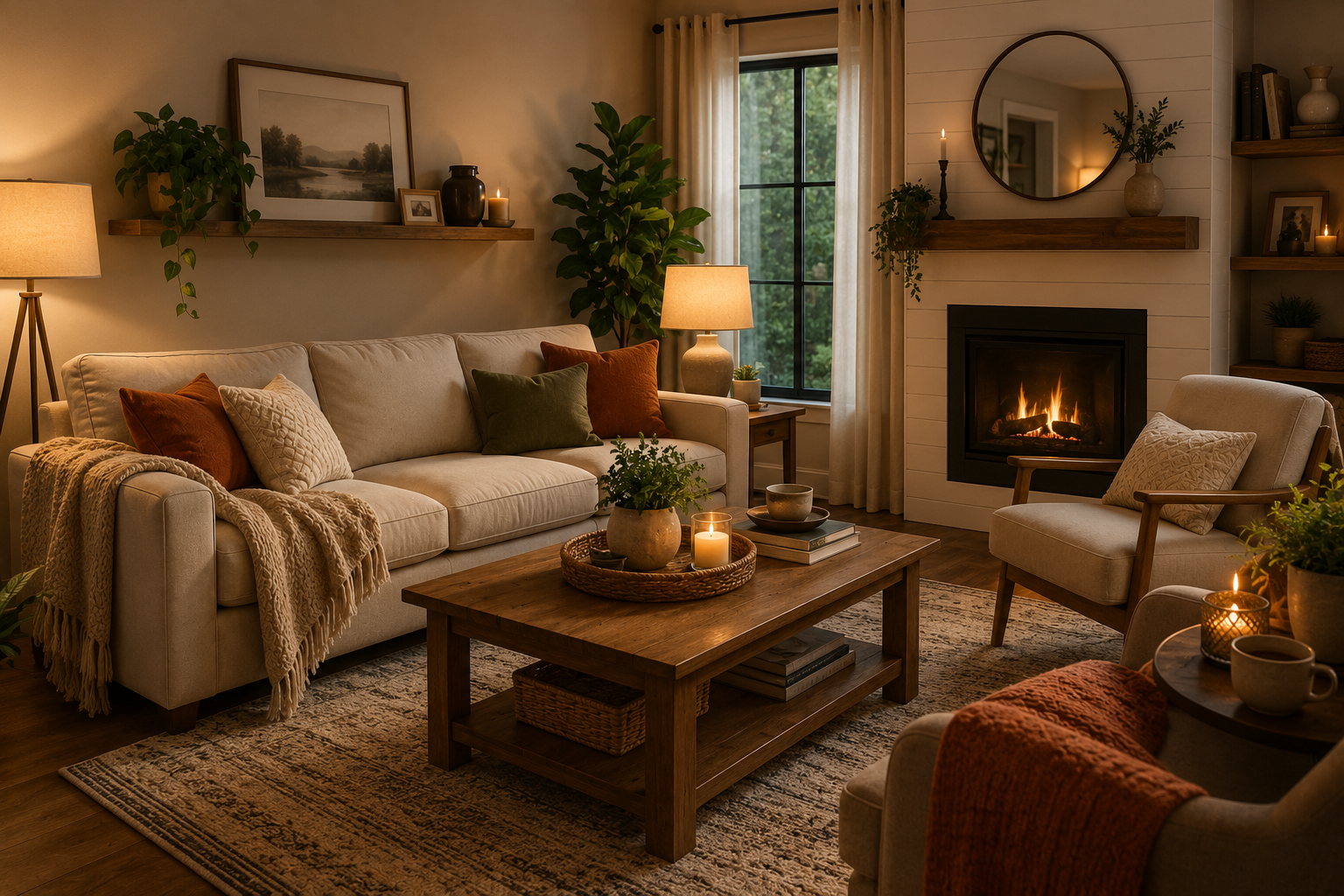
Floor lamps and table lamps — These are what give a living room its evening character. Positioned beside seating areas and near corners, they create pools of warm light at eye level that feel much more inviting than overhead illumination alone. A living room with a central light switched off and two or three lamps on will almost always feel warmer and more comfortable than the same room with only overhead lighting.
Accent lighting — A small light directed at a piece of artwork, a shelf of objects, or an architectural detail adds depth and visual interest to the room in the evening. It’s not essential, but it contributes to a sense that the room has been considered.
Natural light — During the day, maximizing the quality and quantity of natural light is important. Clean windows, window treatments that can be fully drawn back, and light-reflective surfaces help a room feel brighter and more open.
Dimmers — Where possible, having dimmer switches on the main ambient lighting gives flexibility to adjust the room’s atmosphere throughout the day. Brighter for daytime use, lower for evenings. Any hard-wired electrical changes—adding dimmer switches, new circuits, or ceiling fixtures—should be done by a qualified electrician.
The goal of layered lighting is a room that can be adjusted to feel comfortable in different situations: clear and bright when needed, warm and intimate in the evening.
4. Add Soft Textures
Texture does something for a living room that color and lighting alone can’t fully achieve: it makes the space feel genuinely tactile and comfortable rather than simply visually attractive. A room with limited texture—smooth walls, hard flooring, plain upholstery—can look clean and modern but rarely feels as warm and welcoming as one where different surfaces and materials are combined.
Cushions are the most immediate and accessible way to add texture to a seating arrangement. The key is variation—a linen cushion alongside a velvet one, a knitted cover next to a woven one—rather than a coordinated set in identical fabric. The mix of textures is what creates the sense of depth.
Throws serve both a practical and a visual purpose. A throw draped over the arm of a sofa or folded across a chair suggests comfort and ease—that this is a room where people genuinely settle in. Choose materials that feel as good as they look: a chunky knit, a soft wool, or a woven cotton.
Rugs introduce softness to hard floor surfaces and bring the seating arrangement together visually. A textured rug—a wool flatweave, a pile rug with some variation, a natural fiber alternative—adds warmth underfoot and contributes to the room’s overall tactile quality.
Curtains in substantial fabrics—linen, velvet, a woven cotton—hang well and add significant softness to a room. Lightweight synthetic alternatives tend to look flat and less considered, particularly in a room where other textiles have been carefully chosen.
Upholstered furniture — The sofa and any armchairs are the room’s largest textile surfaces. Fabric upholstery in a warm, soft material contributes significantly to how comfortable the room feels. Leather and faux-leather alternatives can work in a warm living room but benefit from being softened with fabric cushions and throws.
5. Choose a Comfortable Sofa and Seating
The sofa is typically the most-used piece of furniture in the living room, and its comfort has a direct effect on how welcoming the space feels. A beautiful sofa that’s uncomfortable to sit in for more than twenty minutes fails at the most fundamental requirement of the room.
Seating depth — Deeper seats tend to feel more relaxed and comfortable for lounging; shallower seats feel more upright and suitable for conversation. Most living rooms benefit from seating that sits somewhere between the two extremes—deep enough to feel comfortable for extended use, upright enough to feel practical.
Cushion support — Seat cushions that lose their shape quickly or that sink uncomfortably are a comfort problem that no amount of design can compensate for. When assessing a sofa, sit in it properly rather than perching on the edge—the difference in quality often only becomes apparent after a few minutes.
Fabric — In practical terms, the fabric should be appropriate for the household’s lifestyle. A cream linen sofa in a home with young children or large dogs is a constant maintenance challenge. More durable, cleanable fabrics in appropriate colors are a more honest choice for households with heavy use.
Scale — The sofa should be proportionate to the room. A three-seat sofa plus a large armchair in a small living room may mean there’s no room to circulate comfortably. A small two-seat sofa in a large room may leave the arrangement feeling insignificant. The right number and size of seats depends on both the room’s dimensions and the household’s actual seating needs.
Mixing seating types — A room with a sofa and two matching armchairs feels very different from one with a sofa, a single armchair, and an occasional chair of a different style. The second arrangement tends to feel more interesting and personal, and it often allows more flexibility in how the seating is used.
6. Add an Area Rug
A well-chosen area rug does more for a living room’s warmth and cohesion than almost any other single accessory. It grounds the furniture arrangement, adds texture and color, softens hard floors, and visually signals that the seating area is a distinct and considered zone within the room.
Size is the most critical decision — A rug that’s too small is the most common mistake. A rug that only the coffee table sits on, with the sofa and chairs floating on bare floor around it, fails to visually connect the arrangement. At minimum, the front legs of the main seating pieces should sit on the rug. A larger rug that has all the furniture fully on it creates the strongest sense of cohesion, though this requires a substantial rug.
Texture and material — A rug with some texture—a flatweave wool, a pile rug with natural variation, a jute or seagrass alternative—adds more warmth to a room than a smooth, flat alternative. The texture also contributes to the room’s overall tactile quality, particularly when combined with other soft surfaces.
Color and pattern — In a room with relatively plain furniture and walls, a rug with some pattern or a stronger color can provide the room’s main visual interest. In a room that already has more color or pattern, a simpler rug tends to work better. The rug’s tones should have a logical relationship with the rest of the room’s color scheme—not necessarily matching, but harmonizing.
Maintenance — Consider how the rug will be maintained, particularly in high-traffic areas or households with children and pets. Natural fibres like wool are durable and age well but require more care than synthetic alternatives. Whatever the material, ensure it can be cleaned in a way that’s practical for how the room is used.
7. Bring Natural Elements Into the Room
Natural materials and living plants have a quality that manufactured alternatives rarely replicate fully. They bring variety, warmth, and a sense of the organic that makes spaces feel more comfortable and less constructed. In a living room that’s meant to feel warm and welcoming, natural elements are a consistently effective tool.
Indoor plants are among the most immediate and accessible improvements. A mix of scales—a larger floor plant in a corner, a couple of smaller plants on a shelf or side table—creates more visual interest and sense of life than a row of identical small pots. Choose plants that will genuinely thrive in the room’s light conditions; a struggling plant adds little visually and becomes a maintenance burden.
Wood in furniture, shelving, or accessories brings warmth and a sense of craft that other materials don’t replicate in the same way. The finish matters: a natural, matte-finished timber reads very differently from a heavily lacquered or painted surface. In a room intended to feel warm, wood with visible grain and a lighter touch tends to integrate more naturally.
Woven materials — baskets, rattan furniture, jute and sisal rugs, woven cushion covers—are practical and visually effective ways to introduce natural texture. A woven basket as a magazine holder, a rattan side table, or a jute rug all contribute texture and natural character at relatively low cost.
Stone and natural surfaces — A stone-topped coffee table, a ceramic pot, or natural stone accessories introduce a different kind of texture and weight. These tend to work as grounding elements alongside softer materials.
Organic shapes — Natural elements often have irregular, organic shapes that contrast with the clean lines of furniture. This contrast—a curved branch in a vase, a gnarled wooden side table, a plant with irregular leaves—adds visual interest that perfectly uniform, manufactured objects rarely achieve.
8. Use Curtains to Add Warmth
Window treatments are often underestimated in their contribution to a living room’s atmosphere. Curtains in the right fabric, the right color, and the right proportion can make a room feel finished, comfortable, and noticeably warmer—both visually and practically. The wrong curtains, or no curtains at all, can make even a well-furnished room feel unfinished.
Fabric — Heavier fabrics add warmth and visual weight that lighter alternatives don’t. A linen curtain in a natural tone, a velvet panel in a deeper color, or a woven cotton in a warm neutral all hang well and contribute substantially to a room’s sense of comfort. Thin synthetic fabrics tend to look flat and cheap against a window, particularly when the rest of the room’s textiles have been carefully chosen.
Length — Full-length curtains that fall from near the ceiling to the floor make the most visual impact. They draw the eye upward, making the room feel taller, and they frame the window more generously than curtains that stop at the window sill.
Hanging height — Mounting the curtain rail close to the ceiling rather than just above the window frame makes the windows appear larger and the room feel more generous. This is a practical improvement that costs almost nothing but makes a noticeable difference to how the room reads.
Color — Curtains in a color that’s harmonious with the room’s overall palette—similar in tone or in the same color family—tend to integrate well without drawing too much attention to themselves. Curtains that contrast strongly with the walls and furniture can work, but they become a more dominant element in the room’s design and need to be chosen accordingly.
Privacy and light — Layering sheer curtains beneath heavier outer panels allows flexibility: natural light during the day, privacy without complete darkness in the evening.
9. Create a Welcoming Focal Point
A room without a clear focal point tends to feel visually restless—the eye moves around without settling anywhere, which makes the space feel less composed and less comfortable than it should. A focal point gives the furniture arrangement a natural orientation, the room a sense of visual structure, and visitors somewhere natural to direct their attention.
Fireplace — Where one exists, a fireplace almost always functions naturally as the room’s focal point. Even a fireplace that’s no longer in use—or one that’s been converted—can anchor the room effectively if it’s well-presented and the seating is oriented toward it. The warmth a fireplace suggests, even symbolically, contributes to a room’s sense of comfort.
Artwork — A significant piece of artwork above a sofa or on the room’s most prominent wall can function as a focal point in a room that doesn’t have a fireplace or other architectural feature. The piece should be large enough to hold the wall it’s on—a small work above a long sofa tends to look lost rather than considered.
Television area — In most family living rooms, the television is the practical focal point and it makes sense to design around it deliberately rather than trying to hide it. A considered media unit or a mounted television on a well-chosen wall, integrated into the overall design, works considerably better than a television that seems placed without thought.
Feature wall — A wall in a contrasting or deeper color, a textured finish, or a carefully composed arrangement of artwork and objects can create a focal point in a room where no obvious architectural one exists.
10. Add Personal Décor
A living room that’s well-designed but entirely impersonal—where nothing reveals anything about the people who live in it—tends to feel more like a show home than a genuine living space. Personal items make a room feel inhabited, and that quality of being genuinely lived-in is a significant part of what makes a room feel welcoming.
Family photographs and meaningful artwork — Images and objects that reflect the household’s history, interests, and personality add warmth that purely decorative objects don’t. They give visitors something to look at and respond to, and they signal that the room belongs to real people with real lives.
Books — A bookcase or a thoughtfully arranged stack of books on a coffee table adds both visual interest and personal character. Books are inherently decorative as well as practical, and they tend to make rooms feel more intelligent and more lived-in.
Travel pieces and collected objects — Something brought back from a journey, a piece found in a market, an object inherited from a family member—these items have a story behind them, and that quality comes through in how they feel in a room. They’re harder to replicate with purely decorative purchases.
Plants — As discussed earlier, plants add life and a sense of care that inanimate objects don’t, and they contribute to the impression of a room that’s genuinely tended.
The important distinction is between a personalized room and an overcrowded one. The goal is a considered selection of meaningful objects, not every item you’ve ever owned displayed simultaneously. A few well-chosen personal pieces have far more impact than many items competing for attention.
11. Keep Clutter Under Control
There’s a paradox in living room design: a room needs enough in it to feel warm and personal, but too much undermines the very comfort it’s trying to create. A living room where every surface is covered, where it’s difficult to find somewhere to set a cup without moving three things, and where pathways are obstructed by accumulated belongings tends to feel more stressful than welcoming—regardless of how carefully each individual item was chosen.
Good storage is what allows a living room to feel both personal and calm. It gives frequently used items a consistent, accessible home, keeps surfaces from accumulating clutter, and makes the room easier to maintain without constant effort.
Storage furniture — A sideboard, media unit, or coffee table with internal storage keeps everyday items—remote controls, cables, children’s things, books—contained when they’re not in use. Closed storage is particularly useful for items that would otherwise live permanently on surfaces.
Baskets — A well-chosen basket on a shelf or beside the sofa provides accessible storage for throws, magazines, or children’s toys without looking obviously utilitarian. It reads as a decorative element while serving a practical purpose.
Shelving — Open shelving can provide both storage and display, but it requires consistent organization to look tidy rather than chaotic. A balance of books, objects, and empty space tends to read better than a shelf packed with every available item.
For a comprehensive approach to storage throughout the home, Best Storage Ideas for a More Organized Home covers this in much more detail.
12. Make a Small Living Room Feel Warm and Inviting
A small living room has its own particular set of challenges, but limited space doesn’t prevent warmth. In some ways, a smaller room has a natural advantage—it’s easier to feel intimate and comfortable in a compact space than in a large one that’s difficult to fill. The goal is to work with the room’s scale rather than against it.
Appropriately scaled furniture — Every piece should be proportionate to the available space. This doesn’t mean everything needs to be tiny, but oversized furniture in a small room quickly makes it feel crowded. Sofas with visible legs, glass or transparent coffee tables, and slimmer-profile pieces all help the room feel less visually heavy.
Warm, light colors — Lighter tones in warm whites, creams, and soft neutrals help small rooms feel more open. This doesn’t mean cold or clinical—a warm cream or a soft sandy tone achieves lightness without losing warmth.
Mirrors — A well-positioned mirror reflects both light and space, making a small room feel larger and brighter. Positioned to reflect natural light or a pleasant view of the room, a mirror is one of the most effective tools in a small living room.
Multifunctional furniture — A storage ottoman that also functions as a coffee table and additional seating, a sofa with internal storage, a console table that doubles as a desk—these reduce the number of separate pieces needed, freeing up floor space.
Layered lighting — Even in a small room, multiple light sources at different heights create warmth and depth. A floor lamp beside the sofa and a table lamp on a side table do more for the room’s atmosphere than a single overhead light.
Smaller decorative accents — Scale accessories to the room. In a small living room, one or two well-chosen plants, a small stack of books, and a few personal objects create personality without overwhelming the space.
13. Make a Large Living Room Feel Cozy
A large living room presents a different challenge. Too much open space without enough furniture or defined areas can make a room feel like a hall rather than a comfortable place to relax. The goal is to divide the space in ways that create warmth and intimacy without making it feel smaller than it is.
Furniture groupings — Rather than one large seating arrangement with furniture scattered around it, a primary seating group and a secondary smaller grouping—perhaps two chairs and a small table near a window or corner—creates distinct areas and makes the room feel more used and more comfortable.
Large, proportionate rugs — A rug that’s appropriate in scale for the room anchors the seating arrangement and helps define the space. In a large room, a rug that’s too small makes the furniture look as though it’s floating without purpose.
Multiple light sources — Lighting a large room with a single central fixture tends to leave the edges in shadow and the center feeling stark. Multiple floor lamps, table lamps, and accent lights distributed through the space create warmth throughout rather than just at the center.
Plants at different scales — Larger floor plants—a substantial fiddle-leaf fig, a large olive tree in a statement container—bring life and visual scale to corners and edges of a large room in a way that smaller plants can’t achieve.
Textiles throughout — Curtains, rugs, cushions, and throws distributed throughout the room rather than concentrated in one area help the whole space feel warm and considered rather than just one part of it.
14. Combine Style With Everyday Functionality
A living room that feels beautiful when the house is tidy but becomes uncomfortable and difficult to use during ordinary daily life hasn’t fully succeeded as a design. A genuinely inviting living room works for the way the household actually lives in it—not for the way it appears in a styled photograph.
Watching television — If the household watches television regularly, the room’s layout and design should make this comfortable. Seating positioned at a practical distance and angle from the screen, sufficient ambient lighting that doesn’t create glare, and easy-to-reach remotes and controls all contribute to a living room that works for everyday use.
Reading — Good task lighting beside the main reading chair or sofa position, and a comfortable place to sit and hold a book for an extended period, makes the room genuinely functional for this purpose.
Entertaining guests — Enough seating for typical social occasions, adequate surface space for drinks and food, and a layout that allows conversation between different people—these are the practical requirements of a room used for entertaining.
Family time — In households with children, the living room often needs to accommodate toys, games, and activities alongside the adult design. Storage for children’s items within the room, washable and durable upholstery, and a layout with enough clear floor space all contribute to a room that works for real family use.
Style should support function, not compete with it — Furniture chosen purely for appearance but that’s uncomfortable to use, storage that looks good but that nobody actually opens, or a layout that’s aesthetically considered but practically inconvenient will undermine the room’s quality as a living space.
15. Use a Balanced Mix of Materials
A living room furnished entirely in one material—all wood, all metal, all fabric—tends to feel either monotonous or lacking in depth. It’s the combination of different materials that creates visual richness and the sense that a room has been considered rather than simply assembled.
Wood and fabric — The most natural pairing in a living room. A timber coffee table alongside an upholstered sofa, wooden shelving with fabric-covered books and objects—this combination is warm, practical, and visually satisfying.
Metal accents — A brass lamp base, steel-framed shelving, a copper pot for a plant—metal accents introduce a different texture and reflectivity that prevents a room from feeling overly soft or uniform. Warm metals (brass, copper, bronze) tend to work better in warm-toned rooms; cooler metals (chrome, brushed nickel) suit cooler schemes.
Glass — A glass-topped table, a glass vase, or glass accessories introduce transparency and light-reflectivity that heavier solid materials don’t. Glass elements tend to make a room feel slightly lighter and less heavy.
Stone and ceramics — A stone-topped surface, terracotta pots, ceramic accessories—these bring weight and texture that softer materials can’t replicate. They also have an inherent quality of craft and permanence that contributes to a room’s sense of character.
The principle is balance: no single material should dominate to the point where others are absent. Two or three primary materials combined with smaller amounts of one or two others tend to create the most visually satisfying result.
16. Make the Living Room Feel More Modern Without Losing Warmth
Modern interior design and warmth are sometimes presented as being in tension—as though achieving a contemporary aesthetic requires sacrificing comfort and homeliness. In practice, the most appealing modern interiors are those that manage to be both visually clean and genuinely comfortable to spend time in.
Simple furniture shapes — Modern furniture tends toward cleaner lines and less ornamental detail, which is visually calm without being cold. The key is choosing pieces that are simple in form without being hard in material or lacking in comfort.
Warm colors in a modern palette — Modern living rooms don’t need to be grey and white. Warm neutrals, earthy tones, and natural wood finishes all work within a contemporary aesthetic and bring warmth that cooler, more minimal palettes lack.
Natural textures — As discussed earlier, natural materials and woven textures are among the most effective tools for preventing a contemporary interior from feeling clinical. A modern living room with a jute rug, linen cushions, and a timber coffee table will feel considerably warmer than the same room with smooth synthetic equivalents.
Soft, warm lighting — This is particularly important in a modern interior that tends toward cleaner surfaces and fewer decorative elements. Good lighting does much of the atmospheric work that layered decoration does in a more traditional scheme.
Personal and minimal décor — A modern approach to décor tends to favor fewer, more carefully chosen objects rather than an abundance of decorative items. The key is that what remains should have genuine meaning or visual quality—not selected simply because a shelf looks empty.
For more on achieving a contemporary interior that doesn’t sacrifice comfort, Best Interior Design Ideas for a Modern Living Room explores this balance in detail.
17. Warm and Inviting Living Room Ideas for Different Budgets
Creating a genuinely warm and inviting living room is possible at almost any level of expenditure. The scale of change varies with the budget, but the underlying principles are consistent.
Low Budget
Significant improvement is often achievable with little or no expenditure:
- Rearranging furniture is the most cost-effective living room improvement available. A fresh layout that improves conversation, orients the room toward its focal point, and clears pathways makes an immediate difference.
- Adding cushions and throws in warm tones and varied textures refreshes tired seating arrangements and adds tactile warmth at modest cost.
- Plants bring life and color to a room for very little outlay—particularly if propagated from existing plants or bought as smaller specimens.
- Artwork and décor — Reorganizing existing artwork, removing pieces that don’t work, repositioning a mirror, or printing and framing photographs can meaningfully improve the room’s character without spending significantly.
- Decluttering — Editing down what’s on display, organizing storage, and creating visual breathing room in the room costs nothing and consistently makes spaces feel calmer and more considered.
Moderate Budget
At a moderate budget level, more targeted improvements become practical:
- A new rug of appropriate size and texture can significantly change how the seating arrangement reads and add warmth to a hard floor.
- Lighting improvements — Adding one or two floor or table lamps, replacing an outdated ceiling fixture, or installing dimmer switches can transform how the room feels in the evening.
- Curtains — Better-quality curtains in an appropriate length and fabric can make a room feel more finished and considerably warmer.
- Accent furniture — A new side table, an additional armchair, or a storage ottoman can improve both the room’s functionality and its visual balance.
Larger Budget
With a larger budget, more substantial changes become worth considering:
- New furniture — Replacing a sofa or seating that’s genuinely past its useful life, or that significantly mismatches the room’s direction, may be the most impactful single investment in the living room.
- Built-in storage — Shelving or cabinetry designed for the specific room creates more functional and visually cohesive storage than freestanding alternatives.
- Flooring — Where the existing floor covering is in poor condition or significantly detracts from the room’s warmth, replacement may be worth considering.
- Larger lighting upgrades — A combination of new ceiling fixtures, additional lamp provision, and professional installation of dimmer switches can fully resolve a room’s lighting challenges.
In every budget category, prioritize the improvements that solve the room’s most significant problems rather than spending on additions that won’t meaningfully address what the room currently lacks.
18. Common Living Room Design Mistakes to Avoid
Understanding where living room design typically goes wrong is as useful as knowing what to do.
Too much furniture — A room that’s overcrowded with furniture becomes difficult to move through and visually uncomfortable. More seating doesn’t automatically mean more comfort.
Poor furniture placement — Furniture pushed to every wall, seating that’s too far apart for comfortable conversation, or an arrangement without a clear orientation all undermine how comfortable the room feels.
Harsh or insufficient lighting — Relying on a single overhead light source, or using very bright cool-toned lighting in a room that’s meant to feel warm, is one of the most common and most easily correctable mistakes.
Too many colors — A room with multiple unrelated colors in the walls, furniture, rug, cushions, and accessories tends to feel visually busy and harder to relax in. A cohesive palette doesn’t mean everything needs to match, but the colors should share some tonal logic.
Excessive matching — A three-piece suite where sofa, love seat, and armchair all match perfectly, or a room where every surface and accessory coordinates completely, can feel stiff and less personal than a room where pieces have been chosen individually but work together.
Too much décor — More objects don’t automatically create more warmth. A carefully curated selection of meaningful pieces tends to feel warmer and more personal than shelves and surfaces covered with many items.
Incorrect rug size — A rug that’s too small for the furniture arrangement fails to visually connect the seating and tends to look as though it belongs in a smaller space.
Ignoring room proportions — Choosing furniture, rugs, and artwork without considering how they’ll relate to the room’s actual dimensions.
Choosing appearance over comfort — A sofa that’s beautiful but uncomfortable, a layout that’s visually considered but impractical to use, or lighting that looks good in a showroom but feels wrong in the actual room.
Lack of storage — A room that has nowhere practical for everyday items to live will accumulate surface clutter that undermines the sense of comfort no matter how carefully everything else has been designed.
Frequently Asked Questions
How can I make my living room feel warmer?
Start with the lighting—switching from a single overhead fixture to a combination of floor and table lamps creates immediate warmth. Then look at color and texture: warm neutral tones on the walls, cushions and throws in soft fabrics, and a textured rug all contribute to a warmer overall feel. Finally, consider adding a few plants and personal objects to give the room a sense of being genuinely lived-in.
What colors make a living room feel cozy?
Warm neutrals are the most reliable foundation: cream, warm white, soft beige, and sandy tones create a calm warmth without being bland. Earthy tones—terracotta, muted ochre, warm clay—bring more color while maintaining warmth. Accent colors in dusty pinks, warm greens, and amber tones can add personality without disrupting the overall warmth. The specific colors that work best depend on the room’s natural light and existing furniture.
How can I make a living room more inviting?
The most immediate improvements are usually the furniture layout and the lighting. A layout that creates a proper conversation area, orients seating toward a focal point, and keeps pathways clear feels more welcoming than one that doesn’t. Layered lighting—multiple sources at different heights—creates a warmer atmosphere than overhead lighting alone. Adding personal items, plants, and warm textures builds on this foundation.
What type of lighting makes a living room feel comfortable?
Warm-toned light from multiple sources at eye level—floor lamps beside seating, table lamps on side tables—creates the most comfortable and inviting atmosphere. Overhead lighting alone, particularly if it’s bright and cool-toned, tends to feel flat and uninviting in the evening. Dimmers on the main ambient light allow adjustment throughout the day. The goal is a room that can be bright when needed and warm and intimate in the evening.
How can I make a small living room feel cozy?
A small room actually has a natural advantage in terms of intimacy—it’s easier to feel comfortable in a compact, well-considered space than in a large one that’s hard to fill. Choose furniture that’s appropriately scaled, maintain a warm and relatively light color palette, add a well-sized rug to ground the seating, and use layered lighting to create warmth in the evening. The key is working with the room’s scale rather than fighting it.
How can I make a large living room feel more intimate?
Divide the room into distinct areas with a primary seating group and a smaller secondary arrangement. Use a large rug to anchor the main seating. Distribute multiple light sources throughout the room rather than relying on a central fixture. Add plants in appropriate scales to corners and edges. Large rooms benefit from design decisions distributed throughout the space rather than concentrated in one area.
What furniture makes a living room more comfortable?
Seating that’s genuinely comfortable to sit in for extended periods—with adequate depth, good cushion support, and fabric that suits the household’s lifestyle—is the most important functional requirement. Beyond the sofa, a coffee table at the right height for the seating, side tables near seating positions for drinks and books, and storage furniture that keeps everyday items accessible and contained all contribute to a room that’s practical and comfortable to use.
How can I decorate a living room without making it cluttered?
Choose a relatively small number of items with genuine meaning or visual quality rather than decorating extensively. Leave breathing space on shelves—a balance of books, objects, and empty space reads better than packed shelving. Give everyday items a storage home so they don’t accumulate on surfaces. Edit regularly—a room that looks considered when every item is in its place is considerably more comfortable than one where the design is trying to accommodate too much.
Final Thoughts
Knowing how to create a warm and inviting living room is, at its heart, about understanding the relationship between comfort and design—how choices about color, light, texture, furniture, and layout interact to produce a room that feels genuinely welcoming rather than simply well-decorated.
The balance that works best brings together lighting that’s warm and layered rather than overhead and flat; colors with warmth and tonal coherence; furniture that’s comfortable enough to actually use and arranged in a way that encourages people to settle and stay; textures that give the room tactile depth; and a degree of personal character that makes the space feel genuinely inhabited.
None of this requires a complete redesign or a significant budget. Many of the most effective improvements in a living room come from reconsidering what’s already there—rearranging the furniture, adding a lamp or two, introducing a textured rug, curating the décor, editing down clutter—rather than starting from scratch. A thoughtful approach to the room’s most significant weaknesses, addressed in order of impact, tends to create lasting results that hold up far better than any single decorative trend.
A living room that people genuinely want to spend time in is the measure of whether its design has succeeded. That’s a more useful goal than any particular aesthetic, and it’s one that every home can achieve.