Fall Home Maintenance Checklist: Complete Guide

Introduction
Fall arrives fast. One week you are still running the air conditioner, and the next you are reaching for a jacket on your morning walk. That transition period, brief as it feels, is the most important window of the entire year for home maintenance.
Everything you do to prepare your home in fall pays off in winter. A well-serviced heating system keeps your family warm without breaking down on the coldest night of the year. Sealed windows and doors reduce heat loss and lower your monthly energy bills. Cleaned gutters prevent ice dams that can cause thousands of dollars in roof and ceiling damage. Proper pipe insulation prevents a burst pipe from flooding your basement.
The consequences of skipping fall maintenance are not theoretical. According to the Insurance Information Institute, winter weather damage is one of the most frequent and costly categories of homeowner insurance claims filed each year. Most of those claims involve problems that routine fall preparation would have prevented or significantly reduced.
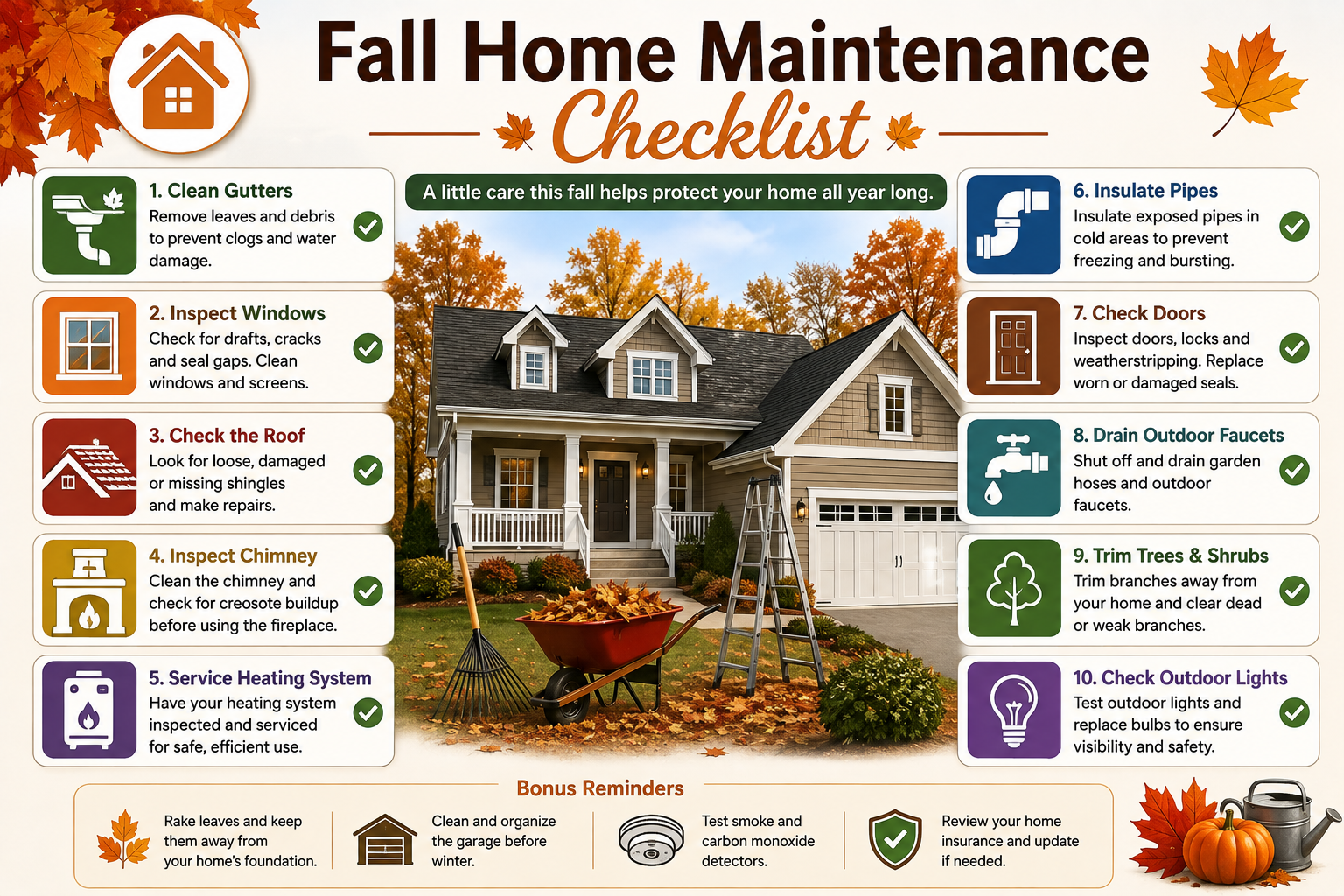
This complete fall home maintenance checklist gives you a clear, season-specific action plan covering every area of your home. You will find detailed task breakdowns, professional tables, cost estimates, expert tips, and answers to the most common homeowner questions about fall preparation. Whether you are working through your first fall as a homeowner or refining a routine you have built over years, this guide helps you get your home fully ready before winter arrives.
What Is a Fall Home Maintenance Checklist?
A fall home maintenance checklist is a structured set of inspection, cleaning, repair, and preparation tasks that homeowners complete each autumn to protect their home from winter weather conditions and address any damage or wear accumulated over spring and summer.
It covers both interior and exterior tasks. Interior work focuses on heating systems, safety devices, insulation, and appliances that face increased demand during winter. Exterior work addresses surfaces, systems, and components that are directly exposed to cold temperatures, ice, and winter storms.
The checklist works most effectively when approached in order of priority. Safety and heating system tasks come first. Structural and weatherproofing tasks follow. Exterior cleanup and winterization tasks complete the process.
A fall checklist is one component of a complete year-round maintenance strategy. For a full picture of how fall tasks connect to spring, summer, and winter care, see our Ultimate Home Maintenance Checklist for Every Season, which provides a comprehensive framework for every month of the year.
Why Fall Home Maintenance Is Important
Winter is the season that exposes every weakness in your home’s envelope, systems, and structure. Cold air finds every gap in your insulation. Ice forms wherever water has collected without proper drainage. Heating systems that were adequate last winter may have deteriorated enough to fail this year under sustained demand.
The financial stakes are significant. The U.S. Department of Energy estimates that heating accounts for approximately 45% of the average American home’s annual energy bill. Gaps in insulation, failing weatherstripping, and unserviced heating systems all increase that cost unnecessarily. Addressing these issues in fall, before the heating season begins, produces measurable savings across every month of winter.
There is also a safety dimension that cannot be overstated. Heating system failures, carbon monoxide leaks, and house fires occur at dramatically higher rates during winter months when heating equipment runs continuously and homes are sealed tightly against cold air. Fall maintenance is when you verify that every safety system is functioning before those risks peak.
Benefits of Preparing Your Home for Winter
Completing a thorough fall home maintenance checklist delivers benefits that extend through the entire cold season and into spring.
- Prevents winter damage by addressing roof vulnerabilities, sealing gaps, and clearing drainage systems before ice and snow arrive
- Reduces heating costs through proper insulation, air sealing, and a well-maintained heating system operating at peak efficiency
- Improves home safety by testing smoke and carbon monoxide detectors, servicing heating equipment, and inspecting chimneys before they are used heavily
- Extends the lifespan of roofing, gutters, heating systems, outdoor plumbing, and exterior surfaces
- Avoids emergency repair costs by identifying and fixing small problems before winter conditions make them worse and harder to repair
- Protects property value by maintaining structural integrity and preventing the hidden damage that moisture and cold cause to walls, foundations, and framing
- Provides peace of mind throughout winter knowing your home is prepared for whatever the season delivers
Complete Fall Home Maintenance Checklist
Work through these tasks in the order presented. Prioritize safety and heating systems, then weatherproofing, then exterior preparation.
Inspect the Roof Before Winter
Your roof is your home’s primary defense against winter precipitation, and fall is your last opportunity to address any weaknesses before snow and ice arrive. Walk the perimeter of your home and use binoculars to scan the entire roof surface from ground level.
Look for missing, cracked, or lifted shingles. Check flashing around chimneys, skylights, and vents, which are the most common entry points for water. Examine the gutters for heavy granule deposits, which indicate shingle deterioration. Any damage you find in fall will only worsen under winter conditions. Address repairs before the first snowfall rather than attempting emergency roof work in freezing temperatures.
Clean Gutters and Downspouts
Fall gutter cleaning is the single most important exterior maintenance task of the season. Leaves fall in large quantities throughout October and November, packing gutters with debris that blocks drainage and sets up the conditions for ice dam formation.
Ice dams form when heat escaping through the attic melts snow on the roof. That meltwater flows down to the cold roof edge, where it refreezes and builds up a ridge of ice. Subsequent meltwater then backs up under shingles and into your home. Clean gutters that drain properly are the first line of defense against ice dams.
Wait until most leaves in your area have fallen before cleaning, typically late October or November depending on your climate. Clear every gutter section and flush downspouts with a garden hose. Confirm water flows freely and discharges at least six feet from the foundation. For a complete safety walkthrough of this process.
Seal Windows and Doors
Cold air infiltration through windows and doors is one of the largest contributors to winter heating cost increases. Even gaps small enough to be invisible to the naked eye allow significant heat loss when outdoor temperatures drop below freezing.
Test every exterior window and door for drafts by holding a lit stick of incense near the frame on a windy day. If the smoke drifts, you have an air infiltration point. Apply fresh exterior-grade caulk around all window and door frames where the frame meets the siding or trim. Remove deteriorated old caulk completely before applying new material for a reliable seal.
Inspect Weather Stripping
Weatherstripping on exterior doors takes significant abuse from daily use and seasonal temperature changes. By fall, the foam, rubber, or vinyl strips around door edges often show compression, cracking, or complete separation that eliminates their sealing function.
Check every exterior door by closing it against a piece of paper. If the paper slides out without resistance, the seal is inadequate and needs replacement. Replace worn weatherstripping on all exterior doors before heating season begins. Also check the door sweep at the base of each exterior door and replace any sweep where daylight is visible beneath the door.
Service the Heating System
Scheduling a professional furnace or boiler tune-up in early fall is one of the highest-return maintenance investments a homeowner can make. A qualified HVAC technician will clean burners, inspect the heat exchanger, check the flue, test safety controls, verify ignition function, and confirm that the system meets manufacturer performance specifications.
Do not wait until the first cold snap to discover a problem. HVAC companies fill their service schedules quickly when temperatures drop, and emergency heating repair calls cost significantly more than planned maintenance visits. Book your fall furnace service in September or early October to ensure availability and to allow time for any needed repairs before the heating season begins.
Replace HVAC Filters
Fall filter replacement is essential before your heating system transitions to continuous operation. A clogged filter restricts airflow through the entire system, forces the blower motor to work under unnecessary strain, reduces heating efficiency, and degrades indoor air quality throughout the winter months when homes are sealed and ventilation is minimal.
Replace your HVAC filter at the start of every heating season without exception, regardless of its appearance. Plan to check and replace filters again in January if your system runs continuously throughout winter. A clean filter is the simplest, least expensive maintenance task that delivers the most consistent return on your HVAC system’s performance and lifespan.
Test Smoke and Carbon Monoxide Detectors
Carbon monoxide poisoning risk increases dramatically in winter. Heating systems run continuously, homes are sealed tightly, and the combination creates conditions where CO from a malfunctioning furnace, water heater, or generator can accumulate to dangerous levels before anyone realizes a problem exists.
The U.S. Consumer Product Safety Commission recommends installing carbon monoxide detectors on every level of the home and testing all detectors monthly. Test every smoke detector and CO detector in your home each fall. Replace batteries in any device that sounds weak or fails to respond. Replace any detector that is more than ten years old. This task takes less than fifteen minutes and can save lives.
Inspect the Chimney and Fireplace
If you use a wood-burning fireplace, insert, or stove, annual chimney inspection and cleaning is not optional. Creosote, a highly flammable byproduct of wood combustion, accumulates inside the flue liner with every use. The National Fire Protection Association recommends annual chimney inspection for every fireplace regardless of how frequently it was used in the previous year.
Have a certified chimney sweep inspect and clean the flue before the first fire of the season. They will remove creosote buildup, check the liner for cracks or deterioration, inspect the damper for proper operation, and confirm that the cap is intact and keeping animals and water out of the flue. Do not use your fireplace until this inspection is complete.
Check the Water Heater
Your water heater faces increased demand during winter as incoming cold water requires more energy to heat to the set temperature. Fall is the right time to perform annual water heater maintenance before that demand peaks.
Flush the tank to remove sediment buildup at the bottom. Sediment insulates the heating element from the water above it, reducing efficiency and extending heating cycles unnecessarily. Set the thermostat to 120 degrees Fahrenheit as recommended by the U.S. Department of Energy for the optimal balance of energy efficiency, safety, and bacterial prevention. Inspect the anode rod if the unit is three or more years old and replace it if it shows heavy corrosion.
Drain and Store Garden Hoses
Leaving garden hoses connected to outdoor faucets during winter is one of the most common and most consequential homeowner oversights. A connected hose traps water inside the faucet body. When temperatures drop below freezing, that water expands, which can crack the internal valve even on frost-free hose bib models.
Disconnect every garden hose from outdoor faucets before the first freeze in your area. Drain them completely by holding one end above your head and letting the water flow out. Store them coiled in a garage or shed where they will not freeze and become brittle. This simple step takes five minutes and prevents a repair that can cost hundreds of dollars.
Shut Off Outdoor Faucets
Even frost-free hose bibs benefit from shutting off their interior supply valve before winter. Locate the shut-off valve for each outdoor faucet inside the home, typically in the basement or utility room directly behind the exterior bib location. Turn each valve clockwise to close it fully.
After closing the interior valve, go outside and open the exterior faucet to release any remaining water pressure in the line. Leave the exterior faucet slightly open until the line is fully drained, then close it again. This two-step process ensures no water remains trapped in the line where it could freeze.
Winterize Irrigation Systems
Irrigation systems left with water in their lines during winter are vulnerable to pipe, fitting, and valve damage from freezing. Proper winterization involves removing all water from the system before the first hard freeze.
The most thorough method is professional blowout using compressed air, which pushes all water out of every zone, valve, and line completely. If you have a simple system without backflow preventers, you may be able to winterize it using the manual drain method by opening drain valves at the system’s low points. Consult a certified irrigation contractor if you are unsure about the correct method for your specific system.
Inspect Plumbing for Leaks
Fall is the time to identify and repair any plumbing leaks before cold weather makes them worse or more difficult to address. Check under every sink, around every toilet base, and at every appliance connection for moisture, staining, or active drips.
Pay particular attention to pipes in unheated areas including crawl spaces, garages, exterior walls, and attic spaces. These pipes are most vulnerable to freezing during winter. Insulate all exposed pipes in these locations using foam pipe insulation before temperatures drop. For comprehensive guidance on protecting your plumbing system through winter, see our Home Plumbing Maintenance: Complete Guide for Homeowners.
Check the Attic Insulation
Inadequate attic insulation is one of the primary causes of high winter heating bills and ice dam formation. Heat rising from your living spaces escapes through poorly insulated attic floors, warming the roof deck and melting snow in patterns that lead to ice dams and water intrusion.
Access your attic and check whether the insulation sits level with or above the floor joists. If you can see the tops of the joists through the insulation, you need more. The U.S. Department of Energy recommends specific R-values based on your climate zone, which you can find through their energy efficiency resources. Adding insulation before winter reduces heat loss significantly and pays for itself through lower heating bills.
Clean Dryer Vents
Dryer vent cleaning is a year-round safety need, but it is particularly important to address in fall before winter increases indoor appliance use and sealed-home conditions make ventilation issues more consequential. The U.S. Fire Administration identifies clogged dryer vents as one of the leading causes of residential fires annually.
Disconnect the dryer duct from the back of the unit and use a long-handled brush to clear lint from the full length of the duct. Clean the exterior vent opening and confirm that the flap opens fully during a test cycle and closes completely when the dryer is not running. The entire process takes about 30 minutes and eliminates one of the most preventable fire hazards in any home.
Trim Trees and Remove Dead Branches
Fall is the ideal time for tree trimming because deciduous trees have dropped their leaves, making branch structure and damage clearly visible. Dead, cracked, and structurally compromised branches that are not removed before winter become serious hazards during ice storms and heavy snowfall.
Have a certified arborist assess any large trees near your home, particularly those with branches overhanging the roofline, driveway, or power lines. Remove all dead and damaged limbs before the first significant winter weather event. Ice loading on compromised branches can cause sudden failures that damage roofs, vehicles, and power lines with little or no warning.
Clean the Yard and Remove Leaves
Clearing your yard of leaves, debris, and dead plant material before winter serves both aesthetic and practical purposes. Leaves left on the lawn through winter create conditions for fungal disease that can damage turf significantly. Debris piled against the foundation holds moisture and provides cover for rodents looking for a warm winter home.
Rake or blow leaves from the lawn and dispose of them through composting or municipal pickup. Cut perennials back to the ground after the first killing frost. Remove dead annuals and empty summer planters. Clear all organic debris from against the foundation, siding, and any deck structures.
Inspect Driveways and Walkways
Fall is your last opportunity to repair driveway and walkway cracks before winter freeze-thaw cycles make them significantly worse. Water that enters a crack in fall freezes, expands, and widens the crack with every cycle throughout winter. A minor crack repaired in October prevents a major repair bill in spring.
Fill concrete cracks with a flexible concrete repair compound before temperatures drop below 40 degrees Fahrenheit, as most repair products require warmer temperatures for proper curing. Seal asphalt driveways if they have not been treated in the past two years. Address any heaved or uneven walkway sections that create tripping hazards, particularly around entry areas where ice accumulation will compound the danger.
Check Exterior Lighting
Shorter days in fall and winter mean your exterior lighting works harder and matters more for both safety and security. Test every exterior light fixture before the time change and replace any burned-out bulbs. Add motion-sensor lights to any dark areas around your home’s perimeter where lighting would improve security and safety during long winter nights.
Check that pathway lighting along walkways, steps, and driveways is functioning correctly. Ice and snow accumulation on unlighted exterior steps is a genuine safety hazard. Switching to LED bulbs in all exterior fixtures at this time reduces energy consumption and eliminates frequent winter bulb replacements caused by cold-weather failures in incandescent bulbs.
Inspect Decks, Patios, and Railings
Before winter load arrives, inspect your deck and patio surfaces carefully. Check every board for rot, surface cracking, and loose fasteners that winter moisture will worsen. Apply firm lateral pressure to all railings and confirm there is no movement or instability.
Clean the deck surface thoroughly and apply a fresh coat of sealant if the previous finish is no longer repelling water. A sealed deck enters winter in a far stronger condition than an unsealed one, as protected wood resists moisture absorption and the resulting expansion, cracking, and rot that freeze cycles cause in unprotected wood surfaces.
Store Outdoor Furniture
Outdoor furniture left exposed through winter deteriorates significantly faster than furniture that is properly stored or covered. Move patio furniture, grills, fire pits, umbrellas, and decorative items to a garage or shed before the first significant freeze.
For furniture too large to store, use high-quality waterproof covers that fit securely and resist wind. Elevate stored or covered items slightly off concrete surfaces to prevent moisture wicking. Clean all furniture before storage to prevent mold and mildew from developing during months of enclosure.
Organize the Garage for Winter
The garage transition from summer to winter storage should happen in fall before you need easy access to snow removal equipment. Clear out summer tools and equipment, perform any needed maintenance on the lawn mower and other summer power equipment, and store them in an organized, accessible manner.
Move winter gear including snow blowers, shovels, ice melt, and cold-weather tools to the front of your garage or to positions where they can be reached quickly. Service your snow blower now by checking the oil, inspecting the auger blades, and testing the engine. Discovering a snow blower that will not start is far less stressful in October than during the first significant snowfall.
Inspect the Foundation
Walk the perimeter of your home after fall rains begin and examine the foundation carefully. Look for new cracking, areas where soil has settled away from the base, and any spots where water pools near the foundation rather than draining away from it.
Check your downspout extensions to confirm they direct water well away from the foundation. Soil that slopes toward the foundation should be built up and regraded to direct drainage away from the structure. Water that collects against your foundation in fall and winter exerts significant pressure through freeze-thaw cycles and is a leading cause of basement water infiltration.
Prepare an Emergency Winter Kit
FEMA recommends that every household maintain a basic emergency supply kit capable of sustaining the household for at least 72 hours during a power outage or severe weather event. Fall is the right time to assemble or restock this kit before winter storm season begins.
Your winter emergency kit should include water, non-perishable food, a battery-powered weather radio, flashlights with extra batteries, a first aid kit, copies of important documents, blankets, medications, and cash. Add home-specific items including extra batteries for smoke and CO detectors, a manual can opener, a portable charger for mobile devices, and rock salt or ice melt for exterior steps. Keep the kit in an accessible location that all household members know.
Indoor Fall Home Maintenance Checklist
Use this quick-reference checklist for all interior fall tasks:
- Schedule professional furnace or boiler service
- Replace HVAC filters before heating season
- Test all smoke detectors and CO detectors
- Replace batteries in all safety devices
- Inspect chimney and schedule cleaning if wood-burning
- Flush water heater and check temperature setting
- Insulate exposed pipes in unheated areas
- Check attic insulation depth and R-value
- Clean dryer vent duct from dryer to exterior
- Inspect all plumbing under sinks and at appliances
- Test GFCI outlets in kitchens, bathrooms, and garage
- Reverse ceiling fan direction to clockwise for winter heat circulation
- Check and replace weatherstripping on all exterior doors
- Caulk interior gaps around window frames and outlets on exterior walls
- Assemble or restock emergency winter kit
- Lubricate door hinges, locks, and garage door hardware
Outdoor Fall Home Maintenance Checklist
Use this quick-reference checklist for all exterior fall tasks:
- Inspect roof shingles and flashing before winter
- Clean gutters and downspouts after leaves finish falling
- Apply fresh caulk around all exterior windows and doors
- Disconnect and drain all garden hoses
- Shut off interior valves to outdoor faucets
- Winterize irrigation system before first freeze
- Inspect foundation perimeter for new cracks and drainage issues
- Fill cracks in driveway and walkways
- Trim dead and overhanging tree branches
- Rake and remove leaves from lawn and foundation areas
- Clean and seal or store outdoor furniture
- Inspect and clean deck boards, railings, and posts
- Apply deck sealant if surface is no longer repelling water
- Check and clean exterior light fixtures
- Replace burned-out exterior bulbs with LED alternatives
- Organize garage and service winter equipment
- Stock rock salt and ice melt before first freeze
Monthly Fall Maintenance Calendar
| Month | Priority Level | Key Tasks |
|---|---|---|
| September | Critical | Schedule furnace service, inspect roof, test smoke and CO detectors, inspect chimney, check weather stripping, service snow blower |
| October | High | Clean gutters after early leaf drop, drain garden hoses, shut off outdoor faucets, seal windows and doors, replace HVAC filters, check attic insulation, inspect plumbing |
| November | Medium to High | Final gutter cleaning after all leaves fall, winterize irrigation system, trim dead trees, store outdoor furniture, clean dryer vent, prepare emergency winter kit, stock ice melt |
Fall Home Maintenance Schedule
| Task | Recommended Frequency | Best Month | Importance |
|---|---|---|---|
| Furnace or boiler service | Annually | September | Critical |
| Chimney inspection and cleaning | Annually | September | Critical |
| Smoke and CO detector testing | Monthly, full check in fall | September | Critical |
| HVAC filter replacement | Every 1–3 months | September | Critical |
| Roof inspection | Twice yearly | September–October | Critical |
| Gutter cleaning | Twice yearly, fall is most important | October–November | Critical |
| Water heater flush | Annually | October | High |
| Window and door sealing | Annually | October | High |
| Weatherstripping inspection | Annually | October | High |
| Attic insulation check | Annually | October | High |
| Dryer vent cleaning | Annually | October–November | High |
| Outdoor faucet winterization | Annually | Before first freeze | Critical |
| Irrigation winterization | Annually | Before first freeze | High |
| Plumbing inspection | Annually | October | High |
| Foundation inspection | Annually | October | High |
| Dead tree trimming | Annually | September–October | High |
| Deck sealing | Every 2–3 years | September | Medium |
| Driveway sealing | Every 2–3 years | September–October | Medium |
Essential Fall Home Maintenance Tools
| Tool | Purpose | Recommended Use | Estimated Cost |
|---|---|---|---|
| Extension ladder | Roof inspection, gutter cleaning | September–November | $80–$300 |
| Gutter scoop | Removing leaf and debris buildup | October–November | $10–$20 |
| Garden hose with nozzle | Flushing downspouts and outdoor cleaning | October | $25–$60 |
| Caulking gun | Sealing gaps around windows and doors | October | $10–$30 |
| Weatherstripping kit | Replacing door and window seals | October | $15–$50 |
| Pipe insulation foam | Insulating exposed pipes before freeze | October | $5–$20 |
| Dryer vent brush | Cleaning lint from vent duct | October–November | $15–$40 |
| Voltage tester | Checking outdoor outlets and safety devices | September–October | $15–$40 |
| Moisture meter | Detecting water intrusion and wood damage | September–November | $20–$80 |
| Snow blower | Winter snow removal (service in fall) | November (service) | $400–$1,500 |
| Leaf blower or rake | Yard and gutter clearing | October–November | $30–$200 |
| Ice melt and spreader | Winter safety on walkways (stock in fall) | November onward | $20–$60 |
For a comprehensive guide to tools for every season, visit our article on Home Maintenance Tools Every Homeowner Needs.
DIY vs Professional Fall Home Maintenance
| Task | DIY Friendly | Professional Recommended | Primary Reason |
|---|---|---|---|
| Gutter cleaning | Yes | Optional | Manageable with proper ladder safety |
| Furnace or boiler service | No | Yes | Requires specialized equipment and certification |
| Chimney inspection and cleaning | No | Yes | Certified sweep required for flue assessment |
| Roof inspection | Ground visual only | Yes for repairs | Steep or damaged roofs require professional access |
| HVAC filter replacement | Yes | No | Simple, inexpensive DIY task |
| Dryer vent cleaning | Yes | Optional | Straightforward with correct brush kit |
| Window caulking | Yes | No | Basic skill requiring minimal preparation |
| Weatherstripping replacement | Yes | No | Simple DIY with no special tools |
| Irrigation winterization | Yes for simple systems | Yes for complex systems | Compressed air blowout requires professional equipment |
| Attic insulation addition | Partial | Yes for large projects | Proper R-value and placement require knowledge |
| Tree trimming near roofline | No | Yes | Large branches require certified arborist |
| Foundation crack repair | Small surface cracks | Yes for structural cracks | Growing cracks need engineering evaluation |
| Water heater flush | Yes | Optional | Manageable with basic instructions |
| Pipe insulation installation | Yes | No | Simple foam sleeve application |
Estimated Fall Home Maintenance Costs
| Category | DIY Cost Estimate | Professional Cost Estimate | Notes |
|---|---|---|---|
| Furnace or boiler service | N/A | $80–$200 | Annual tune-up, professional required |
| Chimney inspection and cleaning | N/A | $150–$350 | Certified sweep required |
| Gutter cleaning | $10–$30 (tools) | $100–$250 | DIY saves cost over multiple seasons |
| Roof inspection | $0 (ground level) | $150–$400 | Professional needed for repairs |
| HVAC filter replacement | $10–$30 per filter | Included in service | Simple DIY task |
| Window and door caulking | $15–$40 (supplies) | $100–$300 | DIY-friendly with basic skill |
| Dryer vent cleaning | $15–$40 (brush kit) | $80–$150 | One-time brush kit purchase |
| Water heater flush | $0–$20 | $75–$150 | Straightforward DIY |
| Pipe insulation | $20–$60 (materials) | $100–$300 | DIY-friendly installation |
| Irrigation winterization | N/A | $75–$200 | Professional blowout recommended |
| Tree trimming | N/A | $300–$1,500+ | Varies by tree size and location |
| Emergency kit supplies | $50–$150 | N/A | One-time purchase, annual restock |
| Total fall estimate | $150–$350 DIY | $1,200–$3,500+ professional | Costs vary by region, home size, condition |
Common Fall Home Maintenance Mistakes
Even diligent homeowners make avoidable errors during fall preparation. Knowing what to watch for keeps your approach effective.
Cleaning gutters too early. Cleaning gutters in September when trees still have most of their leaves means cleaning again in November. Wait until the majority of leaves have fallen in your specific area for maximum effectiveness.
Skipping the furnace service. This is the most common and most consequential fall maintenance oversight. A furnace that ran adequately last winter has experienced another year of wear and may not be ready for this winter’s demand without professional attention.
Forgetting the interior faucet shut-off. Many homeowners disconnect garden hoses but forget to close the interior valve supplying the outdoor faucet. The frost-free design of modern hose bibs only functions correctly when no hose is connected and the interior valve is closed properly.
Applying caulk in cold temperatures. Most exterior caulks require temperatures above 40 to 50 degrees Fahrenheit to adhere properly and cure correctly. Complete your exterior sealing work in September or early October before temperatures drop consistently.
Delaying chimney inspection. Many homeowners light the first fire of fall without having the chimney inspected. A chimney fire from creosote buildup is far more likely on the first fires of the season when the flue warms up rapidly. Never use a fireplace until the annual inspection is complete.
Not servicing winter equipment in advance. Discovering that your snow blower will not start during the first major snowfall is a common and entirely preventable problem. Service winter equipment during October when repair shops are less busy and parts are readily available.
Overlooking the attic. Poor attic insulation and ventilation contribute to ice dams, high heating bills, and moisture damage. Yet most homeowners never go into the attic during their fall inspection. Make it a standard part of your autumn routine.
Money-Saving Fall Maintenance Tips
Smart fall preparation reduces both immediate costs and the much larger expenses that inadequate preparation creates during winter.
- Book your furnace service appointment in late August or early September before HVAC companies fill their fall schedules and before emergency demand drives up pricing
- Replace HVAC filters yourself to save the service cost of having a technician handle this simple task during a paid visit
- Complete all exterior caulking and weatherstripping work yourself. These are genuinely simple skills that save significant professional labor costs
- Purchase ice melt, pipe insulation, and winterization supplies in October before peak-season demand increases prices
- Service your snow blower in October at an off-season service shop where scheduling is easier and pricing is often lower than in January
- Check your utility provider for rebates on insulation improvements, smart thermostats, and heating system upgrades that may offset your fall maintenance costs
- Address all exterior repairs before winter, since any repair that requires warm weather is two to three times more expensive to complete in spring after winter damage has compounded the original problem
- Keep a detailed record of all fall maintenance completed. This documentation supports insurance claims and demonstrates care history when selling your home
Fall Home Safety Tips
Fall maintenance creates a natural opportunity to review every aspect of your home’s safety posture before winter increases risk levels across multiple categories.
- Test every smoke detector and carbon monoxide detector and replace any unit more than ten years old
- Place CO detectors within 15 feet of every sleeping area and on every level of the home
- Keep a charged fire extinguisher in the kitchen and one in the garage, and verify both are currently within their service date
- Never run a portable generator inside the home, in an attached garage, or near any window or vent opening. Generator exhaust contains lethal concentrations of carbon monoxide
- Have your chimney inspected and cleaned by a certified sweep before the first fire of the season without exception
- Stock rock salt or sand for exterior steps and walkways before the first freeze creates hazardous conditions
- Confirm that all exterior railings and handrails are secure before ice and snow make footing uncertain on steps and decks
- Review your family’s emergency plan and confirm that all household members know the location of the main water shut-off, gas shut-off, and electrical panel
FEMA’s Ready.gov website provides free resources for building a complete household emergency plan and supply kit, including specific guidance for winter weather emergencies. Reviewing this resource in fall, before winter weather arrives, ensures your family is prepared for the disruptions that severe winter storms can cause.
When You Should Hire a Professional
Knowing which fall tasks are appropriate for DIY completion and which require professional expertise protects your home and your safety. These situations always warrant a licensed professional.
Call a licensed professional when:
- Your furnace or boiler has not been professionally serviced in the past year
- Your chimney has not been inspected and cleaned by a certified sweep before this heating season
- Roof damage from summer storms has not been properly repaired before winter
- Foundation cracks are horizontal, stair-step pattern, or actively growing since your last inspection
- Your irrigation system uses a backflow preventer that requires professional compressed-air winterization
- Large tree branches near your roofline require removal by a certified arborist
- Your attic shows signs of moisture damage, mold, or structural deterioration
- Any electrical concern is present, including repeatedly tripped breakers, burning smells, or warm panel covers
- Your water heater is more than 10 years old and showing signs of corrosion or reduced performance
- You smell gas near any heating appliance, which requires immediate evacuation and a call to your gas utility
Expert Recommendations
After working with homeowners through many fall seasons, a few consistent habits distinguish those who enter winter fully prepared from those who scramble to address problems after cold weather arrives.
Start in September, not October. The common tendency to delay fall maintenance until leaves are actually falling costs you the warmest, most comfortable working conditions of the season. September offers ideal weather for exterior caulking, deck sealing, and roof inspection. Use it.
Prioritize the furnace above everything else. More homeowners face winter emergencies from heating system failures than from any other single cause. A professional furnace service every fall is non-negotiable. Schedule it before you need it.
Think about water management as a system. Your roof, gutters, downspouts, grading, and foundation drainage all work together. When you address them as interconnected components rather than isolated tasks, your results improve significantly. Clean gutters matter less if your downspouts deposit water two feet from the foundation.
Document everything you complete. Photographs, dates, and cost records from your fall maintenance create a valuable file that benefits you in multiple ways, from insurance claims to contractor conversations to eventual property sale. Our Annual Home Maintenance Checklist provides a year-round framework for building and maintaining this kind of comprehensive documentation habit.
Frequently Asked Questions
When should I start my fall home maintenance checklist?
The ideal starting point is early September for most homeowners in northern and central climates. September offers warm temperatures suitable for exterior caulking, deck sealing, and roof inspection while giving you time to book professional services before fall demand fills contractor schedules. Interior tasks like furnace service scheduling, detector testing, and attic inspection can begin any time after Labor Day. Exterior tasks like gutter cleaning should wait until most area trees have dropped their leaves, typically October or November. Starting the overall process in September rather than October gives you a comfortable two-to-three-month window to complete everything before hard freezes arrive.
How do I know if my gutters need cleaning in fall?
If you have trees near your home that shed leaves, your gutters need cleaning in fall without exception. Visual signs of clogged gutters include water spilling over the sides during rain, plants or moss growing inside the gutter sections, sagging caused by the weight of wet debris, and water staining on siding directly below the gutter line. You can also check by physically inspecting the gutters from a ladder after the majority of leaves have fallen. In most regions, late October through November is the correct window for fall gutter cleaning. Waiting until leaves have fully fallen prevents the need for a second cleaning just weeks after the first.
Is fall furnace service really necessary every year?
Yes, annual furnace service is genuinely necessary and not just a recommendation manufacturers make to generate service revenue. Your furnace works under significant mechanical stress every heating season. Burners accumulate dirt and scale. Heat exchangers develop cracks. Ignitors degrade. Blower motors wear. A professional technician identifies and corrects these issues while they are still minor. A furnace that skips annual service is more likely to fail during the coldest night of winter, when emergency repair costs are highest and replacement lead times are longest. The cost of a professional fall tune-up is typically less than a single emergency service call.
What is the most dangerous fall maintenance oversight?
Failing to have the chimney inspected before using the fireplace represents one of the most serious safety risks of the season. Creosote buildup inside the flue is highly flammable, and chimney fires can spread to surrounding structural framing with little warning. However, failing to test carbon monoxide detectors before heating season begins is equally dangerous. Heating equipment that malfunctions during winter releases CO into sealed homes at concentrations that can incapacitate and kill occupants before the odorless, colorless gas is noticed. Both of these tasks require less than one hour total to address and protect against genuinely life-threatening risks.
How do I winterize my outdoor faucets correctly?
Proper outdoor faucet winterization involves two steps that most homeowners know, and one that many miss. First, disconnect all garden hoses from every outdoor faucet. Second, locate and close the interior shut-off valve that supplies each outdoor faucet, typically found in the basement or utility room directly behind the faucet’s exterior location. Third, return to the exterior faucet and open it fully to release any water remaining in the line between the interior valve and the exterior spout. Leave it open until the line drains completely, then close it. This three-step process leaves no water trapped in the line where it could freeze and cause damage.
Should I seal my deck before winter?
Yes, sealing your deck before winter is strongly recommended if the existing finish is no longer protecting the wood. Test it by sprinkling water on the deck surface. If the water beads up and rolls off, the current sealant is still functional. If the water absorbs immediately, the wood is unprotected and should be cleaned and sealed before winter. Unprotected deck wood absorbs moisture during fall rains, and that moisture then freezes and expands within the wood fibers repeatedly through winter, causing accelerating cracking, splitting, and rot. Sealing in early to mid-September while temperatures are consistently warm allows the product to penetrate and cure properly.
How do I prepare my lawn for winter?
Fall lawn preparation involves several steps that significantly affect lawn health the following spring. Continue mowing until the grass stops growing, cutting to a height of approximately two to three inches for the final cut of the season, which is slightly shorter than summer mowing height to reduce the risk of matting and fungal disease under snow cover. Apply a fall-formula fertilizer in late September or October to strengthen root systems before dormancy. Address any bare or thin patches with overseeding while soil temperatures are still above 50 degrees Fahrenheit. Rake leaves promptly since thick layers of wet leaves left on the lawn through winter create conditions for fungal disease that can kill large turf sections.
What should I put in a winter home emergency kit?
A well-stocked winter home emergency kit should support your household for at least 72 hours without outside assistance. Include one gallon of water per person per day, non-perishable food, a battery-powered or hand-crank weather radio, flashlights with extra batteries, a first aid kit, a manual can opener, blankets and warm clothing, copies of important documents, prescription medications, and cash. Add home-specific items including extra batteries for smoke and CO detectors, rock salt or sand for exterior steps, a portable phone charger, candles with safe holders, and the contact numbers for your utility company, plumber, and HVAC service provider. Review and restock the kit every fall before winter storm season begins.
How much does fall home maintenance typically cost?
Total fall maintenance costs depend significantly on your home’s size, age, and current condition, as well as your region’s labor market. DIY-managed fall maintenance typically costs between $150 and $400 in supplies, tools, and materials. If you hire professionals for furnace service, chimney cleaning, gutter cleaning, and roof inspection, expect to spend between $500 and $1,500 for those services alone, with additional costs if significant repairs are identified. Homes with irrigation systems that need professional winterization, large trees requiring arborist attention, or aging heating equipment approaching replacement will see higher costs. Budgeting one to two percent of your home’s value annually for maintenance, including fall preparation, is the widely accepted guideline.
Can I do gutter cleaning safely myself?
Yes, with proper equipment and careful technique. The primary risk is ladder-related, so proper ladder setup is the most important safety consideration. Use a ladder rated for your weight plus tool weight, set it on stable ground at the correct angle, and never overreach from the current position. Reposition the ladder frequently rather than stretching sideways. Wear work gloves to protect against sharp debris and wood rot. Use a gutter scoop or small trowel rather than your hands for removal. Have someone steady the base of the ladder while you work, or use ladder stabilizers designed to rest against the gutter without damaging it. Our detailed guide on How to Clean Gutters Safely covers the complete process with specific safety recommendations.
Conclusion
Fall home maintenance is not just a seasonal chore list. It is the most important preparation you make all year to protect your home, your family, and your investment.
Every task in this checklist has a purpose. Cleaning the gutters prevents ice dams and water intrusion. Servicing the furnace prevents heating failures on the coldest nights. Sealing windows and doors reduces your energy bill through every month of winter. Inspecting the chimney prevents fires. These are not optional housekeeping tasks. They are genuine protection measures with real financial and safety consequences when skipped.
Start in September with a clear plan. Work systematically through the checklist, starting with safety and heating systems and finishing with exterior cleanup and winterization. Complete professional service appointments early before schedules fill. Address every small problem you find now, knowing that winter will make every one of them worse and more expensive to repair.
Your home will be warmer, safer, more efficient, and better protected throughout winter because of the work you do in fall. That is not a modest return. It is one of the most impactful investments of time and attention a homeowner can make.