
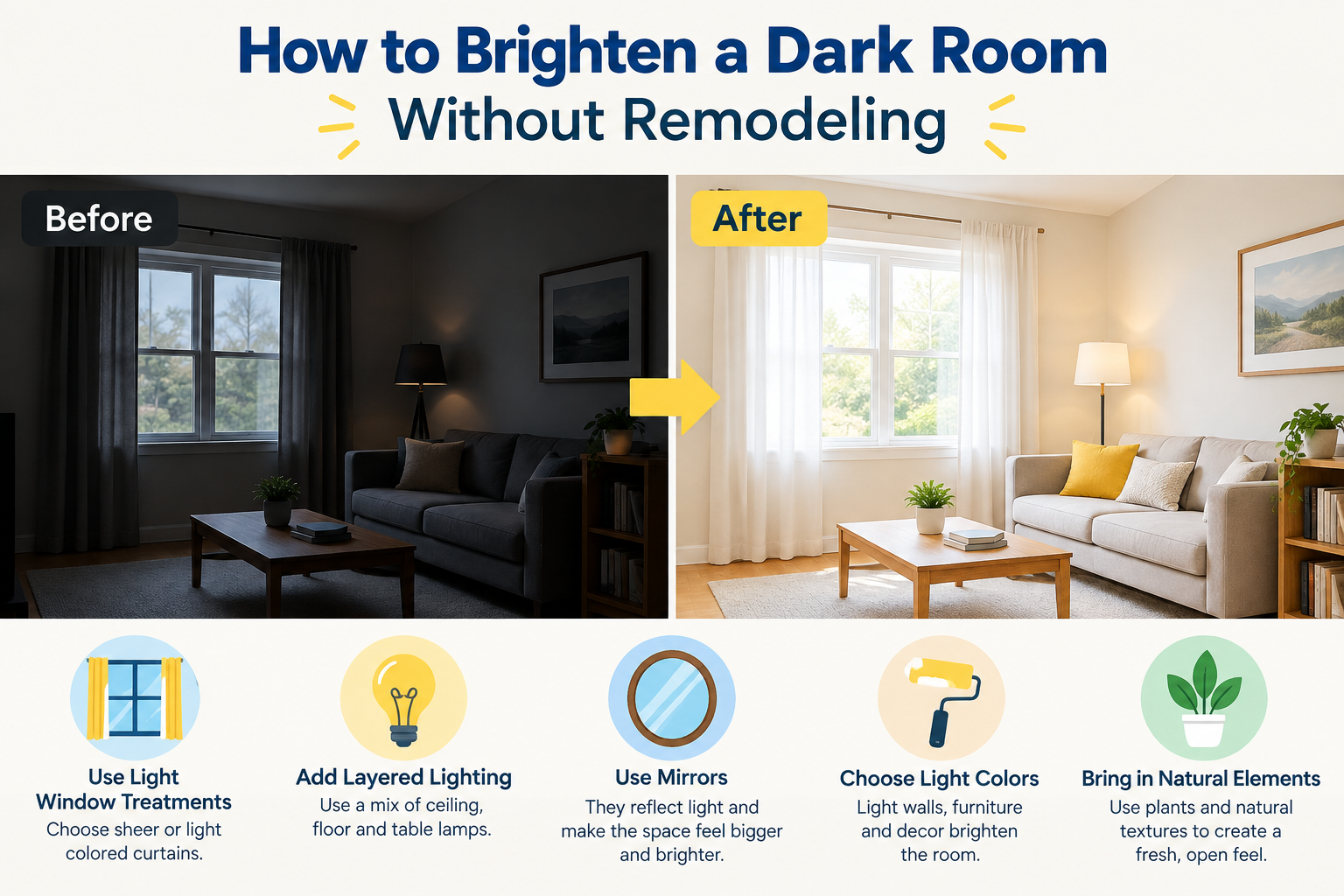
How to Brighten a Dark Room Without Remodeling

Introduction
A dark room does not have to stay dark.
Many homeowners assume that fixing a poorly lit room means knocking down walls, adding skylights, or hiring a contractor for a major renovation. That assumption leads a lot of people to simply live with dim, uncomfortable spaces when practical solutions are well within reach.
The truth is that most dark rooms can be made noticeably brighter through a combination of smarter lighting choices, better use of color, strategic furniture placement, and a few well-chosen accessories. None of these require structural changes, permits, or a significant budget.
This guide covers the most effective ways to brighten a dark room without remodeling — explaining why each approach works, which rooms it suits best, what it costs, and where its limitations are. Whether you are dealing with a dark bedroom, a dim living room, a shadowy hallway, or a home office that feels like a cave, there are real options here worth trying.
Quick Answer
The fastest ways to brighten a dark room without remodeling include switching to brighter, higher-lumen bulbs with a daylight or cool white color temperature, painting walls and ceilings a lighter color, adding mirrors to reflect available light, replacing heavy curtains with lighter window treatments, and layering multiple light sources rather than relying on a single overhead fixture. Used together, these approaches can significantly change how bright and open a room feels.
Why a Room Can Look Dark Even When It Has Windows
Before choosing solutions, it helps to understand what is actually making a room dark. The cause affects which fixes will work best.
A room can feel dim for several reasons that have nothing to do with the number of windows it has. North-facing rooms receive indirect light all day, which tends to be cooler and softer than direct sunlight. Rooms surrounded by tall trees, neighboring buildings, or deep roof overhangs may be blocked from receiving much natural light even on bright days.
Inside the room, dark wall colors absorb light rather than reflecting it. Heavy curtains block what little natural light exists. Dark furniture and flooring pull light downward. A single overhead light fixture in the center of the ceiling creates uneven illumination with bright spots and dark corners.
In older homes, windows are sometimes smaller than what current building standards allow, which limits natural light regardless of how the room is decorated.
Once you identify the primary reason a room feels dark, you can prioritize the fixes that will make the biggest difference rather than trying everything at once.
Start by Cleaning Windows and Removing Light Blockers
This is the most overlooked step, and it costs nothing.
Dirty windows can block a meaningful amount of incoming light. A layer of dust, grime, or mineral deposits on the glass diffuses and reduces sunlight before it ever enters the room. Cleaning interior and exterior window surfaces thoroughly is a reasonable first step before making any other changes.
Beyond cleaning, look at what is physically blocking light from entering. Overgrown shrubs or trees outside a window can cast permanent shade. Trimming back vegetation near windows can make a noticeable difference in rooms at ground level.
Inside the room, heavy curtains, dark blinds, or furniture placed directly in front of windows all reduce the amount of light that reaches the interior. Pulling furniture away from window areas and keeping window treatments open during daylight hours are simple, free changes that immediately allow more light into the space.
For homes with energy efficiency concerns, it is worth knowing that allowing more natural light into a room also reduces the need for artificial lighting during the day, which can lower electricity use. The U.S. Department of Energy notes that daylighting strategies — using natural light as the primary light source during daytime hours — can reduce lighting energy use significantly in residential settings.
Use Lighter Wall and Ceiling Colors
Paint is one of the most cost-effective ways to change how bright a room feels, and it works because of a straightforward principle: lighter colors reflect light while darker colors absorb it.
Walls painted in deep grays, navy blues, forest greens, or dark earth tones absorb a high percentage of both natural and artificial light. Switching to whites, off-whites, pale creams, soft greiges, or light cool grays allows more light to bounce around the room rather than being soaked up by the walls.
The ceiling matters just as much as the walls, sometimes more. A ceiling painted a shade or two lighter than the walls — or painted bright white — acts as a reflective surface that bounces light downward and makes the ceiling feel higher. Painting a ceiling a dark color, even accidentally by using a standard wall color on it, dramatically reduces how open and bright a room feels.
For a dark hallway or a small dark room, painting the trim and baseboards a bright white while keeping walls a pale neutral is a combination that makes the space feel cleaner and more open without requiring a full repaint.
One realistic limitation: paint alone will not fully compensate for a room that receives very little natural light. In a genuinely dark room, paint improvements work best when combined with better lighting rather than used as the only solution.
Choose the Right Light Bulbs
Bulb selection has a larger impact on how bright a room feels than most people expect, and it is one of the least expensive changes available.
Two factors matter most: brightness (measured in lumens) and color temperature (measured in Kelvin).
Brightness and Lumens
Watts measure energy consumption, not brightness. A 10-watt LED bulb can produce the same amount of light as a 60-watt incandescent bulb. When choosing bulbs to brighten a dark room, look at the lumen output rather than the wattage. A standard living room or bedroom typically benefits from bulbs in the 800 to 1,100 lumen range per fixture. Rooms that feel particularly dim may benefit from going higher, up to 1,600 lumens per bulb in fixtures rated for that output.
Color Temperature
Color temperature describes the tone of the light a bulb produces. Bulbs in the 2,700K to 3,000K range produce warm white or soft white light — the kind most people associate with a cozy, residential feel. Bulbs in the 4,000K range produce a neutral or cool white that feels crisper and brighter. Bulbs in the 5,000K to 6,500K range produce daylight-toned light that most closely mimics natural sunlight.
For a dark living room or bedroom where you want warmth alongside brightness, bulbs in the 3,000K to 3,500K range are a reasonable middle ground. For a dark home office or workspace where you want maximum alertness and visual clarity, 4,000K to 5,000K bulbs tend to work better.
The U.S. Department of Energy provides guidance on LED lighting specifications and efficiency, noting that LED bulbs now account for the majority of residential lighting sales due to their efficiency and long lifespan compared to incandescent alternatives.
Layer Different Types of Lighting
Relying on a single overhead ceiling fixture is one of the most common reasons rooms feel dim and flat, even when the bulb itself is bright.
A single light source in the center of a ceiling casts direct light downward but leaves corners and walls in relative shadow. The contrast between the lit center and dark edges actually makes the room feel smaller and darker than it would with distributed lighting.
Layered lighting means using multiple light sources at different heights and positions throughout the room. The three standard layers are:
Ambient lighting provides general illumination for the whole space. This is typically the ceiling fixture or recessed lights.
Task lighting serves specific purposes — a desk lamp for reading or working, under-cabinet lights in a kitchen, a bedside lamp for nighttime reading.
Accent lighting highlights specific areas or objects — a floor lamp behind a chair, lights inside a bookcase, or wall sconces that wash light upward along a wall.
When all three layers are present and working together, a room feels evenly lit and more spacious. Adding a floor lamp in a dark corner, a table lamp on a sideboard, or wall sconces on either side of a window can eliminate the shadow zones that make a room feel gloomy.
This approach is particularly effective in a dark living room or dark home office, where a mix of task and ambient sources creates a noticeably more comfortable environment than a single overhead light ever could.
For more ideas on improving your home’s overall livability, Renoverra’s guide on how to create a more welcoming entryway covers lighting and design approaches for one of the most commonly neglected spaces in a home.
Add Floor Lamps and Table Lamps Strategically
Freestanding and table lamps are among the most practical tools for brightening a dark room because they require no electrical work, no installation, and can be repositioned as needed.
The placement of a lamp matters more than its wattage. A lamp placed in a dark corner does more to eliminate shadow than a second lamp placed next to an existing light source. When choosing where to add lamps, identify the darkest areas of the room first — corners, the space beside large furniture, areas away from windows — and address those locations.
Torchiere floor lamps, which direct light upward toward the ceiling, are particularly effective in rooms with low ceilings because they bounce light off the ceiling and distribute it more evenly across the room. However, they work best with light-colored ceilings. A dark ceiling absorbs the upward light rather than reflecting it.
Table lamps with light-colored or translucent shades allow more light to pass through than opaque dark shades. If you already own lamps that feel dim, replacing a dark shade with a lighter one is an inexpensive way to increase the effective brightness without buying a new lamp.
In a dark bedroom, bedside lamps on both sides of the bed serve both a practical and visual function — they balance the room and eliminate the heavy shadow that a single overhead light creates on one side.
Use Mirrors to Reflect Available Light
Mirrors do not create light, but they reflect it — and in a dark room, that reflection can meaningfully increase how bright the space feels.
The most effective placement for a mirror intended to increase light is on a wall that faces or is angled toward a window. A mirror positioned across from a window catches and reflects natural light back into the room, effectively doubling the visual impact of the light source. A mirror placed on a wall adjacent to a window can redirect light into a shadowed corner.
Size matters. A larger mirror reflects more light and has a greater effect on how open and bright the room feels. A full-length mirror leaning against a wall, a large framed mirror above a fireplace or sideboard, or a grouping of smaller mirrors can all serve this purpose depending on the room’s style and available wall space.
In a dark hallway — one of the most commonly neglected spaces in a home — a large mirror on the end wall or along one side can make the space feel significantly less enclosed. Combined with a well-placed lamp or sconce, mirrors are particularly effective in narrow, windowless corridors.
One limitation worth noting: if a room receives very little natural light to begin with, mirrors will reflect whatever artificial light is present, which may be less dramatic than the effect in a room with at least some window light. In that case, improving the artificial lighting first will make the mirrors more effective.
For inspiration on organizing and decorating spaces so they feel more open, Renoverra’s article on best storage ideas for a more organized home offers practical approaches that complement the visual de-cluttering that makes mirrors more effective.
Choose Light-Colored Curtains and Window Treatments
Window treatments have a significant effect on how much light enters a room and how the light quality changes once it does.
Heavy drapes in dark colors — burgundy, navy, charcoal, deep brown — block incoming light even when they are pulled to the sides of the window. The fabric itself absorbs light near the window opening and casts a shadow effect along the edges.
Replacing dark, heavy curtains with sheer white or off-white panels allows natural light to filter through even when the curtains are closed, maintaining privacy while keeping the room noticeably brighter during the day. Linen-blend sheers and cotton voile are common choices that diffuse light softly without blocking it.
If privacy is not a significant concern, pulling curtains fully back during daylight hours and choosing curtain rods that extend well beyond the window frame allows the window to be fully exposed. Mounting the rod higher than the window frame and extending it 6 to 12 inches on either side of the window makes the window appear larger and allows maximum light in when curtains are open.
Roller shades in light filtering rather than blackout fabrics are another option that maintains a clean look while allowing diffused light through. They work particularly well in rooms where floor-length curtains feel out of scale.
In a dark bedroom where some light control is needed for sleep, layering a light filtering shade with sheer curtains gives flexibility — full light during the day, privacy and some light filtering in the evening, without the room-darkening effect of blackout treatments during waking hours.
Reduce Dark or Heavy Furniture
Furniture scale and color affect how light moves through a room more than most people realize.
Large, dark-colored furniture — a heavy mahogany bookcase, an oversized dark leather sofa, a bulky dark wood dining table — absorbs light and visually anchors the room in shadow. This does not mean replacing all your furniture, but it does mean being intentional about placement and considering lighter alternatives when replacement makes sense.
Moving large furniture away from windows is a straightforward change that immediately improves light flow. A tall bookcase placed in front of or beside a window blocks incoming light from reaching the rest of the room. Repositioning it to an interior wall allows the window to do its job.
Furniture with legs rather than solid bases allows light to pass underneath, which makes the room feel less heavy and more open. A sofa or chair raised on visible legs rather than sitting directly on the floor creates a visual sense of space even in a small room.
If replacing furniture is not practical, slipcovers, throw blankets, or reupholstery in lighter fabrics can soften the visual weight of darker pieces without a significant investment.
Use Lighter Rugs and Textiles
Floor coverings and soft furnishings contribute to the overall light level of a room in a way that often goes unnoticed.
A dark area rug covering most of the floor absorbs light that would otherwise reflect off flooring surfaces, particularly in rooms with light hardwood, tile, or laminate. Replacing a very dark rug with one in a lighter neutral — warm white, cream, light gray, natural jute — allows the floor to contribute to the room’s brightness rather than working against it.
The same principle applies to throw pillows, blankets, and upholstery. A room filled with dark textiles — charcoal cushions, dark throws, heavy velvet upholstery — reads as heavier and darker than one with a mix that includes lighter fabrics and colors.
This does not mean eliminating all dark elements. Contrast is part of what makes a room feel visually interesting. But when a room is already struggling with limited light, shifting the balance of textiles toward lighter tones has a measurable effect on how the space feels.
Keep Surfaces Uncluttered
Clutter and visual noise contribute to a room feeling dark and closed in, even when the lighting itself is adequate.
When surfaces are crowded with objects — shelves packed with books and décor, countertops covered in items, floors cluttered with furniture and accessories — the eye has nowhere to rest and the room reads as dense and heavy. Open surfaces reflect and allow light to move freely through a space.
Clearing surfaces does not mean removing everything. It means being selective. A few well-chosen objects on a shelf or sideboard look intentional and allow the surface itself to reflect light. A shelf packed floor to ceiling with dark-spined books creates a wall of shadow.
This connects directly to the value of good storage solutions — keeping belongings organized and out of sight creates the visual openness that makes lighting work more effectively. Renoverra’s article on best storage ideas for a more organized home covers practical ways to reduce visible clutter without giving up the things you use and need.
Use Reflective and Glass Décor Carefully
Reflective surfaces — glass, polished metal, lacquered finishes, ceramic with a glossy glaze — can help bounce light around a room when used thoughtfully.
A glass-topped coffee table allows light to pass through it rather than stopping at its surface, which makes the room feel less visually blocked. Metallic picture frames, glossy ceramic lamps, and mirrored trays on sideboards all contribute small reflective surfaces that collectively add to the room’s sense of brightness.
The word “carefully” matters here. Overdoing reflective surfaces — particularly highly polished metals and large expanses of mirror — can create glare rather than pleasant brightness. Glare is uncomfortable and makes a room feel harsh rather than welcoming. The goal is gentle reflection, not spotlight-level intensity.
In a dark home office, a glass desk or a desk with a light-colored surface reflects task lighting more effectively than a dark wood surface, which can make working conditions more comfortable without changing the room’s structure.
Improve Lighting Around Dark Corners
Corners are where shadow concentrates in most rooms, and addressing them directly has a disproportionate effect on how bright the overall space feels.
A corner that sits in heavy shadow pulls the eye and makes the room feel smaller and darker than it actually is. Adding a floor lamp with an upward-facing shade, a plug-in wall sconce, or even a small table lamp on a corner shelf can eliminate that shadow zone and make the room feel more evenly lit.
Battery-operated LED puck lights or plug-in LED strips are low-commitment options for shelves, the tops of cabinets, or inside closets that open into a dark room. They require no wiring and can be repositioned as needed.
In dark hallways where electrical outlets may be limited, plug-in wall sconces — which require only a standard outlet and do not need hardwired installation — are an effective and inexpensive option. They direct light upward and outward along the wall, which is far more effective than a single overhead bulb in the center of the ceiling.
Make a Dark Room Feel Larger With Visual Tricks
Brightness and perceived size are related. A room that feels larger also tends to feel less oppressive and dark, and several visual techniques address both at the same time.
Vertical lines draw the eye upward, making ceilings feel higher. Tall bookshelves, floor-length curtains that start at the ceiling rather than just above the window, and vertically striped wallpaper all create upward visual movement that makes a room feel more spacious.
Keeping furniture lower to the ground — choosing a lower-profile sofa, a platform bed, or a coffee table rather than tall, bulky pieces — leaves more visual space between furniture tops and the ceiling, which contributes to an open feeling.
Using the same flooring material throughout connected spaces, rather than switching between different materials in each room, visually extends the floor plane and makes individual rooms feel less confined.
For ideas on how these principles apply in outdoor spaces — where managing light and visual openness creates a welcoming environment — Renoverra’s guide on how to create a stylish outdoor living space explores related design concepts worth considering.
Mistakes to Avoid When Trying to Brighten a Dark Room
Several common approaches either do not work as expected or create new problems while trying to address the original one.
Relying entirely on one overhead fixture. Upgrading a single ceiling light to a brighter bulb helps, but a single overhead source still leaves corners and walls in shadow. Layering sources is almost always more effective than maximizing one.
Using cool or daylight bulbs in living and sleeping spaces without considering atmosphere. A 6,500K daylight bulb in a bedroom may feel harsh and clinical rather than bright and welcoming. Matching color temperature to the room’s purpose matters.
Painting only the walls without considering the ceiling. A dark or medium-toned ceiling counteracts the brightening effect of lighter walls. The ceiling should be addressed as part of any paint refresh aimed at improving brightness.
Adding mirrors without considering the reflection. A mirror that reflects a dark wall, a cluttered space, or an unattractive view does not improve how bright the room feels. Positioning mirrors thoughtfully — toward windows or well-lit areas — is what makes them effective.
Choosing curtains that block more light than they allow. Even sheer curtains bunched tightly against window frames can reduce incoming light. Curtain rods that extend well beyond the window frame and allow curtains to clear the glass entirely when open are a better choice.
When Additional Lighting or Professional Help May Be Needed
Most of the approaches in this article involve no electrical work beyond changing a bulb or plugging in a lamp. That is intentional — the majority of what makes a room feel dark can be addressed without touching your home’s electrical system.
However, some situations genuinely benefit from professional assessment.
If a room has no ceiling fixture and you want one installed, that requires a licensed electrician. The same applies to adding recessed lighting, installing hardwired wall sconces, or upgrading an electrical panel to support additional lighting circuits. Attempting electrical work without the proper knowledge and permits is a safety risk and may create code violations that complicate future home sales.
If windows are in poor condition — damaged frames, broken seals, significant deterioration — the solution may involve window repair or replacement rather than decorating changes. Similarly, if dark rooms result from structural issues such as blocked-in windows or very small original window openings, those are renovation-level problems that decorating approaches will only partially address.
For standard cases — a room that simply feels dim due to paint color, inadequate artificial lighting, heavy curtains, or poor furniture placement — the non-structural approaches in this article are genuinely effective and worth trying before committing to more expensive solutions.
Frequently Asked Questions
How can I brighten a dark room without remodeling?
The most effective non-remodeling approaches include switching to brighter, higher-lumen LED bulbs with an appropriate color temperature, adding multiple light sources rather than relying on one overhead fixture, painting walls and ceilings lighter colors, replacing dark curtains with light-filtering window treatments, and using mirrors positioned to reflect available light. Used in combination, these changes can significantly improve how bright a room feels without structural work.
What color makes a dark room look brighter?
Light neutrals — bright white, warm off-white, pale cream, soft greige, and light cool gray — reflect the most light and make rooms feel brighter and more open. The specific shade matters less than the overall lightness of the color. A matte finish reflects light more diffusely and evenly than a flat finish, while satin and eggshell finishes provide a slight sheen that adds to reflectivity without feeling glossy.
Do mirrors really make a dark room brighter?
Yes, but within realistic limits. Mirrors reflect available light — both natural and artificial — which distributes it more widely across the room and reduces shadow. They are most effective when positioned across from or adjacent to a window so they reflect incoming natural light. In a room with very little natural light, mirrors will reflect artificial light, which is less dramatic but still helpful. A large mirror on a well-chosen wall is more effective than several small ones in random positions.
What type of light bulb is best for a dark room?
LED bulbs with a higher lumen output — typically 1,000 lumens or more per bulb — are the most practical choice for brightening a dark room. Color temperature depends on the room’s purpose: 3,000K to 3,500K for living rooms and bedrooms where a warm, welcoming tone is preferred; 4,000K to 5,000K for home offices and workspaces where clarity and alertness matter more. The U.S. Department of Energy’s LED lighting resources provide detailed guidance on choosing bulbs for different applications.
How can I brighten a dark room with no windows?
Windowless rooms require entirely artificial light, so layering multiple sources becomes especially important. Use a bright ambient fixture in the ceiling, add floor or table lamps to eliminate corner shadows, and consider LED strip lighting behind furniture or along shelving to create indirect light that reduces the flat, cave-like feeling. Light paint colors and mirrors remain useful even without windows — mirrors reflecting well-placed lamps still distribute light more effectively than bare walls.
What curtains are best for a dark room?
Sheer curtains in white, off-white, or pale linen tones are the best choice for rooms where maximizing natural light is the priority. They filter and diffuse light rather than blocking it, maintain some visual privacy, and make the window area feel bright even when the curtains are drawn. If you need more privacy or occasional light blocking, layering a light-filtering roller shade behind sheer curtains gives flexibility without permanently reducing light during the day.
How can I make a small dark room look bigger?
Use light colors on walls and ceilings, choose furniture with legs rather than solid bases, keep surfaces uncluttered, use a lighter area rug, mount curtain rods at ceiling height to make windows appear taller, and add a large mirror on one wall. Keeping the number of furniture pieces to what is genuinely needed — rather than filling every available space — also makes a significant difference in how open and bright a small room feels.
Should I use warm or cool light in a dark room?
It depends on the room’s purpose. Warm light (2,700K to 3,000K) creates a comfortable, relaxing atmosphere suited to living rooms and bedrooms. Cool or neutral white light (3,500K to 5,000K) creates a crisper, more energizing environment suited to kitchens, bathrooms, and home offices. For a dark room where brightness is the primary concern and warmth is also desirable — such as a dim living room — bulbs in the 3,000K to 3,500K range offer a useful balance between the two.
Conclusion
A dark room does not require remodeling to feel brighter, more open, and more comfortable. The most effective changes — switching to brighter bulbs with appropriate color temperature, layering multiple light sources, using lighter wall and ceiling colors, replacing heavy window treatments with light-filtering alternatives, and positioning mirrors to reflect available light — address the actual causes of dimness without touching the home’s structure.
No single change works perfectly in isolation. A room that receives limited natural light benefits most from combining several of these approaches: better bulbs, added lamp sources, lighter paint, and mirrors working together rather than relying on any one fix.
The practical next step is to identify which factor contributes most to your specific room’s darkness — whether that is inadequate artificial lighting, light-absorbing paint colors, blocked windows, or heavy furnishings — and start there. Addressing the most significant cause first allows you to see real improvement before deciding whether additional changes are needed.
Most of what makes a dark room dark is fixable without a contractor, a permit, or a significant budget. That is worth knowing before assuming a renovation is the only answer.
Sources and References
- U.S. Department of Energy — Lighting Choices to Save You Money: energy.gov/energysaver/lighting-choices-save-you-money
- U.S. Department of Energy — Energy Saver: Daylighting: energy.gov/energysaver/daylighting
- ENERGY STAR — LED Lighting: energystar.gov/products/lighting_fans/light_bulbs
- U.S. Department of Energy — Windows and Daylighting: energy.gov/eere/buildings/windows
Disclaimer
The information on Renoverra.com is provided for general educational and informational purposes and should not be considered professional construction, electrical, engineering, or interior design advice. Home improvement projects can involve safety risks and local requirements. Always follow product instructions and local regulations, and consult a qualified professional for electrical work, structural changes, or projects beyond your experience.