Air Conditioner Maintenance Guide: Keep Your AC Running at Peak Performance

Introduction
Your air conditioner works harder than almost any other system in your home. On a hot summer day, it runs for hours, cycling continuously to keep indoor temperatures comfortable while simultaneously managing humidity, filtering airborne particles, and maintaining consistent airflow throughout your living spaces.
That kind of sustained performance does not happen without a cost. Every hour of operation accumulates wear on components, deposits on coils, restrictions in filters, and stress on electrical connections. Without regular maintenance, that wear compounds quietly until performance degrades, energy bills climb, and eventually, the system fails, often in the middle of the hottest week of the year.
The financial reality is straightforward. A well-maintained air conditioner runs more efficiently, costs less to operate, and lasts significantly longer than a neglected one. The U.S. Department of Energy estimates that heating and cooling account for nearly half of a typical home’s energy expenditure. An air conditioner operating with a dirty filter alone can use five to fifteen percent more energy than one with a clean filter.
Regular AC maintenance is not a luxury or an optional add-on to home ownership. It is the most cost-effective way to protect a system that typically costs between four thousand and twelve thousand dollars to replace. This guide gives you everything you need to maintain your air conditioner properly, from basic DIY tasks you can do in an afternoon to the professional services that keep your system operating safely and efficiently for years.
What Is Air Conditioner Maintenance?
Air conditioner maintenance is the systematic inspection, cleaning, and servicing of all components that make up your home cooling system.
It covers everything from the simple tasks a homeowner can perform with basic tools, like replacing the air filter or clearing debris from around the outdoor unit, to the specialized procedures that require licensed HVAC technicians, like checking refrigerant levels, testing electrical connections, and inspecting heat exchanger integrity.
Maintenance is fundamentally different from repair. Repairs address failures that have already occurred. Maintenance prevents those failures from developing in the first place. The goal of a proper AC maintenance program is to keep every component of the system operating within its design specifications so the system delivers maximum cooling performance at minimum energy cost throughout its intended service life.
Why Regular AC Maintenance Is Important
Air conditioning systems fail in predictable ways. Coils get dirty. Drains get clogged. Filters get blocked. Belts and bearings wear. Electrical connections corrode. Each of these failures follows a progression that regular maintenance either prevents entirely or catches early enough to address before it causes a larger, more expensive problem.
A dirty evaporator coil, for example, does not fail immediately. It reduces heat transfer efficiency gradually, forcing the system to run longer to achieve the same cooling output. That extended runtime increases wear on the compressor, which is the most expensive component in the system. Preventive coil cleaning costs a fraction of compressor replacement.
Beyond cost, AC maintenance is a health and comfort issue. Air conditioning systems that are not properly maintained accumulate mold, bacteria, and allergens in coils, drain pans, and ductwork. These contaminants circulate through your indoor air every time the system runs. For households with asthma, allergies, or respiratory conditions, a poorly maintained AC system actively worsens the indoor environment it was meant to improve.
ENERGY STAR recommends scheduling professional AC maintenance annually and performing basic owner maintenance tasks throughout the cooling season to maintain system efficiency and indoor air quality at optimal levels.
Benefits of Air Conditioner Maintenance
Consistent maintenance delivers measurable benefits across every dimension of system performance.
- Maintains peak cooling efficiency and consistent indoor comfort
- Reduces monthly energy bills by keeping system components clean and properly calibrated
- Extends the operational lifespan of the system by five to ten years beyond unmaintained equipment
- Prevents the majority of common mid-season breakdowns through early problem detection
- Improves indoor air quality by keeping coils, drain pans, and filters free of biological growth
- Maintains manufacturer warranty compliance, which often requires documented annual service
- Reduces compressor stress by ensuring adequate airflow and refrigerant charge
- Provides documentation of maintenance history valuable for insurance and resale purposes
Types of Residential Air Conditioning Systems
Central Air Conditioner
Central air conditioning is the most common cooling system in American homes. It consists of an outdoor condenser unit and an indoor air handler connected by refrigerant lines and ductwork that distributes conditioned air throughout the home through a network of supply and return registers.
Central systems offer whole-home cooling from a single point of control and integrate with forced-air heating systems. Maintenance involves both indoor and outdoor components as well as the duct system connecting them.
Split Air Conditioner
A split system shares the same basic configuration as central air, with a separate outdoor condenser and indoor unit. The distinction is primarily in how the system is installed and marketed, with split systems often referring to configurations where the air handler is installed in specific zones or configurations different from standard central ducted systems.
Window Air Conditioner
Window units are self-contained cooling systems that mount in a standard window opening. All components, the compressor, condenser, evaporator, and fan, are contained in a single chassis. They cool a single room or open area and are common in apartments, older homes without ductwork, and supplemental cooling applications.
Maintenance is simpler than central systems but equally important. Coil cleaning, filter cleaning, and proper drainage management are the primary tasks.
Portable Air Conditioner
Portable units operate similarly to window units but sit on the floor and exhaust hot air through a flexible duct routed through a window kit. They require no permanent installation and can be moved between rooms.
Portable units require regular filter cleaning and condensate management. Many models collect condensate water in an internal reservoir that must be emptied, while others exhaust moisture through the exhaust duct.
Ductless Mini-Split System
Ductless mini-split systems consist of an outdoor compressor unit connected to one or more indoor air handler units mounted on interior walls or ceilings. They deliver conditioned air directly to the room without ductwork, making them ideal for room additions, converted spaces, and zoned cooling applications.
Mini-splits require regular filter cleaning on the indoor units, coil cleaning of both indoor and outdoor components, and annual professional service that includes refrigerant system checks and electrical inspection.
How Often Should You Service an Air Conditioner?
The baseline recommendation from HVAC industry professionals is annual professional service, typically scheduled in spring before the cooling season begins.
However, annual professional service is the minimum, not the complete picture. Effective AC maintenance combines professional service with consistent owner-performed tasks throughout the season.
Monthly during the cooling season: Check and replace or clean the air filter as needed.
Before the cooling season (spring): Full system inspection including coil cleaning, drain line clearing, thermostat calibration, and refrigerant check.
During the cooling season (monthly to quarterly): Filter check, visual inspection of outdoor unit for debris accumulation, condensate drain verification.
After the cooling season (fall): Cover or winterize outdoor unit, clean and store window or portable units, schedule pre-season service for the following year.
For homeowners building a comprehensive seasonal home care schedule, the Spring Home Maintenance Checklist covers AC preparation alongside all other spring home priorities in a single organized framework.
Signs Your Air Conditioner Needs Maintenance
Weak Airflow
Noticeably reduced airflow from supply registers indicates a blocked air filter, obstructed ductwork, a failing blower motor, or collapsed duct sections. Weak airflow forces the system to run longer to meet the thermostat’s demand, increasing energy consumption and compressor wear.
Warm Air from Vents
If the air conditioner is running but delivering warm or room-temperature air from vents, the system may have a refrigerant problem, a dirty evaporator coil severely restricting heat transfer, or a compressor that is not operating correctly. This warrants immediate professional evaluation.
Unusual Noises
A properly functioning air conditioner operates with relatively consistent, predictable sound: the outdoor unit running, airflow through registers, and the system cycling on and off. New sounds are almost always diagnostic. Squealing often indicates a bearing issue. Rattling suggests loose components or debris. Grinding points to serious mechanical wear. Clicking repeatedly during startup or shutdown may indicate an electrical or relay problem.
Bad Odors
Musty or mildew smells from vents indicate mold or bacterial growth on the evaporator coil or in the drain pan. Burning smells suggest overheating electrical components. A sweet chemical odor may indicate refrigerant leaking near indoor components. Any of these odors should be investigated promptly.
Water Leaks
Indoor water around the air handler or below a window unit indicates a blocked condensate drain line, a cracked or overflowing drain pan, or frozen evaporator coils that are melting and overwhelming the drainage system. Water damage from a leaking AC system can be significant if not addressed quickly.
Frozen Evaporator Coils
Ice forming on the indoor evaporator coil or the refrigerant lines is a sign of airflow restriction, low refrigerant charge, or operating the system in ambient temperatures too low for its design range. A frozen coil cannot transfer heat effectively and will eventually cause complete loss of cooling. Turn the system off and allow it to thaw completely before attempting to diagnose the underlying cause.
High Electricity Bills
A sudden or progressive increase in cooling-season electricity costs without a corresponding change in usage patterns is a reliable indicator of declining system efficiency. Dirty coils, a low refrigerant charge, a failing compressor, or a blocked filter all increase the energy required to produce the same cooling output.
Frequent Cycling
An air conditioner that turns on and off more frequently than normal, known as short cycling, is working harder than it should to maintain the set temperature. This can be caused by an oversized system, a refrigerant problem, a failing thermostat, or a dirty evaporator coil. Short cycling accelerates compressor wear dramatically and should be diagnosed and corrected quickly.
Air Conditioner Maintenance Checklist
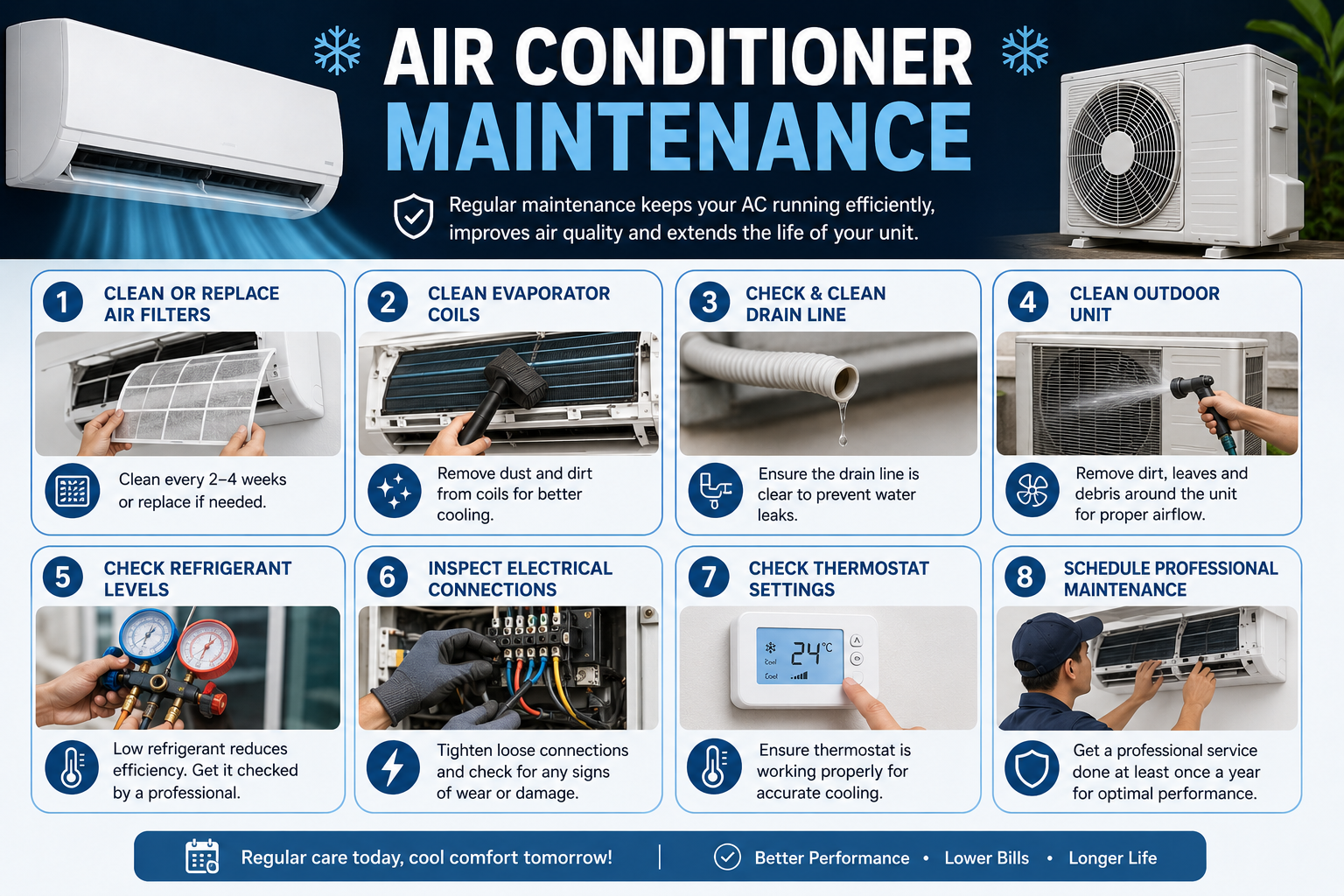
Turn Off the Power
Before performing any maintenance on an air conditioner, cut power to the system completely. For central systems, this means turning off the system at the thermostat, switching off the circuit breaker for both the indoor air handler and outdoor condenser, and pulling the disconnect at the outdoor unit if one is present.
Never work on any AC component with power on. Capacitors in outdoor units retain dangerous electrical charge even after the power is disconnected. Allow at least five minutes after disconnection before working near capacitor components.
Replace or Clean the Air Filter
The air filter is the single most important routine maintenance item in any forced-air system. A clean filter maintains proper airflow through the system, protects coils from dust accumulation, and plays a critical role in indoor air quality.
Check filters monthly during the cooling season. Disposable filters should be replaced when visibly loaded with dust and debris, or according to the manufacturer’s interval for the filter type. Washable filters should be cleaned with water, allowed to dry completely before reinstallation, and never returned to the system while damp.
For detailed guidance on filter types, MERV ratings, and the complete filter replacement process, the How to Replace an HVAC Filter guide covers this task comprehensively.
Clean the Outdoor Condenser Unit
The outdoor condenser unit pulls air through its coil fins to reject heat from the refrigerant. When the fins are blocked with grass clippings, cottonwood seeds, leaf debris, or dirt, the unit cannot reject heat efficiently. This forces the compressor to work harder and run at higher temperatures, accelerating wear.
With power disconnected, use a garden hose to rinse the condenser coil fins from inside the unit outward, flushing debris out rather than pushing it deeper into the coil. Use low to moderate water pressure. High-pressure washing can bend the delicate aluminum fins. Remove all vegetation, debris, and dirt from around the unit and clear a minimum two-foot clearance on all sides.
Clean the Evaporator Coil
The indoor evaporator coil absorbs heat from room air. Over time, dust, pollen, and airborne particles accumulate on the coil surface even with a functioning filter, particularly on fine-pitch coil designs. A dirty evaporator coil dramatically reduces heat transfer efficiency.
Apply a no-rinse evaporator coil cleaner spray available at HVAC supply houses and hardware stores. The cleaner penetrates and loosens buildup, which then drips into the condensate drain pan with the normal condensate flow. For heavily soiled coils or coils in difficult access positions, professional cleaning with more aggressive methods provides better results.
Inspect Refrigerant Lines
The insulated refrigerant lines running between the outdoor condenser and indoor air handler should be inspected for physical damage, deteriorated insulation, and signs of refrigerant leakage. Refrigerant leaks often appear as oily residue on or near the line connections.
Insulation on suction line refrigerant tubing, the larger of the two lines, prevents condensation and heat gain that reduces system efficiency. Replace any insulation that is cracked, missing, or saturated with moisture.
Check Refrigerant Levels
Refrigerant level checking and adjustment is a task that requires a licensed HVAC technician. Working with refrigerants requires EPA Section 608 certification and proper manifold gauge equipment. A system that is low on refrigerant has a leak that must be found and repaired before recharging, as simply adding refrigerant to a leaking system is not a solution and is illegal under EPA regulations.
If you suspect low refrigerant based on warm air output or ice formation on lines, schedule professional service rather than attempting to address this yourself.
Clean the Condensate Drain Line
The condensate drain line carries moisture removed from the air by the evaporator coil to a floor drain or outdoor exit point. Algae growth, mold, and debris accumulate in the drain line over time and eventually cause complete blockages that result in water overflowing the drain pan and leaking into the home.
Flush the condensate drain line monthly during the cooling season by pouring a cup of diluted white vinegar or a condensate drain treatment tablet into the drain pan access port. For a fully blocked line, use a wet-dry vacuum at the outdoor drain exit to pull the blockage clear.
Inspect Electrical Connections
Inspect all accessible electrical connections at the air handler and outdoor unit for corrosion, loose terminals, and damaged wiring. Loose connections create resistance that generates heat, which accelerates insulation breakdown and can eventually cause connection failure or electrical fires.
Electrical inspection inside the outdoor unit near the capacitor and contactor requires caution even with power disconnected due to stored capacitor charge. If you are not comfortable with electrical components, include this as part of your annual professional service.
Test the Thermostat
Confirm the thermostat is responding accurately and calibrated correctly. Set the system to cooling and lower the set point by five degrees below current room temperature. The system should engage promptly and run until the set temperature is reached.
If the thermostat is battery-powered, replace the batteries annually before the cooling season. Smart thermostats should have their firmware updated if available. A thermostat that is reading two to three degrees off from actual room temperature wastes energy and compromises comfort.
Inspect the Blower Motor
The indoor blower motor circulates air through the system. Inspect the blower wheel for dust and debris accumulation, which creates imbalance that causes vibration, noise, and motor bearing wear. A heavily loaded blower wheel should be carefully cleaned with a soft brush.
Listen to the blower motor during operation for bearing noise, which sounds like a grinding or scraping and indicates the motor may be nearing end of service life. Blower motor replacement is a professional task requiring proper sizing and installation.
Lubricate Moving Parts
Some older air handler designs include blower motor bearings and other moving parts that require periodic lubrication with oil ports. Modern permanently lubricated sealed bearing motors do not require this. Check your system documentation to determine whether lubrication ports are present and what type of oil the manufacturer recommends.
Using the wrong lubricant or over-lubricating can attract dust that causes more problems than it solves. When in doubt, have a professional perform this step during annual service.
Inspect Air Ducts
Inspect accessible ductwork for disconnected sections, physical damage, excessive dust accumulation at registers, and gaps in insulation on ducts running through unconditioned spaces. Leaky ductwork can reduce delivered cooling capacity by twenty to thirty percent.
Seal accessible duct gaps with mastic sealant or metal-backed tape. Never use standard cloth duct tape on HVAC ductwork, as it fails quickly under thermal cycling. For comprehensive duct system assessment, professional duct leakage testing provides quantified results that inform whether professional duct sealing or replacement is warranted.
Check Insulation Around Refrigerant Lines
Confirm that insulation on suction line refrigerant tubing is continuous and in good physical condition from the outdoor unit to where it enters the home. Replace any sections that are cracked, missing, or deteriorated with appropriately sized foam pipe insulation.
Test the Entire Cooling System
With all components inspected and cleaned, restore power and run the system through a complete cooling cycle. Measure the temperature differential between supply air and return air using a thermometer. A properly functioning system should produce supply air that is fifteen to twenty-two degrees Fahrenheit cooler than return air.
Check that all registers are delivering airflow. Walk the home and confirm the system reaches the thermostat set point within a reasonable time. Note any unusual sounds, odors, or performance concerns that emerged during testing.
Record the Maintenance Date
Document the maintenance session with the date, tasks performed, filter type and MERV rating used, any observations about system condition, and the planned next service date. This record supports warranty claims, informs service technicians, and confirms maintenance compliance if required by your homeowner’s insurance.
Adding AC maintenance records to your broader home maintenance log alongside other systems keeps your complete property maintenance history organized and accessible. The Annual Home Maintenance Checklist provides a comprehensive framework for tracking this alongside all other home systems.
Seasonal AC Maintenance Schedule
| Task | Pre-Season (Spring) | Active Season (Monthly) | Mid-Season Check | Post-Season (Fall) |
|---|---|---|---|---|
| Air filter inspection and replacement | Required | Required | Required | Required |
| Outdoor unit debris clearing | Required | Monthly check | Required | Required |
| Condenser coil cleaning | Required | Visual check | As needed | Optional |
| Evaporator coil cleaning | Required | N/A | As needed | N/A |
| Condensate drain flush | Required | Monthly | Required | N/A |
| Thermostat test and calibration | Required | Optional | Optional | Optional |
| Refrigerant line insulation check | Required | N/A | N/A | N/A |
| Electrical connection inspection | Required | N/A | N/A | N/A |
| Blower motor inspection | Required | Listen for noise | As needed | N/A |
| Duct visual inspection | Required | N/A | N/A | N/A |
| System performance test | Required | Monthly observation | Required | N/A |
| Professional service | Required (annual) | N/A | As needed | Optional |
| Winterize or cover outdoor unit | N/A | N/A | N/A | Required |
| Store window or portable units | N/A | N/A | N/A | Required |
Essential Air Conditioner Maintenance Tools
| Tool | Purpose | Recommended Use | Estimated Cost |
|---|---|---|---|
| Garden hose with spray nozzle | Rinsing outdoor condenser coil | Pre-season and mid-season | $20 – $60 |
| No-rinse coil cleaner spray | Cleaning evaporator and condenser coils | Annually or as needed | $10 – $25 |
| Fin comb | Straightening bent condenser fins | As needed | $10 – $25 |
| Wet-dry vacuum | Clearing condensate drain blockages | As needed | $30 – $150 |
| Thermometer (digital) | Testing supply and return air temperature differential | Seasonally | $10 – $30 |
| Soft bristle brush | Cleaning blower wheel and coil surfaces | Annually | $5 – $15 |
| Flashlight or headlamp | Inspecting inside air handler and around outdoor unit | Every maintenance session | $15 – $60 |
| Screwdrivers (flat and Phillips) | Accessing air handler panels and covers | Every maintenance session | $10 – $30 |
| Nut driver set | Removing outdoor unit panels and access covers | Every maintenance session | $10 – $30 |
| Non-contact voltage tester | Confirming power is off before working on system | Every maintenance session | $15 – $40 |
| Cordless drill | Accessing panels with screwed covers | As needed | $50 – $200 |
| Foam pipe insulation | Replacing deteriorated suction line insulation | As needed | $5 – $20 |
| Condensate drain tablets | Preventing algae growth in drain line | Monthly during season | $8 – $20 |
| Metal-backed HVAC tape | Sealing accessible duct leaks | As needed | $10 – $25 |
For a complete guide to building your home maintenance tool collection, the Home Maintenance Tools Every Homeowner Needs article covers both HVAC-specific and general home maintenance tools in detail.
DIY vs Professional Air Conditioner Maintenance
| Task | DIY Appropriate | Professional Required | Notes |
|---|---|---|---|
| Air filter replacement | Yes | No | Most important routine DIY task |
| Outdoor unit debris clearing | Yes | No | Simple, high-impact task |
| Condensate drain flush | Yes | No | Monthly vinegar flush is highly effective |
| Thermostat battery replacement | Yes | No | Simple maintenance task |
| Condenser coil rinse (low pressure) | Yes | Optional | Avoid high-pressure washing |
| Evaporator coil cleaning (accessible) | Experienced DIY | Recommended | No-rinse spray is DIY friendly |
| Refrigerant check and recharge | No | Yes | Requires EPA 608 certification |
| Electrical connection testing | Visual only | Yes | Capacitors retain dangerous charge |
| Blower motor lubrication | Only if ports present | Yes | Risk of over-lubricating |
| Refrigerant leak detection | No | Yes | Requires specialized equipment |
| Duct leakage testing | No | Yes | Requires blower door and measurement equipment |
| Full system diagnostic | No | Yes | Requires manifold gauges and training |
| Compressor evaluation | No | Yes | Requires specialized electrical testing |
| Annual professional tune-up | N/A | Yes (annual) | Includes tasks not DIY accessible |
Estimated Air Conditioner Maintenance Costs
| Service or Task | DIY Cost | Professional Cost | Notes |
|---|---|---|---|
| Air filter (standard 1-inch) | $5 – $30 | N/A (DIY only) | Replace every 1 – 3 months |
| Air filter (high-efficiency 4-5 inch) | $20 – $60 | N/A (DIY only) | Replace every 6 – 12 months |
| Annual professional tune-up | N/A | $75 – $200 | Central system, includes inspection |
| Condenser coil cleaning (professional) | $10 – $25 (DIY) | $100 – $300 | Professional for heavy soiling |
| Condensate drain clearing | $0 – $20 | $75 – $200 | Professional for complete blockage |
| Refrigerant recharge | N/A | $150 – $600 | Includes leak check |
| Thermostat replacement | $20 – $250 | $150 – $400 | Smart thermostat installed |
| Capacitor replacement | N/A | $100 – $300 | Common outdoor unit failure |
| Contactor replacement | N/A | $100 – $250 | Common outdoor unit failure |
| Blower motor replacement | N/A | $300 – $700 | Parts and labor |
| Duct sealing (professional) | $10 – $30 (accessible DIY) | $300 – $1,000+ | Depends on duct system size |
| Window AC unit service | $0 – $30 (DIY clean) | $75 – $150 | Limited professional service availability |
| Total Annual Estimated Cost | $50 – $150 | $200 – $500 | Combined DIY plus professional |
Common Air Conditioner Maintenance Mistakes
Even well-intentioned homeowners make maintenance errors that reduce system performance or cause unintended damage.
Closing supply registers in unused rooms. This seems logical but it is counterproductive. Residential AC systems are sized and designed to distribute air through all registers simultaneously. Closing registers increases static pressure in the duct system, which reduces airflow, stresses the blower, and can cause evaporator coil freezing.
Using high MERV filters without system compatibility check. Higher MERV ratings capture more particles but also restrict airflow more significantly. Installing a MERV 13 filter in a system designed for MERV 8 can reduce airflow enough to cause evaporator coil freezing and compressor stress. Match filter MERV rating to your system’s specification.
Pressure washing the condenser coil. High-pressure water bends delicate aluminum fins, creating permanent airflow restriction that cannot be corrected without complete coil replacement. Always use low-pressure rinsing with a standard garden hose.
Setting the thermostat significantly lower to cool faster. Air conditioners do not cool faster when set to a lower temperature. They simply run longer. Setting the thermostat to 60 degrees when you want it to reach 72 degrees does not speed up the process. It wastes energy and risks over-cooling.
Skipping the professional annual service. Many homeowners perform basic DIY maintenance faithfully but skip the annual professional tune-up. Professional service catches issues that DIY inspection cannot: refrigerant charge deviations measured with manifold gauges, electrical component degradation tested with proper meters, and system performance characteristics that require trained interpretation.
Ignoring condensate drain maintenance. The condensate drain line receives no attention in many homes until it backs up and causes water damage. Monthly prevention with a simple drain treatment is one of the easiest and highest-value maintenance tasks in any cooling season.
Tips to Improve Air Conditioner Efficiency
Small adjustments and habits deliver measurable improvements in cooling system efficiency and comfort.
- Set the thermostat to 78 degrees Fahrenheit when home and higher when away to minimize runtime without sacrificing comfort. Each degree of set point reduction increases energy consumption by approximately three percent.
- Use ceiling fans in occupied rooms to increase the perceived comfort at higher thermostat settings. Fans create a wind-chill effect that allows you to feel comfortable at two to three degrees warmer.
- Keep window coverings closed on south and west-facing windows during peak afternoon sun hours to reduce solar heat gain that the AC system must overcome.
- Seal air leaks around windows, doors, and utility penetrations to reduce the volume of hot outdoor air the system must condition.
- Ensure the outdoor condenser unit has adequate shade from trees or structures without obstructing the two-foot clearance required for proper airflow.
- Avoid running heat-generating appliances like ovens, dishwashers, and dryers during the hottest hours of the day.
- Have ductwork in unconditioned spaces like attics and crawl spaces properly insulated and sealed to prevent conditioned air losses before it reaches living spaces.
For broader summer energy efficiency strategies that complement your AC maintenance efforts, the Summer Home Maintenance Tips to Protect Your Home article covers a comprehensive range of seasonal home protection measures.
Ways to Extend the Life of Your Air Conditioner
The average service life of a residential central air conditioner is fifteen to twenty years. Units that receive consistent maintenance regularly exceed that range. Those that are neglected often fail within ten to twelve years.
- Maintain a clean air filter without exception. This single practice has more impact on system longevity than any other owner action.
- Schedule professional service every spring without skipping. A technician catches developing problems, from a slightly low refrigerant charge to a capacitor measuring near its lower limit, before they cause compressor failure.
- Keep the outdoor unit clear of vegetation, mulch, and debris year-round, not just when you remember to check it.
- Never operate the system in ambient outdoor temperatures below 60 degrees Fahrenheit unless your system is specifically rated for low-ambient operation. Most standard residential equipment is not designed for cooling in cold conditions.
- Address unusual sounds, odors, or performance changes promptly. Small problems become expensive failures when ignored.
- Protect the outdoor unit during winter in cold climates by clearing debris from the top of the unit and, if desired, covering the top only with a breathable cover. Never completely seal the unit, which traps moisture and encourages corrosion and pest nesting.
- Consider a programmable or smart thermostat upgrade to reduce unnecessary runtime and optimize the system’s operating cycles throughout each day.
Expert Recommendations
After years of working on residential HVAC systems across a range of ages, conditions, and climates, certain recommendations consistently produce the best outcomes for homeowners.
Never let filter replacement slide. Of all the maintenance failures that lead to expensive AC repairs, a neglected air filter is the most common contributing factor. It restricts airflow, loads the evaporator coil with dust, stresses the blower motor, and can cause evaporator coil freezing that damages the compressor. Keep a supply of filters on hand and check them monthly without exception.
Schedule professional service in early spring, not June. HVAC contractors are significantly busier once summer heat arrives. Scheduling your annual tune-up in March or April means better appointment availability, more technician time on your system, and any parts needs addressed before the peak season when supply can be stretched.
Take unusual sounds seriously from the first time you hear them. Homeowners commonly adapt to a new sound and assume it is normal. A grinding bearing, a chattering contactor, or a vibrating panel is never normal. Each of these sounds indicates a developing problem that is far less expensive to address when caught early.
Invest in a smart thermostat if you have not already. Modern smart thermostats provide runtime data, efficiency ratings, and maintenance reminders in addition to superior scheduling capability. The energy savings from optimized thermostat programming typically pay for the device within one cooling season.
Connect your AC maintenance to your complete home maintenance calendar. Treating your cooling system as an isolated concern rather than one component of a comprehensive home maintenance program leads to inconsistent service.
The Home Maintenance Checklist by Month and the Monthly Home Maintenance Checklist both provide frameworks for integrating AC care into your full-year home maintenance routine so it receives consistent attention alongside every other system in your home.
Frequently Asked Questions
How long does a professional AC tune-up take?
A thorough professional AC tune-up on a central cooling system typically takes between one and two hours for a single-system home. Multi-system homes, complex configurations, or systems with known issues that require additional diagnostics may take longer. During that time, a qualified technician will check refrigerant pressure with manifold gauges, inspect and test electrical components, clean coils, check the condensate drain, measure airflow, test system performance, and document findings. If you are scheduling service for the first time in several years, budget additional time for the technician to address any accumulated maintenance needs beyond the standard annual service checklist.
What MERV rating filter should I use in my home?
The appropriate MERV rating for your air filter depends on your system’s airflow specifications and your household’s filtration needs. Most residential systems operate well with MERV 8 to 11 filters, which capture a good range of dust, pollen, and airborne particles without restricting airflow significantly. MERV 13 filters offer hospital-grade filtration but require a system capable of handling the increased air resistance. Using a filter with too high a MERV rating for your system causes the same problems as a clogged filter: reduced airflow, coil freezing, and compressor stress. Check your system documentation or ask your HVAC technician what MERV range is appropriate for your specific equipment.
Is it okay to run my AC if the outdoor temperature is below 60 degrees?
Most standard residential central air conditioners and window units are not designed to operate efficiently or safely in outdoor ambient temperatures below 60 degrees Fahrenheit. Below this threshold, refrigerant pressure drops, lubricant viscosity in the compressor changes, and the risk of liquid refrigerant entering the compressor increases. This condition, called liquid slugging, can cause immediate compressor damage. If you need cooling in cool weather conditions, some ductless mini-split systems are rated for low-ambient cooling operation. Check your equipment specifications before operating any cooling system in cold conditions.
How do I know if my AC needs refrigerant?
Refrigerant level problems typically present through a combination of symptoms: the system runs continuously without reaching the set temperature, the air from supply registers feels less cool than usual, ice forms on the suction line or evaporator coil, and electricity bills increase without a change in usage. A definitive refrigerant charge assessment requires a licensed technician with manifold gauges to measure actual system pressures against the manufacturer’s specifications for current outdoor and indoor conditions. If refrigerant is low, it confirms a leak that must be located and repaired before recharging. Refrigerant does not get consumed or evaporate in normal operation. A low charge always indicates a leak.
How do I clear a clogged condensate drain line?
Start by locating the condensate drain line access point, typically a capped PVC tee fitting near the indoor air handler. Remove the cap and pour a mixture of one cup of white vinegar diluted with water into the drain. For an actively clogged line where water is backing up into the drain pan, go to where the drain exits outdoors or at a floor drain and use a wet-dry vacuum against the drain exit for one to two minutes to pull the clog clear. After clearing, flush with water to confirm free flow. Prevent future clogs with monthly condensate drain treatment tablets or vinegar flushes throughout the cooling season.
Should I cover my outdoor AC unit in winter?
Full covering of the outdoor condenser unit in winter is generally not recommended by HVAC professionals. A fully covered unit traps moisture inside, which promotes corrosion of the coil and internal components. It also creates an attractive sheltered nesting space for rodents, which can damage wiring and insulation over winter. If you want to provide some protection from falling debris like leaves and tree seeds, covering only the top of the unit with a breathable cover or a piece of plywood weighted down is sufficient. The unit is designed to withstand weather exposure. Inspect and clear any debris that has accumulated around or inside the unit before starting the system in spring.
What is the ideal thermostat setting for energy efficiency?
The U.S. Department of Energy recommends setting your thermostat to 78 degrees Fahrenheit when you are home and awake, and higher when you are away or asleep. Each degree below 78 increases cooling energy consumption by approximately three percent. A programmable or smart thermostat that automatically adjusts the set point based on your schedule can deliver ten to fifteen percent savings on cooling costs compared to maintaining a constant lower temperature around the clock. Use ceiling fans in occupied rooms to increase comfort at the higher set point. Remember that fans cool people, not rooms, so turn them off when leaving a room.
How do I maintain a ductless mini-split system?
Mini-split maintenance differs from central system maintenance primarily in how and where you access the key components. The indoor air handler units have washable filter panels that slide out from the front of the unit and should be cleaned monthly by rinsing with water and allowing to dry completely before reinstalling. The evaporator coil behind the filters can be carefully cleaned with a no-rinse coil cleaner spray. The outdoor unit should be kept clear of debris with adequate clearance on all sides. Both the indoor and outdoor units have drain paths that should be confirmed clear during seasonal checks. Professional service annually covers refrigerant, electrical, and comprehensive cleaning of components not accessible for DIY maintenance.
Can I perform my own air conditioner maintenance if my system is still under warranty?
Most residential AC equipment warranties require documented annual professional service to remain valid. Performing only DIY maintenance without professional service may technically void the warranty if the manufacturer requires certified technician service as a warranty condition. Read your warranty documentation carefully and confirm what the manufacturer requires. When professional service is performed, ensure you receive and retain a written service record documenting what was done, including any parts replaced, refrigerant added, or repairs made. This documentation is your evidence of warranty compliance if you ever need to make a warranty claim during the coverage period.
How does air conditioner maintenance affect indoor air quality?
The connection between AC maintenance and indoor air quality is direct and significant. A clean, properly maintained air conditioner filters airborne particles, controls humidity, and delivers conditioned air through clean coils and ductwork. A neglected system does the opposite. A dirty evaporator coil covered with organic matter becomes a breeding ground for mold and bacteria that circulate through the entire home with every cooling cycle. A saturated or overdue air filter allows particles through that would otherwise be captured. A blocked condensate drain creates standing water in the drain pan that promotes biological growth. Consistent AC maintenance is not just about cooling efficiency. It is a foundational element of maintaining healthy indoor air for everyone in the household.
Conclusion
Air conditioner maintenance is one of the most straightforward and highest-return investments a homeowner can make. The tasks are not complicated. Most of what determines whether your system runs efficiently, lasts its full service life, and keeps your home comfortable through every summer are simple practices performed consistently.
Replace the filter. Keep the outdoor unit clear. Flush the condensate drain. Schedule your annual professional service before the heat arrives. Address problems when they first appear rather than when they become emergencies.
The financial case is clear. A well-maintained AC system costs less to operate every month, requires fewer emergency repairs, and lasts significantly longer than a neglected one. The comfort case is equally clear. A system that receives consistent care delivers consistent performance. It cools reliably when you need it, runs quietly in the background, and improves rather than degrades the air you breathe.
Building your AC maintenance into a broader home care schedule ensures it receives the attention it deserves year after year.
The Ultimate Home Maintenance Checklist for Every Season and the DIY Home Inspection Checklist provide the comprehensive frameworks that connect cooling system care to your complete whole-home maintenance program.
Start with this season. Check the filter. Clear the outdoor unit. Schedule your professional service. Then add these tasks to your maintenance calendar and trust the process. Your air conditioner will reward the attention every time you need it most.