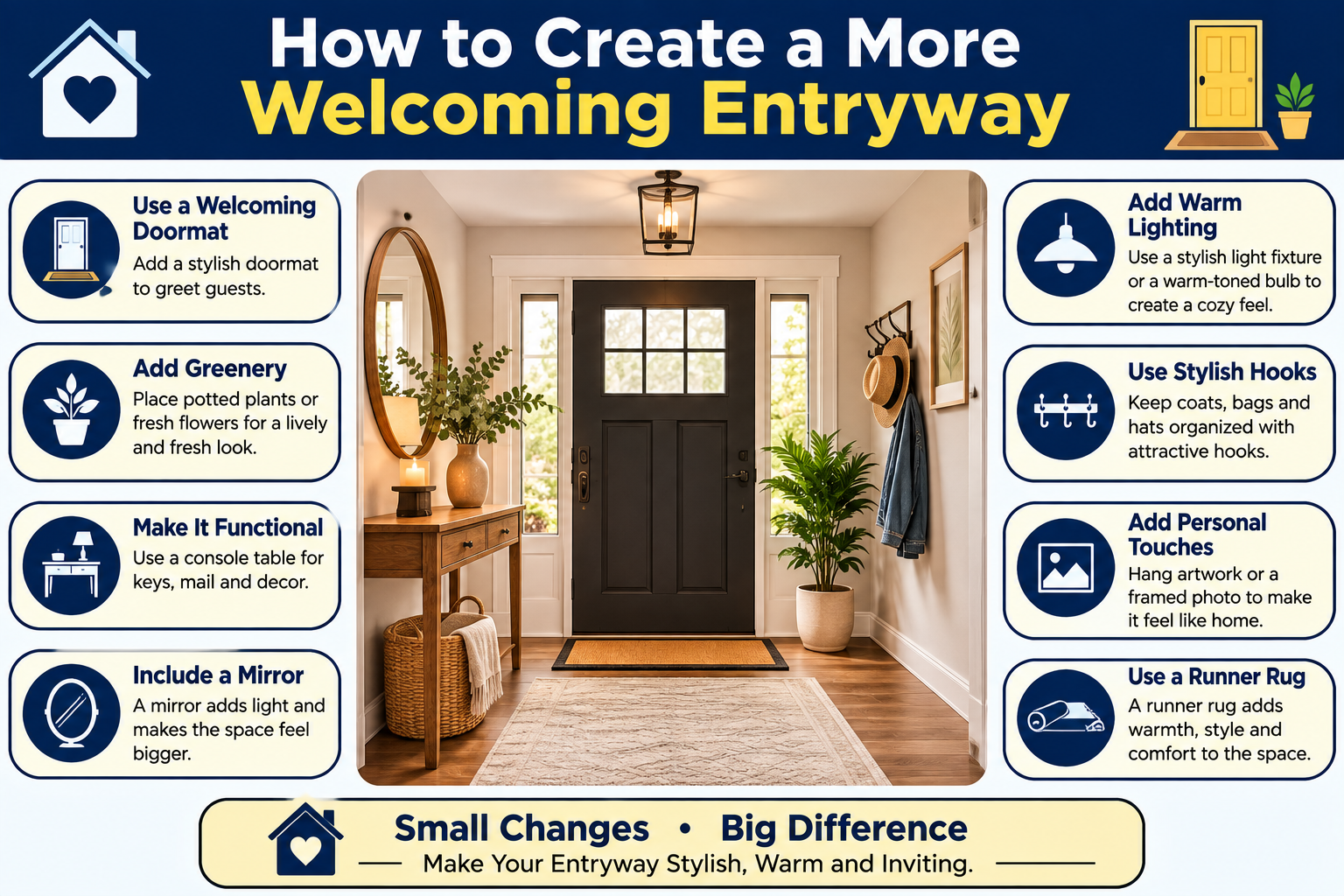
How to Create a More Welcoming Entryway

Introduction
The entryway is where a home introduces itself. Before anyone has seen the living room, the kitchen, or any other room in the house, the entrance has already formed the first impression. That impression is shaped by a combination of things, the quality of the lighting, the sense of order or chaos at the door, the colors on the walls, and whether the space feels welcoming or simply functional.
Even a very small entrance can feel significantly more welcoming with some thoughtful attention. A narrow hallway in a modest apartment and a generous foyer in a larger house both benefit from the same fundamental principles: good lighting, practical storage, appropriate scale, considered color, and enough personal character to feel like it belongs to someone rather than simply connecting one space to another.
Knowing how to create a more welcoming entryway is less about following a specific design style and more about understanding how each element, lighting, storage, color, furniture, mirrors, organization, and décor, contributes to the overall impression the space makes. This guide covers practical improvements for entryways of different sizes, styles, and budgets, with explanations for why each one makes a genuine difference.
1. Start by Decluttering the Entryway
Before any improvement can take hold, the entryway needs to be cleared of the accumulated items that most entrances collect over time. Shoes in piles near the door, bags hanging from every available surface, unopened packages, umbrellas leaning in corners, and seasonal items that never found another home all create an impression of disorder that no amount of decorating can fully overcome.
The entryway is a naturally high-traffic, high-deposit area of the home. Items arrive here and stop because the entrance is where journeys end. Without deliberate systems that give these items a proper place, they stay where they were left. The solution is not simply clearing the entry once but creating storage that makes it easy to put things away consistently.
Start by sorting everything that currently lives in the entrance into categories. What genuinely belongs here because it is used daily, keys, everyday bags, frequently worn coats? What has migrated here from elsewhere and should be returned? What can be removed from the home entirely?
The goal of this initial clearing is not minimalism. It is clarity. An entryway with appropriate storage for the items that genuinely belong there, organized in a way that makes daily use easy, will stay clearer than one where items are simply removed without creating anywhere logical for them to live.
2. Improve Entryway Lighting
Lighting does more to determine the atmosphere of an entryway than any other single element. A well-lit entrance feels welcoming and safe. A poorly lit one feels closed and slightly unwelcoming regardless of how good the decoration is or how clean the floor is.
Most entrance halls receive limited natural light, particularly in homes where the front door opens into an interior corridor rather than directly into a room with windows. This makes the quality of artificial lighting disproportionately important in entryways compared to other rooms.
A ceiling fixture that provides adequate general illumination for the scale of the space is the starting point. In a small entry, a single well-chosen fixture is often sufficient. In a larger one, multiple fixtures or a statement fixture with good light distribution provide more even coverage.
The character of the fixture matters for the overall impression of the entry. The entryway is where guests first encounter the home’s interior design language. A fixture that is in character with the rest of the home creates a consistent first impression. One that is clearly mismatched or is the standard builder fixture that was never replaced draws attention to itself for the wrong reasons.
Where the entryway has a console table or side surface, a table lamp adds a lower, warmer light source that makes the space feel more welcoming in the evening. This layer of light at a different height from the ceiling fixture is what creates the settled, comfortable quality that a single overhead source cannot achieve.
Warm light temperatures, bulbs in the range of 2700K to 3000K, create a more welcoming first impression than cool or daylight-temperature bulbs in an entryway. Any new light fixture installation should be carried out by a qualified electrician, particularly where additional wiring is required.
3. Choose a Welcoming Color Scheme
The color of an entryway walls, the trim, and any significant surfaces, communicates the home’s character immediately. It is also the color that both household members and guests see as they arrive home, which means it sets the emotional tone of the entry experience every time.
Warm neutrals, soft creams, warm whites, and earthy tones tend to create the most consistently welcoming entry atmospheres because they reflect available light and feel settled rather than stimulating. A warm greige, a soft terracotta, a muted sage, or a warm stone color can all create a welcoming entry depending on the home’s overall palette and the amount of natural light available.
The entryway color should feel related to the colors used in the adjacent rooms, even if it is not identical. When a hallway color clashes sharply with the living room or kitchen that can be seen from it, the transition feels disjointed. When the hallway color shares enough tonal quality with the surrounding spaces to feel like part of the same home, movement through the entrance feels more natural.
In homes where the entryway is very small and lacks natural light, slightly lighter versions of the chosen color scheme reflect more of the available artificial light and prevent the space from feeling dark and enclosed. Where the entry has good natural light or decent ceiling height, a slightly deeper or more distinctive color can create genuine character without making the space feel oppressive.
4. Add a Functional Console Table
A console table in an entryway provides both visual structure and practical function. It gives the entrance a piece of furniture that anchors the space, creates a surface for everyday items, and introduces an opportunity for decoration that a plain hallway wall does not provide.
The most important consideration when choosing a console table for an entryway is its depth relative to the available floor space. A console table that is too deep reduces the circulation space and can make it difficult to open the front door fully. Slim-profile console tables, those that project only 10 to 12 inches from the wall, suit most entryways without significantly reducing the movement space.
The width of the table should be proportional to the wall it occupies. A very narrow table on a wide hallway wall looks undersized and awkward. A table that extends close to the edges of the wall it sits on looks more considered and fills the space more naturally.
The surface of the console table is the entryway’s primary display area. A lamp, a small plant, a few objects with personal significance, and a bowl for keys and everyday small items is a practical and visually complete arrangement that serves daily function alongside visual appeal. The temptation to add more is worth resisting. A console table that is covered with accumulated objects becomes visual noise rather than a composed display.
Storage beneath the console table, baskets, a low shelf, or a small cabinet, extends its practical function and provides a place for items that do not belong on the surface.
5. Use a Mirror Strategically
A mirror in the entryway serves practical, atmospheric, and visual purposes simultaneously. Practically, it allows household members a final check of appearance before leaving and a moment to adjust on arrival. Atmospherically, it reflects light and makes the space feel brighter. Visually, it creates the impression of additional depth that is particularly valuable in a narrow or enclosed entry.
The position of the mirror relative to the light sources in the entry determines how effectively it reflects light. A mirror positioned opposite or beside a window reflects natural light deepest into the space. A mirror positioned to reflect a lamp or ceiling fixture extends the artificial light’s effective range. In a windowless entry, this relationship with the artificial light sources is worth considering specifically when deciding where to place the mirror.
Size matters for the visual effect. A mirror that is appropriately large for the wall it hangs on creates a meaningful visual expansion of the space. A mirror that is too small looks decorative but does not achieve the spatial effect that makes mirrors genuinely useful in entryways.
Shape can reflect the home’s overall design character. A vertically oriented rectangular mirror suits a traditional or more formal entry. A large circular mirror creates a contemporary focal point that suits more modern interiors. An arched mirror sits at an interesting point between these two characters and suits a range of styles.
The frame should coordinate with the other hardware and finishes visible in the entryway. A consistent metal finish between the mirror frame, the console table hardware, the coat hooks, and the light fixture creates a more deliberate and finished overall impression.
6. Create Practical Storage
The quality of an entryway’s storage directly determines how functional the space is for daily life and, by extension, how organized the rest of the home is. When the entryway has adequate, well-organized storage for every category of item that passes through it regularly, those items have a home and the entryway stays clear. When the storage is inadequate, items migrate into the rest of the house.
Shoe storage is typically the most significant entryway storage challenge. Shoes that have no designated place end up on the floor near the door, which is both visually untidy and a tripping hazard. A shoe cabinet with doors conceals the shoes entirely and keeps the entryway looking organized. An open shoe rack is more accessible but requires consistent discipline. A bench with shoe storage beneath it serves double duty, providing seating and containing footwear simultaneously.
Coat hooks or a coat rack at an appropriate height for the household’s users provide a specific place for coats, bags, and everyday outerwear. The number of hooks should match the household’s needs. Insufficient hooks mean items end up somewhere else. Wall-mounted hook rails can be positioned and sized to suit the available wall space more flexibly than freestanding coat stands.
A dedicated location for keys, ideally at a consistent position that is checked automatically when leaving, prevents the daily frustration of searching for them. A small hook beside the door, a bowl on the console table, or a dedicated key cabinet all serve this purpose.
Drawers or baskets in the entryway area provide contained storage for smaller items, sunglasses, chargers, headphones, gloves, and similar everyday objects that tend to accumulate near the entrance without proper storage.
7. Add Comfortable Seating When Space Allows
A seating element in the entryway is not a luxury addition. It is a genuinely practical feature that makes a common daily activity, putting on and taking off shoes, significantly easier. Anyone who has tried to balance on one leg in a narrow hallway while pulling on a shoe understands the practical value of somewhere to sit.
In smaller entryways, a compact bench or a single stool provides seating without consuming enough floor space to interfere with circulation. In larger entries, a more substantial bench, upholstered for comfort, creates a more complete furnished appearance and can provide storage beneath it.
The height of the seating matters. A bench that is too low makes standing back up difficult, particularly for older adults or anyone with limited mobility. A standard bench height of approximately 17 to 19 inches from the floor is comfortable for most adults.
Seating in the entryway should be positioned so that it does not block the primary route through the entrance. In a hallway, a bench against the wall to one side of the door, rather than directly opposite it, allows the main circulation space to remain clear.
Upholstered seating adds visual softness and warmth to an entryway that is otherwise dominated by hard surfaces. The fabric should be robust enough to withstand daily use and easy enough to clean that accumulated outdoor dirt from clothing and bags does not become a persistent maintenance problem.
8. Choose the Right Entryway Rug
An entryway rug defines the entrance zone, adds texture and warmth, introduces color, and provides a practical function by capturing dirt and moisture from outdoor footwear before it reaches the rest of the home’s flooring.
The size of the rug should be appropriate to the specific entryway rather than based on a universal measurement. In a small entry, a rug that fits comfortably within the space without running under the door or folding against walls reads as intentional and appropriately scaled. In a larger entry, a rug that is too small looks like an afterthought rather than a deliberate design choice.
Durability and ease of cleaning are the most important practical qualities for an entryway rug because it receives the heaviest foot traffic of any rug in the home and is the first to encounter outdoor dirt and moisture. Natural fiber rugs, wool, jute, and sisal, are durable and attractive but vary in how easily they can be cleaned. Flat-woven or machine-washable rugs are often the most practical choice for high-traffic entries.
The pattern and color of the rug should work with the floor material it sits on and the wall color around it. A patterned rug in an otherwise simple entry adds visual interest without requiring pattern elsewhere. A plain rug in a textured material adds warmth without visual complexity. Both approaches can work depending on the overall design character of the home.
9. Add Plants and Natural Elements
Plants in an entryway bring life and color to what can sometimes be one of the most visually straightforward spaces in the home. A single well-chosen plant in a proportional pot creates visual interest and warmth that manufactured accessories do not replicate.
The available light in the entry determines which plants are suitable. Many entryways receive limited natural light, which restricts the plant selection to shade-tolerant species. Pothos, snake plants, ZZ plants, and peace lilies all tolerate low light conditions and are practical choices for dimly lit entries. Where a window provides reasonable natural light, a broader range of plants becomes viable.
A tall, slender plant placed beside the console table or in a corner adds vertical interest without occupying significant floor space. A smaller plant on the console table surface contributes to the curated display quality of that surface.
Natural materials beyond plants, woven baskets for storage, a wooden console table, a stone dish for keys, a linen cushion on a bench, all contribute to the organic warmth that makes an entryway feel more comfortable and genuine. These are elements that appear across many home styles because their natural quality is broadly compatible with a range of interior characters.
For more on how natural materials can improve the comfort and atmosphere of a home more broadly, our article on best home improvement ideas for a cozy home covers the use of texture, warmth, and natural elements across different rooms.
10. Use Wall Art and Personal Décor
The walls of an entryway provide an opportunity to establish the home’s character immediately and to express something of the people who live there. A front door that opens into a hallway with a single well-chosen piece of artwork or a considered personal display communicates that the home is genuinely inhabited and cared for.
The artwork or display should be appropriate in scale to the wall it occupies. A single large piece, positioned at the right height with enough space around it to be seen properly, is more effective than multiple small pieces arranged without a clear logic. A gallery wall of personal photographs in coordinated frames creates a warm, personal quality that suits family homes particularly well.
Meaningful personal objects, travel items, handmade pieces, inherited objects with history, contribute to an entryway that feels like it belongs to specific people rather than a generic designer’s vision. These objects do not need to be arranged formally. A small collection of items with a shared material, similar proportions, or a connected visual quality creates cohesion without rigidity.
The balance between decoration and function in an entryway is worth maintaining deliberately. A display that is too dense or too varied creates visual noise in a space that is experienced briefly and in transition. Each addition should justify its place by contributing to the overall impression rather than simply occupying available space.
11. Make a Small Entryway Feel Larger
Small entryways are among the most common design challenges in residential homes. They need to accommodate all the storage and functional requirements of a larger space while feeling open enough to be welcoming rather than cramped.
Mirrors are the most effective single tool for making a small entry feel larger. A large mirror on the main wall of a narrow hallway creates the impression of additional depth that visually doubles the apparent length of the space. Positioned to reflect whatever natural or artificial light is available, it also makes the entry feel brighter.
Light colors on walls and ceiling reduce visual weight and reflect more of the available light, which makes a small entry feel more open. This does not mean the space must be white. Soft warm neutrals achieve the same light-reflecting effect while providing more warmth and character.
Slim furniture profiles matter significantly in a small entry. A console table that projects only 10 inches from the wall provides all the practical surface function of a deeper table while occupying far less of the limited floor space. Furniture with visible legs allows the floor to be seen beneath it, which creates a sense of more floor space than solid-based furniture.
Vertical storage that uses wall height efficiently, tall cabinets, hooks mounted high enough to keep hanging items off the floor, and shelving that reaches toward the ceiling, maximizes storage capacity without increasing the floor footprint. The floor itself should be as clear as possible, because visible floor area is what makes a small space feel open rather than contained.
For more detailed guidance on making compact spaces feel larger and more comfortable, our article on how to make a small home feel more spacious covers the full range of techniques that apply across small rooms, including entryways, with practical explanations of why each approach works.
12. Make a Large Entryway Feel More Inviting
A large entryway presents the opposite challenge. Space that is not defined or furnished appropriately can feel empty, echoey, and disconnected from the rest of the home rather than grand and welcoming. The openness that seems like an advantage becomes a problem when it has no clear visual structure.
Appropriate furniture scale is the starting point. Furniture sized for a normal room looks undersized and slightly lost in a generous entryway. A more substantial console table, a full bench rather than a small stool, and a larger mirror or artwork all fill the visual space more naturally.
A rug that is genuinely sized for the space defines the entry zone and grounds the furniture arrangement within it. A rug that is too small for a large entry floats visually without creating the defined zone that gives the space structure.
Seating in a larger entry, a pair of chairs or a substantial upholstered bench, creates a furnished quality that makes the space feel like a genuine room rather than an oversized corridor. This is also practically useful where guests or family members need somewhere to wait.
Statement lighting, a chandelier or a substantial pendant appropriate to the ceiling height, addresses both the practical need for adequate illumination in a large space and the visual need for a focal point that draws the eye upward and establishes the character of the entry.
Plants at a scale appropriate to the space, a large specimen plant in a generous ceramic pot, make a positive contribution to a large entryway where a smaller plant would appear token rather than considered.
13. Design the Entryway Around Your Daily Routine
The most attractive entryway is one that also works for the household using it every day. An entryway designed around the actual arrival and departure habits of the people who live in the home functions more reliably than one designed around an idealized but unrealistic vision of how the space should be used.
Families with children have specific entryway needs that differ from those of a couple or a single occupant. Multiple sets of shoes, school bags, sports equipment, and children’s coats all need somewhere to go. Low hooks that children can reach independently, a dedicated shoe storage area sized for the actual number of household members, and a surface for the bags and items that arrive daily alongside the children are all practical necessities that should be designed into the entryway before the decorative elements are considered.
People who work from home often arrive and depart multiple times a day, sometimes carrying work equipment or materials. A clear place for work bags that keeps them accessible but off the main surface, and a hook for a jacket that can be grabbed quickly, supports this more frequent transition through the entry.
Homes that host frequent guests benefit from an entryway that can accommodate the additional coats, bags, and shoes that arrive with visitors without becoming immediately overwhelmed. Extra hooks, a basket for guest shoes, and a surface that can accommodate a few items belonging to guests alongside the household’s everyday belongings all make hosting more comfortable.
14. Make the Entryway Match the Rest of the Home
The entryway creates the transition between outside and inside, and between the public and private aspects of the home. Its design character should connect to the rest of the home’s interior rather than feeling like a separate space that happens to be attached to the front door.
Color coordination is the most accessible way to create this connection. The entryway color does not need to match the living room exactly. It needs to feel related enough that moving from one space to the other does not feel like a jarring shift. Sharing undertones, a warm entryway color that leads to a warm living room, even if the specific hues are different, creates a sense of visual flow.
Material and finish consistency contributes to the same effect. If the hardware throughout the home uses brushed nickel, the entryway hooks and fixture should coordinate. If the flooring transitions from the entryway tile or wood into the adjacent room’s material, a clean and appropriate transition piece manages the change.
The design character of the furniture and accessories should sit within the same general aesthetic as the rest of the home rather than being treated as an opportunity to try a completely different style. An entryway with maximalist decoration in a home that otherwise uses a minimal, quiet aesthetic creates confusion about the home’s character that visitors cannot quite resolve.
For guidance on how to approach updates across the home with a consistent and modern overall direction, our article on how to make your home look more modern covers practical approaches to creating visual coherence across connected spaces.
15. Improve Entryways on Different Budgets
Low Budget
The most accessible and often most impactful entryway improvements cost very little. Decluttering the entrance, returning misplaced items to other rooms, and organizing what genuinely belongs in the entry costs nothing and can transform the space immediately.
Rearranging existing furniture and storage improves the function and appearance of many entryways without purchasing anything. A new rug appropriate to the entry size adds warmth and definition at a modest cost. A large, simply framed mirror, which is often available at accessible price points, creates a visual improvement that is disproportionate to its cost. A plant and a small collection of thoughtful decorative objects complete the entry with minimal investment.
Moderate Budget
At a moderate budget, improvements extend to a console table appropriate to the entry’s scale, improved lighting through a better-chosen ceiling fixture or the addition of a table lamp, and dedicated storage solutions including wall-mounted hooks, shoe cabinets, or a storage bench.
Quality rugs and upholstered seating that genuinely suit the entry in size and material represent moderate investments that significantly improve both the appearance and the practical function of the space.
Larger Budget
Larger investments in an entryway make the most sense where genuine space or functionality problems cannot be resolved through more modest improvements. Built-in cabinetry that uses the full wall height for storage creates organized, tailored storage that freestanding furniture cannot match in efficiency. Custom cabinetry ensures the design is specific to the exact dimensions of the space.
Flooring improvements where the existing entry floor material is in poor condition or genuinely inconsistent with the rest of the home are worth considering when the overall entry is being substantially updated. Any work involving significant structural changes should involve appropriately qualified professionals.
16. Common Entryway Mistakes to Avoid
Too much furniture in a small entry creates an immediate circulation problem. The entry needs to be walkable before it is decoratable. Adding furniture that reduces the walking space to an uncomfortable degree makes the entrance feel worse to use than an underfurnished one.
Poor lighting makes the most beautifully designed entryway feel unwelcoming. The quality and character of the lighting is the most immediate sensory experience of the space and deserves genuine attention rather than the builder-grade fixture that came with the house.
Oversized rugs that run under the front door or fold against walls create a messy appearance and can create a tripping hazard near the primary entrance. The rug should fit the specific entry with room for the door to operate freely.
Blocking doors or pathways with furniture is a basic spatial error that makes the entry harder to navigate. Every piece of furniture should be positioned so that doors can open fully and movement through the space is comfortable.
Too many decorations create visual noise in a space that is experienced briefly and in transition. The entryway is not the place for accumulated collections or multiple competing design elements.
Lack of storage is the most consistent cause of entryway clutter. When there is nowhere logical for everyday items to go, they stay where they were left. Storage should be the foundation of the entryway’s design, not an afterthought.
Ignoring household routines produces an entryway that looks good in photographs but fails in daily use. The entry needs to accommodate the actual habits of the people who use it.
Choosing appearance over functionality creates an entry that requires conscious maintenance to keep looking acceptable and that feels slightly stressful to use as a result.
Using finishes that do not suit the rest of the home makes the entryway feel disconnected from the property it leads into.
Frequently Asked Questions
How can I make my entryway more welcoming?
A welcoming entryway combines practical organization with warm, considered design. Start by ensuring the space is clear of unnecessary clutter and that everything belonging in the entry has a proper storage place. Add warm, adequate lighting that flatters the space rather than simply illuminating it. Choose a wall color that feels settled and warm. Position a mirror to reflect available light. Add a plant or two for life and color. Include a personal element, a piece of artwork, a meaningful object, or a family photograph, that makes the space feel genuinely inhabited rather than simply styled.
How do I make a small entryway look bigger?
A large mirror on the main wall creates the impression of additional depth and is the single most effective visual tool in a small entry. Light wall colors reflect more of the available light and reduce visual weight. Good lighting that reaches every corner eliminates the dark areas that make a small space feel more enclosed. Slim furniture with visible legs allows floor to be seen beneath it. Keeping the floor as clear as possible is particularly important in small entries, where every object on the floor takes a disproportionate share of the limited visual space.
What should every entryway have?
An effective entryway should include adequate lighting that suits both daily use and the atmosphere it creates. Storage for every category of item that regularly passes through the space, shoes, coats, bags, keys, and smaller everyday items. A rug appropriate to the entry’s size and traffic level. A mirror for both practical and visual function. At least one personal element that makes the space feel like part of the home rather than a neutral waiting area. The specific form each of these elements takes should be matched to the household’s actual needs and the available space.
What type of lighting is best for an entryway?
Warm white light, generally in the 2700K to 3000K range, creates the most welcoming entry atmosphere. A ceiling fixture that provides adequate general illumination suited to the scale of the space is the foundation. Layering a second light source at a lower level, a table lamp on a console table or a wall sconce, adds warmth and visual depth that a single overhead fixture cannot achieve. The fixture style should coordinate with the home’s overall design character, since the entryway is where guests first encounter the interior’s design language.
Should I put a mirror in my entryway?
Yes, in most cases. A mirror in the entryway serves multiple useful functions simultaneously. It allows a practical appearance check before leaving the house. It reflects natural and artificial light further into the space, making the entry feel brighter. It creates the impression of additional visual depth, which is particularly valuable in narrow or enclosed entries. The mirror should be appropriately large for the wall it occupies, positioned to reflect a useful light source, and framed or styled in a way that coordinates with the surrounding finishes.
What furniture works best in a small entryway?
In a small entryway, furniture should be selected specifically for its compact footprint. A slim console table that projects only 10 to 12 inches from the wall provides all the practical surface function of a deeper table while preserving more circulation space. A compact bench or a single stool provides seating without the bulk of a larger piece. Wall-mounted hooks and shelving use vertical space without touching the floor at all. The common thread is choosing pieces that serve a genuine daily function without occupying more of the limited floor space than their contribution justifies.
How can I keep my entryway organized?
Organization in an entryway is most sustainable when the storage is convenient enough that using it is easier than not using it. Hooks at a comfortable height for every household member who uses them regularly. A shoe storage solution that the actual number of shoes in daily rotation can fit in. A dedicated surface or container for keys that is checked automatically on departure. Regular editing of what lives in the entryway so that items that no longer belong there are removed rather than accumulated. The specific systems should be matched to the household’s actual daily habits rather than an idealized version of how the entry should be used.
What colors make an entryway feel welcoming?
Warm, settled tones create the most consistently welcoming entry atmosphere. Warm neutrals, soft creams, earthy putty shades, muted terracotta, and gentle warm grays all work well in entries. The specific tone should coordinate with the adjacent rooms it leads into and work with both the natural and artificial light available in the entry. Very cool or very sharp colors can feel slightly unwelcoming in an entry where the light is limited. Where natural light is generous, a broader range of colors is workable. Testing a paint sample on the wall and observing it at different times of day, including under the evening artificial lighting, is the most reliable way to assess whether a specific color will feel right in the actual entry.
Final Thoughts
Knowing how to create a more welcoming entryway comes down to understanding that the space needs to serve two purposes simultaneously: making a good impression and supporting daily household life. An entryway that looks beautiful but does not accommodate coats, shoes, keys, and bags effectively will be chronically untidy regardless of the design quality of its decoration. One that functions well but has received no design attention will feel like a utility space rather than a welcoming transition into the home.
The best improvements are those that address both purposes together. Storage that keeps daily items contained and organized while being designed in a way that looks intentional and coordinated. Lighting that is warm and welcoming while being adequate for the practical tasks of arriving and departing. Decoration that is personal and considered while being scaled appropriately to the space rather than accumulated without a clear visual logic.
Start by solving the biggest daily frustrations. If shoes are always on the floor, better shoe storage solves that. If the lighting makes the entry feel dark and unwelcoming, improving the light quality addresses the atmosphere problem. If the space always feels cluttered, better storage organized around the household’s actual habits creates lasting improvement.
Make those practical improvements the foundation. Then build the welcoming quality on top of them through color, mirrors, plants, artwork, and personal touches that give the entry character and warmth. The result will be an entryway that genuinely welcomes people home rather than simply marking the transition between outside and inside.