
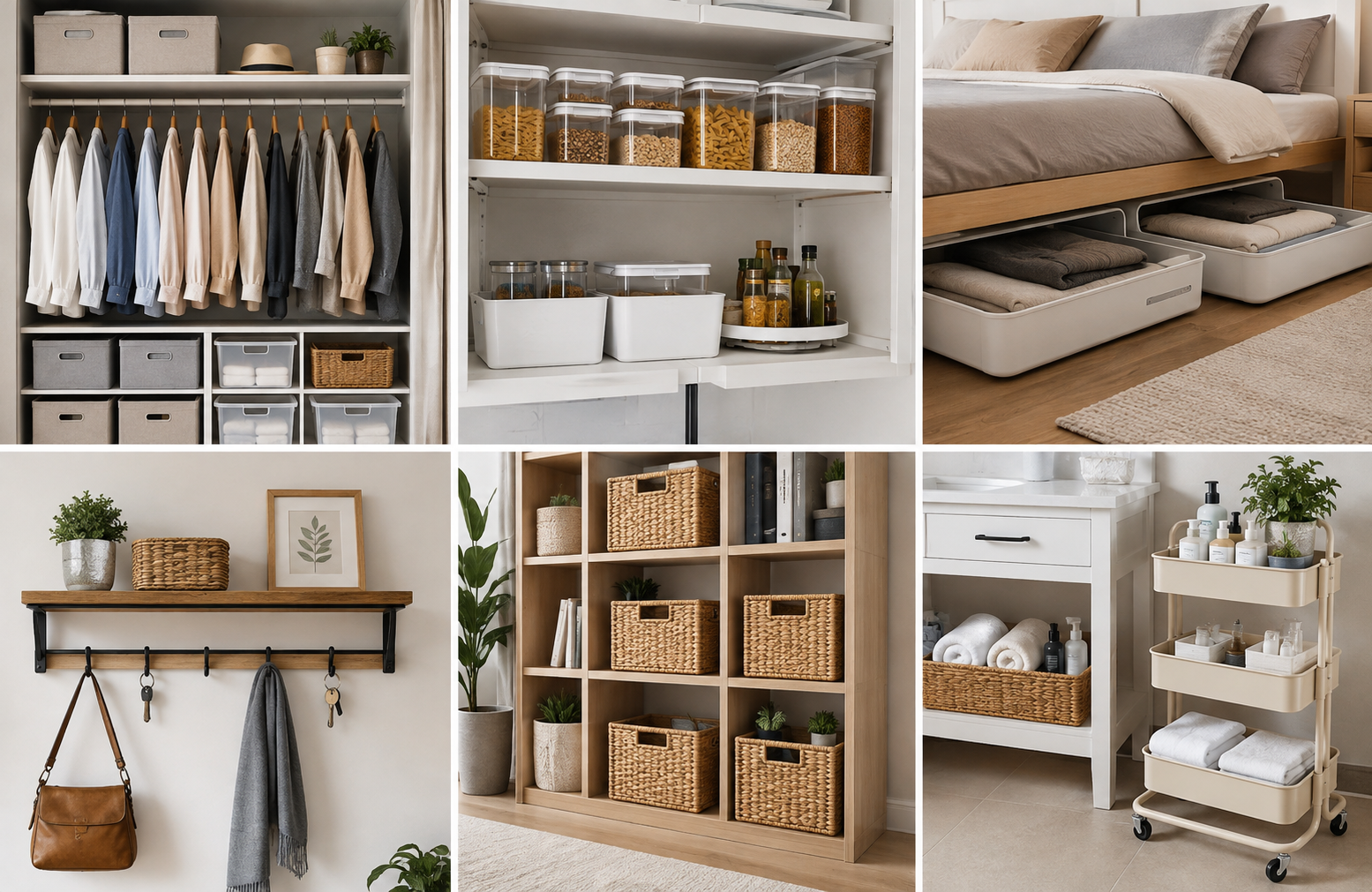
Best Storage Ideas for a More Organized Home

An organized home isn’t about owning fewer things. Most households have a realistic amount of belongings—kitchen equipment, clothing, books, tools, children’s toys, paperwork—and all of those things need somewhere to live. The difference between a home that feels chaotic and one that feels calm usually comes down to whether the storage is working.
Good storage keeps necessary items accessible without leaving them in plain sight when they don’t need to be. It makes rooms easier to move around in, simpler to keep tidy, and more comfortable to spend time in. When storage is thoughtfully planned, maintaining a reasonably organized home stops feeling like a constant effort.
The best storage ideas for a more organized home share three qualities: they’re easy to access, they suit the space they’re in, and they’re designed around how the people living there actually use the room. A system that looks great but requires you to drag a step ladder out twice a day isn’t going to work. Neither will a beautiful built-in wardrobe that doesn’t have enough hanging space for the clothes you actually own.
This guide covers practical storage solutions for every room, different budgets, and different types of homes—from compact apartments to larger family houses. It also covers common mistakes, so you can spend money and effort where it will genuinely make a difference.
1. Start by Identifying Your Home’s Storage Problems
Before you buy a single basket or install a single shelf, spend a few days noticing where clutter tends to collect in your home. Clutter almost always accumulates in the same places, and those places are telling you something specific about where storage is missing or isn’t working.
Here are the most common problem areas and what they often signal:
Entryways — Shoes piling up near the door, coats draped over chairs, and keys left on the nearest surface usually mean the entryway has no proper place for these items, or the storage that exists there isn’t convenient enough to actually use.
Kitchen counters — If appliances, mail, snacks, and random household items are always covering the kitchen counters, the kitchen likely needs better cabinet organization, a dedicated spot for everyday appliances, or a proper landing zone for non-kitchen items.
Bedroom floors and chairs — Clothes that aren’t being stored properly end up on the floor or draped over a bedroom chair. This usually points to a wardrobe or closet that isn’t organized to match how you actually use it, rather than a shortage of space.
Bathroom surfaces — Products cluttering the vanity, ledges, and bathtub edge are a sign that there isn’t enough functional shelf or cabinet space for the number of products the household uses.
Living room surfaces — Remotes, books, toys, chargers, and blankets left out in the living room often indicate there’s no consistent, convenient place for these items to go.
Children’s belongings — Toys, schoolbags, and craft supplies that spread throughout the home suggest storage is missing either in the children’s rooms or in shared spaces where these items tend to be used.
Home office supplies — Papers, chargers, and stationery spread across desks or dining tables often mean the workspace lacks proper filing, drawer space, or a designated area for work items.
Garage and utility areas — These spaces frequently become dumping grounds for anything without a home elsewhere. Poor shelving, no clear categories, and limited hanging space all contribute to this.
Identifying where clutter actually accumulates—rather than assuming every room needs more storage—helps you spend time and money solving the problems that will make the biggest difference to daily life.
2. Make Better Use of Vertical Space
Most homes use horizontal space reasonably well. It’s vertical space that gets overlooked. Walls extend upward, and in most rooms, the area above eye level is completely empty. Tapping into this space can meaningfully increase storage capacity without occupying more floor area.
Tall shelving units that run from floor to ceiling offer significantly more storage than standard-height bookcases. In a living room or home office, a tall shelving unit along one wall can hold books, boxes, baskets, and decorative items while taking up only a few inches of floor depth.
Wall-mounted cabinets work well in kitchens, bathrooms, and home offices where you want storage that stays off the floor entirely. Floating cabinets are particularly useful in smaller rooms because they don’t add visual weight at floor level.
High-level cabinets above standard kitchen units or fitted wardrobes are often underused because they’re harder to reach. They’re best suited for seasonal or rarely used items—Christmas decorations, spare bedding, luggage—where easy daily access isn’t required.
Built-in storage that runs floor to ceiling makes the most efficient use of wall space and tends to look more intentional than freestanding units of different heights. In a hallway or alcove, a built-in that reaches the ceiling can double usable storage capacity compared to a standard sideboard or cabinet.
Vertical organizers and dividers inside existing cabinets and drawers help stack items that would otherwise take up too much horizontal space—baking trays, cutting boards, and pan lids, for example, are better stored vertically than stacked flat.
Vertical storage is useful in almost every room, but it’s especially valuable in smaller homes and rooms where floor space is limited.
3. Choose Furniture With Built-In Storage
Furniture that serves two purposes—providing a place to sit, sleep, or set things down while also offering internal storage—is one of the most practical investments for homes where storage space is limited.
Storage beds are one of the most effective options available. A bed with drawers underneath or a hydraulic lift base can hold a significant amount of seasonal clothing, spare bedding, and other items that would otherwise need a separate piece of furniture. This works particularly well in bedrooms without dedicated wardrobe space, or in guest rooms that also serve another purpose.
Ottomans with lids provide seating and a surface while concealing blankets, cushions, or children’s toys. A storage ottoman in the living room can replace the need for a separate blanket basket and works especially well in rooms where you want to keep items accessible without leaving them visible.
Storage benches are versatile and practical in entryways, at the foot of beds, or in mudrooms. A bench with a hinged lid or interior compartments can store shoes, sports equipment, or seasonal items, and it provides useful seating at the same time.
Coffee tables with drawers or shelves offer a discreet place for remote controls, books, and everyday living room items that would otherwise cover the surface.
Console tables with lower shelves or drawers are useful in hallways and entryways for keeping keys, bags, and small items contained.
The important caveat: furniture with built-in storage can look bulky in smaller rooms if you choose pieces that are too large for the space. It’s worth measuring carefully and considering whether the room can accommodate a piece comfortably before buying it primarily for its storage capacity.
4. Improve Entryway Storage
The entryway is the first space people enter and the last they pass through when leaving. When it has no proper system, items get dropped in random spots and that disorder tends to drift further into the home. When it’s organized, the rest of the house generally stays tidier as a result.
For a deeper look at how the entryway affects the whole home, How to Create a More Welcoming Entryway covers the space in greater detail.
The most important items to find homes for in an entryway are:
Shoes — A shoe rack, shoe cabinet, or purpose-built bench with shoe storage keeps footwear contained near the door. The right solution depends on how many pairs typically accumulate and how much floor space is available. A slim shoe cabinet is useful in a narrow hallway; a bench with shoe cubbies below works well in a larger entryway or mudroom.
Coats and bags — Wall hooks at different heights accommodate adults, children, and bags simultaneously. A built-in coat cupboard works better if you want a cleaner appearance, though it requires opening and closing a door, which some households use less consistently than open hooks.
Keys, post, and small items — A small wall-mounted organizer, a tray on a console table, or a drawer unit near the door gives these items a consistent home. Without a designated spot, keys in particular tend to end up wherever they’re set down.
Seating — A bench or stool near the entryway is genuinely useful for putting on and taking off shoes, and it can double as storage if the design allows it.
The most effective entryway storage is the kind that’s easy to use without thinking about it. If putting away a coat requires opening three doors, most people won’t do it consistently.
5. Create Better Kitchen Storage
The kitchen is typically the most active room in the house and often the one with the most storage challenges. Counter space fills up quickly, cabinets become disorganized, and awkward layouts can make it difficult to access everyday items efficiently.
Pantry organization — Whether you have a dedicated pantry cupboard or a section of kitchen cabinets, organizing food storage by category and frequency of use makes a significant difference. Items used daily should be at eye level or just below; canned goods and specialty items can go higher or lower. Using shelf risers to create additional levels within deep cabinets prevents items from getting lost at the back.
Drawer inserts and dividers — Kitchen drawers without dividers tend to become chaotic very quickly. Inserts for utensils, cutlery trays, and drawer dividers for miscellaneous tools keep items visible and easy to find.
Cabinet door storage — The inside of cabinet doors is often unused. Narrow racks mounted on the inside of a pantry or base cabinet door can hold spices, lids, foil, and cling film, freeing up shelf space for larger items.
Vertical storage for awkward items — Baking trays, chopping boards, roasting pans, and pan lids are difficult to stack. A vertical divider or adjustable rack inside a cabinet stores these items upright, making them accessible without having to unstack everything else to reach them.
Appliance storage — Appliances that are used daily are worth keeping on the counter. Those used weekly can go in a lower cabinet. Appliances used only occasionally—a bread maker, a food processor—can be stored in a pantry, on a high shelf, or in another accessible location outside the kitchen.
Under-sink organization — The cabinet under the kitchen sink is often poorly used because it’s an awkward shape and easy to turn into a dumping ground. A two-tier pull-out organizer or a set of adjustable risers can make this space significantly more functional for cleaning products and kitchen supplies.
Kitchen storage should be organized around cooking habits. A household that cooks from scratch daily has different needs from one that mainly uses quick everyday meals. The layout should reflect how the kitchen is actually used.
6. Improve Bedroom Storage
The bedroom has a specific purpose: rest. When clothing, accessories, and personal items have no clear home, they tend to accumulate in ways that make the room feel busy and harder to relax in. Good bedroom storage solves this by keeping everyday items accessible and everything else out of sight.
Wardrobes and fitted storage — A wardrobe that’s organized to match how you actually dress works better than one divided by generic sections. If you hang most of your clothing, you need more rail space than shelves. If you fold most items, you need more shelving. Matching the internal layout to your actual habits makes a wardrobe easier to use consistently.
Closet organizers — Adjustable shelf systems, hanging organizers, and drawer inserts can significantly increase the capacity of an existing closet without replacing it. These are worth considering before investing in new furniture.
Under-bed storage — Beds with built-in drawers are the most practical option, but if your bed doesn’t have them, shallow storage containers on castors can slide underneath. This space works well for seasonal clothing, spare bedding, or shoes.
Bedside storage — A bedside table with at least one drawer keeps reading glasses, books, chargers, and similar items contained rather than scattered on the nightstand surface.
Seasonal clothing rotation — Storing off-season clothing in vacuum-seal bags, underbed boxes, or on high wardrobe shelves frees up accessible space for the clothing you’re currently wearing.
Shoe and accessory storage — A small shoe rack inside or below a wardrobe, and a drawer divider or box for accessories, prevents these items from spreading across shelves and surfaces.
Bedroom storage should reduce the morning effort of finding what you need. If you’re regularly digging through a wardrobe or searching for accessories, that’s a sign the storage needs restructuring, not necessarily expanding.
7. Make the Living Room More Organized
The living room is used by the whole household for different purposes—relaxing, watching television, reading, entertaining, and in many homes, playing. Because it’s a shared space, it tends to collect a wide range of items that don’t always have a clear home.
If you’re thinking about how storage fits into the broader function of this room, How to Create a More Functional Living Space offers useful guidance on layout and design.
Media and electronics storage — A media unit or TV cabinet with doors can keep devices, cables, and remote controls inside when not in use. Open shelving for equipment looks fine in some homes, but it tends to accumulate visible cable clutter quickly.
Books — Bookshelves remain one of the most practical storage solutions for a living room. Tall shelving along one wall is both functional and visually grounding. A mix of books, baskets, and a few decorative items keeps shelving looking intentional rather than crowded.
Blankets and cushions — A storage ottoman, a basket, or a cabinet with doors can contain blankets and spare cushions without leaving them draped over furniture.
Toys in family living rooms — If children use the living room regularly, dedicated toy storage in the room is more practical than expecting toys to always be returned to a bedroom. A cabinet with doors or a large basket keeps toys accessible but contained.
Games and everyday items — A sideboard or media unit with internal shelving and drawers can hold board games, chargers, stationery, and other household items that tend to end up in the living room.
Balancing open and closed storage in the living room helps maintain a space that feels both lived-in and comfortable. This is covered in more detail in Section 13.
8. Upgrade Bathroom Storage
Bathrooms tend to accumulate a lot of products in a relatively small space. The combination of moisture, limited wall and floor area, and frequent daily use makes bathroom storage one of the more challenging areas to get right.
Vanity storage — A vanity unit with enclosed storage below the basin is far more practical than a pedestal basin in any bathroom where cabinet space is limited. Drawers are generally more useful than doors in a bathroom vanity because they allow you to see and access items without having to move things around.
Medicine cabinets — A recessed or surface-mounted medicine cabinet above the basin adds storage without taking up shelf or counter space. It’s a practical solution in smaller bathrooms where wall-mounted cabinets might feel intrusive.
Wall-mounted cabinets — A separate wall cabinet for toiletries, spare products, and medication works well in family bathrooms where the vanity fills up quickly. Placement matters: a cabinet positioned above a toilet or beside a door uses wall space that would otherwise be empty.
Shelving — Open shelving in a bathroom works for towels and a small number of products, but it can start to look cluttered quickly in a busy household. Closed storage generally keeps a bathroom looking calmer.
Towel storage — Towel rails, hooks, and rings all have a place. A combination of a heated towel rail for drying and hooks or a small ladder rack for additional towels works well for larger households.
Small item organization — Drawer inserts for hair accessories, cosmetics, and small toiletries reduce the amount of time spent searching through drawers. In bathrooms without drawers, small trays or containers on a shelf serve a similar purpose.
One practical consideration: any shelving, furniture, or storage installed in a bathroom should be appropriate for humid environments. Solid materials with moisture-resistant finishes will last significantly longer than furniture designed for dry areas.
9. Create a More Functional Home Office
A home office needs storage that actively supports work rather than getting in the way of it. Cluttered desks, misfiled papers, and poor cable management all interrupt focus and make the workspace less comfortable to spend time in.
Desk storage — A desk with drawers is more practical than a flat surface alone. Even one or two drawers for stationery, notebooks, and chargers makes a significant difference to how organized the surface stays.
Shelving — Shelves above or beside a desk provide accessible storage for reference books, files, and frequently used items. Adjustable shelving is more flexible as needs change.
Filing and document storage — Physical filing systems are less common than they used to be, but many households still have documents that need to be stored and accessible. A small filing cabinet, a dedicated drawer with hanging folders, or a labeled box system on a shelf all work. The key is consistency—documents filed in the right place are easy to find; documents stacked to be filed “later” typically aren’t.
Cable management — Loose cables on a desk or trailing across a floor are a common source of visual clutter in a home office. Cable clips, a cable tray attached underneath the desk, or a cable management box can contain this without significant effort or expense.
Closed cabinet storage — A cabinet with doors in a home office allows you to close off supplies, equipment, and paperwork at the end of the workday. This is particularly useful in rooms that also serve another purpose, where visible work items can make it harder to switch off.
An organized home office doesn’t require extensive renovation. In many cases, reorganizing existing storage, adding a few shelves, and establishing a consistent filing habit makes a more meaningful difference than new furniture.
10. Use Built-In Storage Where It Makes Sense
Built-in storage—cabinetry and shelving that’s designed and installed as a fixed part of a room—tends to use space more efficiently than freestanding furniture. It can be made to fit awkward dimensions, reach the ceiling, and create a more cohesive look. But it’s not the right solution for every situation.
When built-ins make sense:
Built-in shelving or cabinetry works particularly well in alcoves, chimney breast recesses, and hallways where the dimensions are fixed and freestanding furniture rarely fits well. It’s also a strong option when you want to maximize storage in a room without compromising the look or feel of the space.
Locations worth considering include:
- Hallways and landing areas, where a built-in cabinet or shelving run can provide substantial storage without encroaching on a room
- Living rooms, particularly in alcoves either side of a chimney breast
- Bedrooms, where fitted wardrobes can make better use of the full height and width of a wall than freestanding alternatives
- Home offices, where floor-to-ceiling shelving or cabinetry along one wall can consolidate all storage in one place
- Under-stair areas, which can be fitted with drawers, shelving, or a combination of both
- Mudrooms or utility areas, where fitted storage for coats, bags, shoes, and household supplies can be organized around how the family actually uses the space
When freestanding furniture is more practical:
If you’re renting, planning to move, or uncertain about the layout you want, freestanding furniture is a more flexible choice. Built-ins generally require a professional carpenter or joiner, and in some cases depending on the scale and nature of the project, other trades may be involved. If the work involves any structural changes, consult a professional before proceeding.
Built-ins also represent a more significant investment than most freestanding furniture. They’re worth prioritizing in rooms where storage is a genuine daily problem and where the layout is unlikely to change.
11. Make Use of Awkward or Unused Spaces
Most homes have areas that are technically usable but get overlooked when storage is planned. These spaces aren’t always large, but they can hold a surprisingly useful amount if approached thoughtfully.
Under-stair storage — The space beneath a staircase is one of the most versatile unused areas in a house. Depending on the height of the cavity, it can be fitted with drawers, shelving, a small wardrobe, a desk, or a combination of these. Even a simple fitted door with hooks and shelving inside makes the space more functional than leaving it as an informal cupboard.
Alcoves and recesses — Recesses in a living room, bedroom, or hallway are natural locations for shelving or fitted cabinetry. They’re already partially enclosed, so adding shelves or building a simple fitted unit is often straightforward.
Corners — Corner spaces in kitchens and bedrooms are often wasted. Corner shelving units, lazy Susan inserts in corner cabinets, or pull-out corner drawers can make these areas usable.
Space above cabinets — In kitchens with high ceilings, the gap between the top of the upper cabinets and the ceiling can hold baskets or boxes for rarely used items.
Narrow wall sections — A short section of wall that’s too narrow for a standard piece of furniture can sometimes accommodate a column of open shelves, a shallow console, or a row of hooks.
There’s a practical limit to how many awkward spaces it’s worth pursuing. Focus on those that are genuinely accessible and would be used regularly. Storage that’s difficult to reach or awkward to use tends to collect disorganized clutter rather than solving it.
12. Make a Small Home Feel Less Cluttered
Storage in a small home requires a different approach than storage in a larger one. The instinct is often to add more storage furniture, but in a compact space, too many storage units can make rooms feel more crowded rather than less cluttered.
If you want to explore this further, How to Make a Small Home Feel More Spacious covers spatial planning and design in more detail.
The most effective strategies in a small home tend to be:
Use furniture that does more than one thing — A bed with storage underneath, a dining table with drawer space, a bench that opens for storage—these allow you to consolidate rather than multiply furniture.
Prioritize vertical storage over floor-standing units — Wall-mounted shelving, tall narrow cabinets, and cabinets that reach the ceiling use vertical space without shrinking the floor area further.
Use hidden storage where possible — In a small living room, an ottoman with a lid or a coffee table with internal storage keeps items accessible without leaving them visible.
Keep storage systems consistent — Matching containers, baskets, or drawer inserts across different storage areas reduces visual noise. A mix of different storage products in a small space often looks busier than it is.
Avoid duplicate storage furniture — It’s easy to keep adding baskets, bins, and boxes to solve immediate clutter problems. If the result is storage units stacked on top of each other, it’s worth reconsidering whether the space actually has room for everything in it.
Foldable and flexible items — A foldaway desk, a folding dining table, or stackable storage that can be rearranged gives small homes adaptability that fixed furniture can’t.
One honest consideration for small homes: there’s a point where a storage problem is actually a space problem, and the only effective solutions are reducing the number of belongings, reorganizing the layout, or finding additional storage outside the main living areas.
13. Combine Open and Closed Storage
Open and closed storage each have genuine advantages. The most organized rooms usually use both, but in proportions that match the household’s habits and the room’s function.
Open Storage
Open shelving, hooks, and open baskets are more immediately accessible than closed alternatives. You can see what’s there, reach it quickly, and return items without having to open a door or lid. Open storage also tends to be less expensive and easier to install.
The main limitation is that open storage shows everything on it. In a household that keeps things tidy by habit, this works fine. In a busy household with young children, open shelving in a living room may simply mean that everything visible is in clear view all the time—which can make a room feel noisier than it is.
Open storage is well-suited for items you use regularly and want to display—books, folded towels, decorative items—or for clearly labeled baskets that contain miscellaneous items.
Closed Storage
Closed cabinets, drawers, and cupboards conceal everyday clutter behind doors. A living room sideboard with doors, a bathroom vanity with drawers, or a kitchen with doors on all the cabinets presents a calmer visual surface regardless of what’s inside.
Closed storage does require the habit of opening and closing doors or drawers, which not everyone maintains consistently. It also makes it easier to overfill compartments, since the contents aren’t visible.
Closed storage works best for items that are used but don’t need to be on display—toiletries, paperwork, cleaning products, cables, toys.
Finding the Balance
A practical combination for most rooms is closed storage as the primary system, with a small amount of open storage for frequently used or visually pleasant items. In a living room, for example, a sideboard with doors can hold most items while a shelf above or nearby displays books and decorative objects. In a kitchen, upper cabinets behind doors keep the visual space calm, while a small section of open shelving holds cookbooks or everyday oils and spices.
14. Organize Storage Around Everyday Habits
One of the most consistently useful principles of good storage is simple: items you reach for every day should be the easiest to access. Items you use occasionally can be stored more deliberately, and items you use rarely can go in less accessible spaces.
This sounds obvious, but a surprising number of kitchens, wardrobes, and cabinets are organized the wrong way around—with everyday items at the back of deep shelves or on high shelves, while rarely used items occupy the most convenient spaces.
In the kitchen, daily cooking equipment and most-used ingredients should be at arm’s level and near the areas of the kitchen where they’re used. Baking equipment used once a month can go in a higher or lower cabinet.
In the wardrobe, the clothing you wear regularly should be hanging or folded in the most accessible position. Seasonal items, formal wear, and rarely used pieces can go on higher shelves or in less convenient drawers.
For cleaning products, the products used most often should be somewhere easy to reach—under the kitchen sink or in a utility cupboard at eye level. Specialist cleaning products used occasionally can go further back.
For school or work materials, the things needed daily—a laptop charger, a planner, pens—should have a consistent, immediate home. Filing and archiving for less current documents can be stored separately.
For bathroom essentials, the products used every day should be within easy reach of where they’re used, not tucked behind other items in a cabinet.
Seasonal items—outdoor furniture covers, Christmas decorations, holiday luggage—can be stored in less accessible locations, such as high cabinets, loft space, or garage shelving, because they’re retrieved infrequently.
This habit-based approach doesn’t require new storage; it often just requires rethinking how existing storage is allocated.
15. Create Flexible Storage for Changing Needs
A family with young children has different storage needs from the same family five years later. A spare bedroom used as a home office might eventually need to become a guest room. A household of two might become a household of three or four. Storage that can adapt to these changes is more valuable in the long run than highly customized solutions that only work for one configuration.
Adjustable shelving — Shelving with adjustable brackets allows heights to be changed as what’s being stored changes. This is particularly useful in closets, home offices, and utility rooms.
Modular storage systems — Many furniture brands offer modular systems where individual cabinets, shelves, and drawers can be combined in different configurations and added to over time. These allow storage to grow or be rearranged without replacing everything.
Multi-purpose rooms — Designing a room’s storage to support more than one use—a home office that can also function as a guest room, a playroom that can convert to a study—makes the home more adaptable without requiring renovation.
Freestanding furniture in the right contexts — In rooms or households where change is likely, freestanding storage furniture is easier to reconfigure or replace than built-ins. The trade-off is that it’s rarely as space-efficient.
For growing families in particular, the ability to reconfigure storage without significant cost or disruption can be genuinely valuable. A child’s room with adjustable shelving and modular storage can serve well through very different stages of a child’s development.
16. Storage Ideas for Different Budgets
Not every storage improvement requires a significant financial investment, and not every expensive storage solution is appropriate for every home. What matters most is directing whatever budget you have toward the storage problems that affect your daily life most.
Low Budget
A meaningful amount of storage improvement is possible without spending a lot of money:
- Reorganizing existing storage is the most cost-effective starting point. Clearing out rarely used items, changing how things are arranged, and using what’s already there more efficiently can free up substantial space.
- Hooks are inexpensive and immediately useful in entryways, bedrooms, bathrooms, and behind doors.
- Baskets and labeled containers can consolidate and organize items that are currently loose across shelves and surfaces.
- Rearranging furniture to improve traffic flow and access to storage areas costs nothing.
- Removing duplicate items reduces what needs to be stored in the first place—two items doing the same job is a storage problem as much as a clutter problem.
- Basic shelving installed in a cupboard, utility room, or garage can dramatically increase usable storage in spaces that currently have very little.
Moderate Budget
At a moderate budget level, it becomes practical to invest in storage furniture and improvements that make a more significant difference:
- Storage furniture such as a storage ottoman, a sideboard with doors, or a bed with built-in drawers can replace existing furniture while solving a storage problem.
- Closet organization systems from flat-pack or modular ranges can substantially improve wardrobe capacity without custom work.
- Better shelving in an office, living room, or kitchen provides more organized and visually tidier storage than makeshift alternatives.
- Cabinet organizers—pull-out trays, lazy Susans, drawer inserts—improve the usability of existing cabinets considerably.
- Multi-functional furniture pieces that serve more than one purpose and include storage are worth considering as replacements for single-purpose items.
Larger Budget
With a larger budget, it becomes practical to pursue more permanent and comprehensive storage improvements:
- Built-in cabinetry in living rooms, bedrooms, or hallways provides efficient, tailored storage that makes the most of available wall and ceiling height.
- Custom or semi-custom fitted wardrobes that are designed around an individual household’s wardrobe make a bedroom significantly easier to use and keep organized.
- Mudrooms or boot rooms, if the layout of the house allows for one, can consolidate all the household’s outdoor storage in one dedicated area rather than spreading it across the entryway, hallway, and garage.
- Integrated home office storage—built-in shelving, a fitted desk, and closed cabinets designed as part of the room—creates a workspace that’s both functional and visually comfortable.
- Larger storage redesigns such as converting under-stair space, creating a utility room from unused space, or adding a pantry room can solve storage problems that smaller interventions can’t address.
Regardless of budget, the principle remains the same: prioritize the storage problems that disrupt daily life most, rather than purchasing storage products because they’re appealing or on offer.
17. Common Storage Mistakes to Avoid
Storage problems are sometimes created, rather than solved, by well-intentioned decisions. These are the most common ones worth being aware of:
Buying storage without measuring — A storage unit that doesn’t fit the space is worse than not buying anything. Always measure the area first, including height if you’re buying a tall unit, and allow clearance for doors and drawers to open.
Using too many open shelves — Open shelving looks organized in styled photographs. In everyday use, it shows everything on it all the time. Too many open shelves in a living room or kitchen can make a space feel busier than it actually is.
Storing frequently used items in inconvenient locations — Items that are reached for daily but stored at the back of a deep cabinet, on a high shelf, or behind other things won’t be returned to those locations consistently. Inconvenient storage usually leads to clutter elsewhere.
Overfilling cabinets — A cupboard that’s packed so tightly that finding something requires removing other items isn’t functioning as storage—it’s functioning as a holding area. Overfilled storage typically means more belongings than the storage can actually accommodate.
Choosing furniture that’s too large — A large storage unit in a small room takes up floor space, interrupts the natural flow of the room, and can make the space feel cramped. A slightly smaller unit that fits the room properly is almost always a better choice.
Ignoring room circulation — Storage should be accessible without disrupting how you move through a room. A wardrobe door that blocks a bedroom door when open, or a cabinet that makes a kitchen feel narrow, creates daily friction.
Creating storage without thinking about who will use it — Storage at adult height isn’t useful for children. Storage in a bedroom that requires someone to get on their knees to reach it won’t be used consistently. Accessibility matters.
Organizing without considering household routines — A filing system that requires several steps to use, or a coat cupboard that’s inconvenient to open while carrying bags, will be bypassed. Storage should work with how people actually behave, not how they intend to behave.
18. How to Keep a Home Organized Long-Term
Good storage takes much of the effort out of keeping a home organized because it gives every item a consistent, logical place to go. When that’s in place, maintaining order becomes a much smaller task.
The most important principle is straightforward: frequently used items need a designated home that’s easy to access and easy to return to. When an item always goes in the same place, putting it away becomes reflexive rather than a decision that gets deferred.
Keep storage accessible — If returning something to its storage place requires effort, it won’t happen consistently. Storage that’s working well tends to be used without thinking about it.
Review storage periodically — Households change. Children grow out of toys. Hobbies change. Work situations change. A storage system that worked well a few years ago may no longer match current needs. An occasional review of how storage is allocated—perhaps once a year or after a significant change in the household—keeps things from gradually slipping into disorder.
Avoid accumulating duplicate storage products — Adding a new basket or box to solve an immediate clutter problem is a reasonable response. Doing this repeatedly without addressing the underlying storage issue leads to storage products becoming part of the clutter.
Choose flexible storage where possible — Storage systems that can be reconfigured as needs change reduce the likelihood of things falling apart when the household’s needs evolve.
An organized home isn’t one that requires constant maintenance. It’s one where the storage is designed well enough that things naturally tend to stay in order.
Frequently Asked Questions
What is the best storage solution for a small home?
There isn’t a single best solution, but the most effective approach for smaller homes is to prioritize vertical storage, use furniture that serves more than one purpose, and choose closed storage where possible to reduce visual clutter. The most important step is identifying which areas of the home cause the most day-to-day disruption and solving those first.
How can I add storage without making a room feel crowded?
Focus on wall-mounted or built-in storage rather than adding more freestanding furniture. Tall, slim shelving units use vertical space without taking up much floor area. Closed storage tends to feel less visually heavy than open shelving full of miscellaneous items. In a smaller room, one well-chosen piece of storage furniture is usually better than several smaller ones.
What furniture is best for hidden storage?
Storage ottomans, beds with integrated drawers or a lift base, coffee tables with drawers or lower shelves, and sideboards with doors all provide useful hidden storage. The right choice depends on the room and what you need to store. In a living room, an ottoman or sideboard works well. In a bedroom, storage beds or fitted wardrobes with drawers are generally the most practical options.
Is built-in storage worth the investment?
Built-in storage tends to be more space-efficient than freestanding furniture and often looks more cohesive in a room. It’s worth the investment when you’re solving a genuine, ongoing storage problem in a permanent home, particularly in rooms with awkward dimensions or where freestanding furniture doesn’t fit well. It makes less sense if you’re renting, planning to move soon, or uncertain about what you need. Professional installation is recommended for anything beyond simple shelving.
How can I improve storage in a small bedroom?
The most impactful changes are usually: organizing the wardrobe or closet so it actually fits how you dress, using the space under the bed for seasonal or less frequently used items, keeping bedside surfaces clear with a nightstand that has at least one drawer, and moving rarely used items to storage elsewhere in the home. A small bedroom often has more usable storage than it appears to—the challenge is usually organizing what’s already there rather than adding more.
How can I organize a small kitchen?
Start by moving the things you use least often out of the most convenient spaces and putting everyday items at eye level and arm’s reach. Use vertical dividers for baking trays and cutting boards. Add a shelf riser or lazy Susan inside deep cabinets to make better use of the space. Organize the inside of cabinet doors with narrow racks for spices or lids. If counter space is limited, prioritize keeping only daily-use appliances on the surface.
Should I use open or closed storage?
Both have advantages, and most rooms benefit from a combination. Open storage is more immediately accessible and works well for items you use regularly or want to display—books, towels, everyday kitchen items. Closed storage creates a calmer visual environment and is better for items that are used frequently but don’t need to be seen—toiletries, paperwork, cables, children’s toys. A common approach is to use closed storage as the primary system with a smaller amount of open storage for frequently used or visually pleasant items.
How can I make my home easier to keep organized?
Give the things you reach for every day a specific, easy-to-use storage location and be consistent about returning them to it. Ensure that storage is genuinely convenient—if putting something away requires extra steps, it won’t happen reliably. Periodically check that your storage still matches your current habits and adjust it if not. The goal is a system where maintaining order takes minimal conscious effort because everything has a logical and accessible place to go.
Final Thoughts
The best storage ideas for a more organized home aren’t the most elaborate or the most expensive—they’re the ones that suit the space, match how the household actually lives, and make everyday routines easier rather than more complicated. A beautifully styled storage system that doesn’t work in practice solves nothing. A simple, well-placed shelf that keeps a constantly cluttered surface clear is a genuine improvement.
Rather than trying to improve storage everywhere at once, start with the areas where poor storage is creating the most disruption. An entryway that consistently overflows with shoes and coats, a kitchen counter that’s never clear, a wardrobe that doesn’t accommodate how you dress—these are specific, solvable problems that will make a real difference to daily life once addressed.
Good home storage doesn’t demand perfection. It asks for enough structure that things can be found, returned, and maintained without significant effort. When that’s in place, your home tends to stay more organized simply because the systems are working with the way you live rather than against it.
Focus on the problems that matter most in your home. Solve those well, and the results will be more lasting and more useful than any amount of storage furniture added without a clear purpose.