Roof Maintenance for Rainy Seasons: A Complete Homeowner’s Guide

Introduction
Rain does not damage roofs. What damages roofs is the combination of rain and neglect.
A well-maintained roof handles even heavy rainfall season after season without a single interior drop. But a roof with a loose shingle, cracked flashing, or clogged gutter turns every rainstorm into a slow-motion disaster. Water finds the smallest weakness and exploits it without hesitation.
The consequences go further than a wet ceiling. A roof leak left unaddressed leads to damaged insulation, rotting roof decking, mold growth inside walls, and structural deterioration that reaches into the home’s framing. What begins as a fifty-dollar repair can grow into a ten-thousand-dollar restoration if it goes unnoticed for a season.
The good news is that virtually all rain-related roof damage is preventable. Regular inspection and targeted maintenance before the rainy season arrives gives your roof exactly what it needs to perform as designed: a complete, unbroken barrier between the elements and your home.
This guide covers every aspect of roof maintenance for the rainy season. Whether you are preparing a newly purchased home or maintaining a roof you have owned for years, the steps here give you a clear, practical, and expert-informed framework for keeping your roof watertight when the rain arrives.
What Is Roof Maintenance for the Rainy Season?
Rainy season roof maintenance is a focused set of inspection, cleaning, and repair tasks performed before and during wet weather periods to ensure your roof can handle sustained rainfall without failing.
It is different from general annual roof maintenance in one important way: it is timed and targeted. The goal is not just general upkeep. It is specifically preparing every drainage pathway, every water-shedding surface, and every sealed penetration to perform under the stress of extended rain.
This includes assessing the condition of shingles and flashing, verifying that gutters and downspouts move water efficiently away from the structure, checking attic ventilation and interior indicators of moisture, and addressing any vulnerability before the first major storm of the season arrives.
Rainy season preparation is one of the most impactful investments a homeowner can make in their property. The cost of prevention is nearly always a fraction of the cost of repair.
Why Roof Maintenance Before Rain Matters
Timing is everything in roof maintenance. Performing inspections and repairs before the rainy season begins means you are working under favorable conditions with dry surfaces, stable weather, and ample contractor availability.
Once rain arrives consistently, every unaddressed issue compounds. Water infiltrating through a small gap in flashing soaks the underlying wood decking. That wet wood promotes mold. The mold spreads into attic insulation. The insulation loses its thermal value. The decking begins to rot. All from a gap that would have taken twenty minutes and a tube of sealant to fix in September.
The National Roofing Contractors Association consistently emphasizes that preventive maintenance extends roof lifespan significantly and reduces the frequency and severity of repairs over the life of the roof system. Catching a failing shingle before a storm is dramatically less expensive than repairing the interior water damage that follows a storm-season failure.
Beyond financial reasons, rain-season roof preparation is a safety issue. Active roof leaks introduce moisture into electrical systems, create slip hazards, and accelerate mold growth that affects indoor air quality for everyone in the home.
Benefits of Regular Roof Maintenance
Consistent preventive roof maintenance delivers benefits that accumulate over the entire lifespan of the roof system.
- Extends roof lifespan by five to fifteen years beyond the average for unmaintained roofs
- Prevents water infiltration that leads to interior structural damage
- Reduces the frequency and cost of emergency repairs during storm season
- Protects attic insulation and maintains home energy efficiency
- Prevents mold and mildew growth that affects indoor air quality and health
- Preserves the integrity of exterior walls and foundation by ensuring proper drainage
- Maintains homeowner insurance compliance in many policy conditions
- Documents maintenance history that supports insurance claims after storm damage
- Protects property value by preventing the visible and structural deterioration caused by deferred maintenance
Common Roofing Problems During the Rainy Season
Roof Leaks
Roof leaks are the most immediate and damaging consequence of inadequate rainy season preparation. They rarely announce themselves at the point of entry. Water enters through a gap, travels along roof decking or rafters, and often appears on the interior ceiling far from where it actually entered.
Leak sources are almost always the same: failed flashing, displaced shingles, cracked sealant at penetrations, or blocked drainage causing water to back up under the roofing surface.
Missing or Damaged Shingles
Shingles protect the roof decking below them. When shingles crack, curl, blister, or go missing entirely, the decking is exposed to direct rainfall. Even a single missing shingle can allow enough water infiltration over a wet season to rot the decking in that section.
Wind is the primary cause of shingle loss. Shingles that have lost their sealing adhesive or are nearing the end of their service life are particularly vulnerable in the pre-rain high-wind events common in many regions.
Cracked Roof Flashing
Flashing is the metal sheeting that seals the transitions between the roof surface and penetrations, walls, chimneys, and valleys. It is the most common single failure point on residential roofs during rainy periods.
Flashing fails through corrosion, physical damage, thermal expansion and contraction cycles, and improper installation that allows sealant to crack over time. Even a hairline gap in flashing at a chimney or skylight is enough to allow significant water infiltration during sustained rainfall.
Clogged Gutters
Gutters full of leaves, debris, and sediment cannot move water away from the roof and foundation efficiently. During heavy rain, clogged gutters overflow. That overflow runs directly down the exterior wall, behind siding, and against the foundation.
Perhaps more damaging, backed-up water in gutters can force water up under the first course of shingles at the eave line, causing damage from underneath in an area that is nearly impossible to detect until interior damage appears.
Poor Roof Drainage
Beyond gutters, the entire roof drainage system must be assessed. Roof pitch, valley design, and downspout placement all affect how quickly and completely water exits the roof system. Low-slope sections of a roof are particularly vulnerable to drainage problems during extended rainfall.
Standing Water
Standing or ponding water is most common on flat or low-slope roofing systems but can occur in valley areas and behind built-up debris on any roof type. Water that cannot drain off the roof surface exerts continuous pressure on seams, seals, and membranes.
Even a thin layer of standing water significantly accelerates deterioration of roofing materials and dramatically increases the risk of infiltration.
Mold and Mildew Growth
Moisture trapped in the roofing system or attic creates ideal conditions for mold growth. Mold on roof decking and in attic insulation often goes undetected until it is extensive. It reduces insulation effectiveness, weakens structural wood, and poses health risks to building occupants.
The Environmental Protection Agency notes that mold can begin growing on wet building materials within 24 to 48 hours under the right conditions, making prompt detection and moisture control essential during wet seasons.
Roof Moss and Algae
Moss and algae thrive in shaded, damp roof environments. Moss is particularly damaging because its root structure physically lifts shingles, breaking the seal between them and creating pathways for water infiltration. Algae causes surface deterioration and staining but is less immediately damaging than moss.
Both grow rapidly during rainy seasons and can spread significantly across a roof surface within a single wet season if not addressed beforehand.
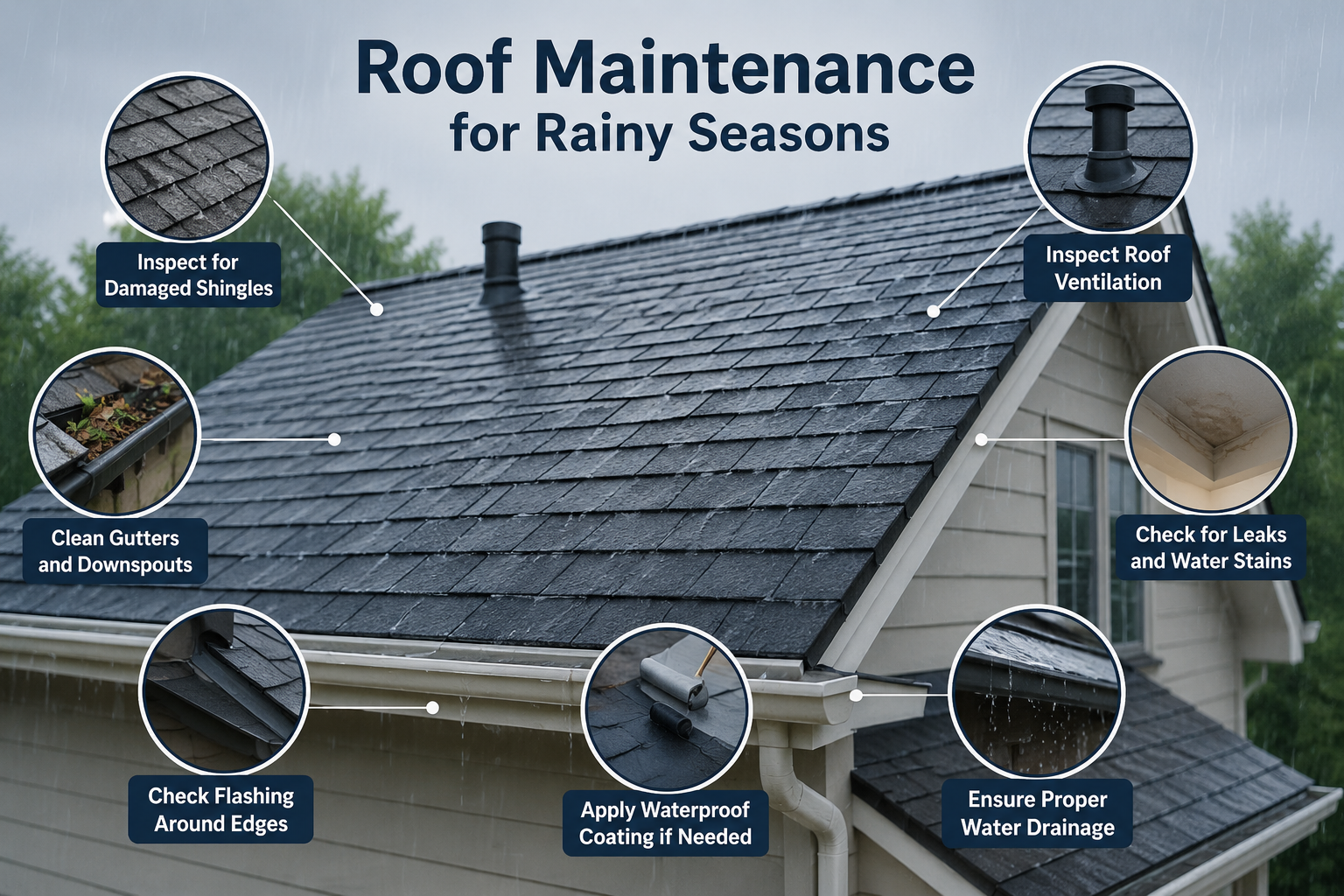
Complete Roof Maintenance Checklist for the Rainy Season
Inspect the Roof Surface
Begin every rainy season preparation with a comprehensive visual inspection of the entire roof surface. Use binoculars from the ground or from a second-story window to assess shingle condition across all slopes.
Look for:
- Cracked, curled, cupped, or blistering shingles
- Missing shingles or bare spots where shingles have shifted
- Dark streaking indicating algae growth
- Moss patches, particularly on shaded north-facing slopes
- Areas where shingles appear flattened or granule loss is visible
- Discoloration patterns suggesting past water infiltration
Never walk on a roof for inspection purposes without proper safety equipment and experience. Binoculars provide adequate information for most surface assessments.
Replace Damaged or Missing Shingles
Any shingle identified during inspection as cracked, curled, lifting, or missing must be addressed before rain season begins. Individual shingle replacement is a manageable repair for experienced DIYers on accessible roof sections with a low to moderate pitch.
For replacement, match the shingle type and weight class as closely as possible to the existing material. Mismatched shingles not only look inconsistent but may not integrate properly with the existing roofing system’s weather-shedding design.
On steep slopes, complex roof geometries, or areas near roof edges, hire a licensed roofing contractor. The repair cost is minimal compared to the water damage a failed shingle causes over a full wet season.
Check Roof Flashing
Inspect all flashing locations carefully. These include:
- Chimney base on all four sides
- Skylight perimeter
- All plumbing vent pipe boots
- Roof-to-wall transitions on dormers and additions
- Valley flashing along all roof valleys
- Drip edge along eaves and rakes
Look for lifted edges, visible gaps, rust, or cracked sealant at flashing joints. Apply roofing sealant to minor gaps and cracks. Replace sections of flashing showing significant corrosion or physical damage.
Flashing repairs are among the most impactful investments in rainy season preparation because failed flashing is the leading cause of interior roof leaks in residential construction.
Inspect Roof Valleys
Roof valleys carry more concentrated water flow than any other section of the roof. They are where two slopes meet and where water from both sides converges before flowing to the gutters.
Valley flashing should be fully intact with no exposed nail heads, lifted edges, or cracks in the metal. Debris accumulates quickly in valleys and can back up water during heavy rain. Clear any leaves, twigs, or sediment from valley sections before rain season.
Clean Gutters and Downspouts
Gutter cleaning is the single most important drainage task before any rainy period. Gutters should be completely clear of debris, properly sloped toward downspouts, and firmly attached to the fascia without sagging sections.
For a complete step-by-step approach to this task, including safety guidance and inspection tips, the article on How to Clean Gutters Safely covers everything you need to do this job correctly and safely.
After cleaning gutters, flush them with a garden hose to confirm water flows smoothly to downspouts and exits at ground level away from the foundation. Check every downspout for partial blockages that reduce flow even when the gutter channel appears clear.
Trim Overhanging Tree Branches
Tree branches overhanging the roof contribute to roofing problems in multiple ways. They deposit leaves and organic debris that clog gutters and retain moisture against shingles. They provide a pathway for squirrels and other rodents to access the roof. In storms, they can break and cause direct physical damage.
Trim branches back to at least ten feet from the roof surface if possible. For large limbs close to the roof, hire a certified arborist who can remove them safely without damaging the roof in the process.
Remove Moss and Algae
Address existing moss and algae growth before the rainy season begins. Moss can be physically removed using a soft-bristle brush working downslope to avoid lifting shingles. Never pressure wash roof shingles. High-pressure water forces water under shingles, strips granules, and voids most shingle warranties.
Apply a commercially available zinc- or copper-based roof treatment after removal to inhibit regrowth through the wet season. Installing zinc or copper strip flashing near the ridge is a long-term solution that releases trace metals in rainfall, flowing down the roof and preventing biological growth.
Check the Attic for Moisture
The attic is your early warning system for roof problems. Water that enters through the roof surface often appears in the attic long before it reaches interior ceilings.
Inspect the attic with a good flashlight, looking for:
- Water stains on rafters or roof decking
- Wet or compressed insulation
- Mold or mildew on wood surfaces
- Daylight visible through the roof deck
- Frost accumulation on decking in colder climates indicating condensation from inadequate ventilation
Check attic ventilation to confirm intake vents at the eaves and exhaust vents at the ridge are clear and unobstructed. Proper attic ventilation prevents moisture buildup and reduces the risk of condensation-related damage during cold rainy periods.
Inspect Ceilings for Water Stains
Walk every room in the home and look at every ceiling surface carefully. Water stains appear as yellowish or brownish rings or patches. They are often dry by the time you find them but indicate past water infiltration that may recur under rainy season conditions.
Pay particular attention to ceilings directly below the roof and near exterior walls. Stains near light fixtures or electrical boxes in the ceiling require immediate professional attention because water near electrical components is a serious safety hazard.
Seal Roof Penetrations
Every pipe, vent, fan exhaust, and cable that penetrates the roof surface is a potential entry point for water if its seal deteriorates. Inspect the rubber boots around plumbing vent pipes for cracking, which is extremely common as rubber ages under UV exposure.
Cracked vent pipe boots are one of the leading causes of residential roof leaks and one of the least expensive to address before they fail. A replacement rubber boot costs under twenty dollars and installs in under an hour.
Apply roofing sealant around any other penetration where the seal appears cracked, separated, or deteriorated.
Check Skylights
Skylights combine glass, framing, and roofing materials in a way that creates multiple potential leak points. Inspect the flashing around every skylight perimeter and the seal between the skylight frame and the glass unit.
Look for cracks in the glazing, deteriorated weatherstripping inside the skylight frame, and any evidence of water staining on the ceiling or walls below the unit. Reseal any gaps in the perimeter flashing with compatible roofing sealant.
Inspect Chimney Flashing
The chimney is one of the most common roof leak locations on homes with fireplaces. It requires flashing on all four sides and typically includes a base flashing layer overlapped by step flashing on the sides and a cap or counter flashing anchored into the chimney masonry.
Check mortar joints where counter flashing is embedded into the masonry. Deteriorated mortar allows water to enter behind the flashing, bypassing all the waterproofing below. Have a masonry contractor repoint any failing chimney mortar joints before the rainy season if the chimney has not been serviced recently.
Examine Soffits and Fascia
Soffits and fascia boards are at the intersection of the roof and the exterior wall system. Damaged fascia allows water to infiltrate the roof structure at the eave line, which is a particularly damaging and difficult location to repair once deterioration is advanced.
Inspect fascia boards for soft spots, peeling paint, and areas where gutters have pulled away from the board. Press on soft areas with a screwdriver. Boards that compress easily are rotting and need replacement before attaching new or repositioned gutters.
Check soffits for holes, staining, or paint failure that indicates moisture infiltration from above.
Test Roof Drainage
After completing all cleaning and minor repairs, run a garden hose on the roof surface and watch how water flows. Confirm it moves efficiently through valleys, into gutters, through downspouts, and away from the foundation at grade.
Any area where water hesitates, pools, or backs up needs further investigation. Proper drainage from roof surface to foundation perimeter is the complete system that protects your home during sustained rainfall.
Inspect Flat Roofs
Flat and low-slope roofing systems require additional attention before rainy season because they rely on sealed membrane surfaces rather than shedding water through pitch. Inspect the membrane for blistering, cracking, seam separation, and punctures.
Check all drains for debris accumulation and confirm they are clear and flowing freely. A blocked drain on a flat roof creates ponding water that dramatically increases leak risk and structural load. Apply compatible sealant to any visible membrane cracks or compromised seam areas.
Schedule a Professional Roof Inspection
For any roof that has not been professionally inspected in the last two to three years, scheduling a professional inspection before rainy season is the highest-value single action a homeowner can take.
A licensed roofing inspector carries equipment and training that allows them to identify issues invisible to a homeowner: compromised roof decking under intact shingles, subtle flashing failures, early-stage membrane deterioration, and ventilation problems that accelerate moisture damage.
Professional inspections typically cost between $150 and $350 for a residential roof and should be considered essential maintenance rather than an optional expense. This is also a task worth incorporating into your DIY Home Inspection Checklist process as a professional complement to your own seasonal assessments.
Signs Your Roof Needs Immediate Attention
Some conditions cannot wait for a scheduled maintenance window. If you observe any of the following, contact a roofing professional promptly.
- Active interior dripping during rainfall
- Sagging ceiling sections anywhere in the home
- Visible daylight through the roof deck from inside the attic
- Extensive missing shingles across multiple areas of the roof
- Roof decking that appears soft or spongy when walked upon by a professional
- Severe granule loss leaving bare fiberglass mat visible on shingles
- Large sections of separated or lifted flashing
- Water stains appearing on multiple ceilings simultaneously
- Any electrical fixture showing moisture or producing unusual behavior after rainfall
These conditions indicate active or imminent system failure and require professional evaluation and repair before the next rainfall event.
DIY Roof Maintenance vs Hiring a Professional
| Task | DIY Appropriate | Professional Recommended | Notes |
|---|---|---|---|
| Visual roof inspection from ground | Yes | Optional | Binoculars adequate for surface assessment |
| Gutter cleaning (single story) | Yes | Optional | Requires proper ladder safety |
| Gutter cleaning (two story) | Optional | Recommended | Significantly higher fall risk |
| Individual shingle replacement (low slope) | Experienced DIY | Recommended for most | Match shingle type carefully |
| Roof flashing repair (minor sealant) | Yes | Optional | Larger repairs need professional |
| Flashing replacement | No | Yes | Requires proper installation technique |
| Moss and algae removal | Yes (soft brush only) | Optional | Never use pressure washer |
| Vent pipe boot replacement | Experienced DIY | Optional | Manageable with guidance |
| Chimney flashing repair | No | Yes | Complex multi-layer system |
| Flat roof membrane repair | No | Yes | Requires material compatibility knowledge |
| Professional roof inspection | N/A | Yes (every 2-3 years) | Detects issues invisible to homeowners |
| Emergency leak containment | Yes (tarping) | Yes (repair) | Temporary measure only |
| Complete roof replacement | No | Yes | Major structural project |
Essential Roof Maintenance Tools
| Tool | Purpose | Recommended Use | Estimated Cost |
|---|---|---|---|
| Binoculars | Ground-level roof surface inspection | Seasonal inspection | $20 – $100 |
| Extension Ladder | Gutter access and eave inspection | Seasonally | $80 – $300+ |
| Ladder Stabilizer | Safe ladder placement against fascia | Every use | $30 – $80 |
| Flashlight or Headlamp | Attic and crawl space inspection | Year-round | $15 – $60 |
| Roofing Sealant | Sealing minor flashing gaps and penetrations | Pre-rain season | $8 – $25 per tube |
| Caulking Gun | Applying roofing sealant and caulk | As needed | $10 – $30 |
| Gutter Scoop | Removing packed debris from gutters | Seasonally | $5 – $15 |
| Garden Hose and Nozzle | Flushing gutters and testing drainage | After cleaning | $20 – $60 |
| Soft Bristle Brush | Moss and debris removal from shingles | As needed | $10 – $30 |
| Moisture Meter | Detecting hidden moisture in attic materials | Seasonally | $20 – $80 |
| Safety Harness | Fall protection when roof access required | Whenever on roof | $50 – $200 |
| Roof Inspection App | Documenting and photographing findings | Every inspection | Free – $30 |
| Rubber Gloves | Hand protection during cleaning | Every use | $5 – $20 |
| Zinc Roof Treatment | Inhibiting moss and algae regrowth | Annually | $20 – $60 |
Roof Maintenance Schedule
| Task | Spring | Summer | Pre-Rain (Fall) | Winter |
|---|---|---|---|---|
| Visual roof inspection | Required | After storms | Required | Visual only |
| Gutter cleaning | Required | After storms | Required (critical) | If accessible |
| Flashing inspection | Required | Optional | Required | Visual only |
| Attic moisture check | Required | Optional | Required | Required |
| Moss and algae treatment | Required | Optional | Required | Avoid |
| Shingle replacement | Required | As needed | Required | Avoid |
| Skylight inspection | Required | Optional | Required | Visual only |
| Chimney flashing check | Required | Optional | Required | Visual only |
| Soffit and fascia check | Required | Optional | Required | Visual only |
| Vent pipe boot inspection | Required | Optional | Required | Visual only |
| Tree branch trimming | Required | Optional | Required | Optional |
| Flat roof drainage check | Required | Monthly | Required (critical) | Monthly |
| Professional inspection | Every 2-3 years | As needed | Recommended | As needed |
| Roof sealant application | Required | Optional | Required | Avoid |
Estimated Roof Maintenance Costs
| Service or Repair | DIY Cost | Professional Cost | Notes |
|---|---|---|---|
| Visual inspection | $0 | $150 – $350 | Professional recommended every 2-3 years |
| Gutter cleaning | $0 – $50 | $100 – $300 | Twice yearly |
| Individual shingle replacement | $20 – $60 | $150 – $400 | Per small area |
| Flashing sealant repair | $10 – $30 | $100 – $300 | Professional for replacement |
| Vent pipe boot replacement | $15 – $40 | $100 – $250 | Simple repair with high impact |
| Moss treatment and removal | $20 – $60 | $200 – $500 | Depends on roof size |
| Chimney flashing repair | N/A (DIY not recommended) | $300 – $800 | Complex multi-layer system |
| Skylight reseal | $15 – $40 | $150 – $400 | Depends on skylight size |
| Flat roof membrane repair | N/A (DIY not recommended) | $300 – $1,000+ | Depends on damage extent |
| Emergency tarping | $30 – $80 | $200 – $500 | Temporary measure only |
| Full roof replacement | N/A | $8,000 – $25,000+ | Depends on size and material |
| Annual maintenance program | $50 – $200 (tools/supplies) | $300 – $600/year | Professional service plan |
Common Roof Maintenance Mistakes
Even well-intentioned homeowners fall into patterns that undermine their roof maintenance efforts or create new problems.
Pressure washing shingles. This is one of the most damaging things a homeowner can do to an asphalt shingle roof. High-pressure water strips protective granules, forces water under shingles, and voids manufacturer warranties. Always use low pressure or no pressure for roof cleaning.
Inspecting only from inside. Many homeowners check the attic for stains and believe that is sufficient. An attic check reveals evidence of past problems but misses active vulnerabilities on the roof surface that have not yet leaked into the structure.
Ignoring minor flashing issues. A small gap in flashing seems insignificant until a three-day rainstorm drives water continuously through that gap. Minor flashing repairs are inexpensive and take minutes to perform. The water damage from delaying them can cost thousands.
Cleaning gutters without checking downspouts. Perfectly clean gutter channels are ineffective if the downspout has a partial blockage that restricts flow. Always flush downspouts separately after cleaning gutters to confirm unrestricted drainage.
Walking on the roof unnecessarily. Each footstep on an asphalt shingle roof risks breaking the seal between shingles, cracking brittle winter shingles, or damaging flat roofing membranes. Limit roof surface access to when it is absolutely necessary and use proper footwear and safety equipment when you do.
Skipping the attic after a storm. Post-storm attic checks catch active infiltration before it causes extensive damage. Many homeowners go years without entering their attic and discover extensive mold and decking rot that developed invisibly after storm damage went undetected.
Money-Saving Roof Maintenance Tips
Smart maintenance habits keep costs down without compromising the protection your roof provides.
- Clean gutters yourself on single-story homes using proper ladder safety to eliminate the twice-yearly service cost
- Address minor sealant failures around flashings and penetrations immediately. A tube of roofing sealant costs under twenty dollars. The water damage from ignoring a small gap can cost tens of thousands
- Install zinc or copper ridge strips once as a long-term moss and algae prevention solution rather than paying for repeated treatment services
- Schedule professional roof inspections during off-peak months when contractors are more available and sometimes offer better rates
- Keep a basic roof maintenance supply kit on hand: a tube of roofing sealant, replacement rubber boots for vent pipes, and a caulking gun eliminate service calls for minor repairs
- Photograph your roof from the ground each season to build a visual record that makes changes easier to identify over time
- Address tree trimming proactively every few years rather than paying for emergency removal after storm damage
Rainy Season Home Safety Tips
Roof maintenance is one component of broader rainy season home safety. A few additional steps protect your home and family during wet weather.
- Test smoke and carbon monoxide detectors before the rain season begins. For proper testing procedures, see How to Test Smoke Detectors
- Inspect basement sump pump operation before the first heavy rain of the season
- Check that all exterior GFCI outlets are functioning and have proper weatherproof covers
- Confirm your home’s grading directs rainwater away from the foundation on all sides
- Know the location of your main water shutoff valve in case a roof leak reaches plumbing components
- Keep emergency contact numbers for your preferred roofing contractor accessible so you can respond immediately to active storm damage
- Maintain adequate homeowner insurance coverage that includes roof damage from storm events
For a comprehensive view of home preparation tasks that complement your roof maintenance efforts,
the Fall Home Maintenance Checklist and Home Maintenance Checklist by Month provide complete seasonal frameworks that keep your entire home protected as the rainy season arrives.
Expert Recommendations
After working with roofs across a wide range of climates, construction types, and maintenance histories, certain recommendations consistently produce the best outcomes for homeowners.
Inspect twice, repair once. The most common and costly pattern in residential roofing is incomplete inspection followed by incomplete repair. Take the time to identify every vulnerability before the rain season begins. Addressing five small issues in one preparation session is dramatically more efficient than making five emergency calls during wet weather.
Treat the roof as a system, not a surface. A roof is not just shingles. It is shingles, underlayment, decking, flashing, ventilation, gutters, and downspouts working together. A weakness in any one component affects the entire system’s performance. Your maintenance assessment must cover every element.
Budget for professional inspection every two to three years. DIY monitoring is valuable and important. But a licensed inspector sees things a homeowner cannot. Thermal imaging can reveal moisture trapped in decking beneath intact shingles. Professional eyes can assess structural movement in the roof framing that would be invisible from the ground. This investment pays for itself repeatedly in early problem detection.
Document everything. Photograph your roof from the ground each season. Take attic photos during inspections. Keep records of every repair with dates and materials used. This documentation supports insurance claims, informs contractors, and creates the baseline you need to detect changes over time.
Do not delay minor repairs. In roofing, the word minor is always conditional on timing. A minor issue addressed before rain season remains minor. The same issue discovered during week two of sustained rainfall is no longer minor. It is an emergency with interior damage compounding every hour.
Connecting your roof maintenance program to a broader home maintenance schedule ensures it gets done consistently.
The Ultimate Home Maintenance Checklist for Every Season and the Annual Home Maintenance Checklist both provide the comprehensive frameworks that keep roof care integrated with whole-home maintenance rather than treated as an afterthought.
Frequently Asked Questions
How often should I inspect my roof before the rainy season?
A thorough pre-rainy-season inspection should happen once each year, typically four to six weeks before your region’s primary wet season begins. This timing gives you adequate opportunity to schedule professional repairs before contractor demand peaks. In addition to this annual pre-rain inspection, perform a quick visual check from the ground after every major storm event throughout the year. Significant wind, hail, or debris events can cause immediate shingle or flashing damage that should not wait for the annual inspection cycle. The combination of scheduled inspection and post-storm monitoring gives you comprehensive coverage.
What is the most common cause of roof leaks during the rainy season?
Failed flashing is the most common cause of interior roof leaks during sustained rainfall periods. Flashing fails in multiple ways: corrosion of older galvanized metal, sealant cracking at joints due to thermal cycling, improper installation that was never watertight, and physical damage from debris impact or foot traffic. The areas most frequently affected are chimney base flashing, skylight perimeters, and vent pipe boots. These three locations account for the majority of leak calls roofing contractors respond to during rain season. Addressing flashing integrity during pre-season preparation prevents the majority of rainy season leak events.
Can I repair my roof myself before the rainy season?
Some roof maintenance and minor repair tasks are within DIY capability for homeowners with basic skills, the right safety equipment, and comfort working at heights. Cleaning gutters, applying sealant to minor flashing gaps, replacing cracked vent pipe boots, removing moss with a soft brush, and clearing roof valleys of debris are all manageable DIY tasks on accessible roof sections. More complex tasks including flashing replacement, chimney repairs, flat roof membrane work, and any repairs on steep or complex roof geometry should be handled by a licensed roofing contractor. Safety must always be the primary consideration in any roof-level decision.
How do I find a roof leak if there are no obvious ceiling stains?
Detecting a leak without interior staining requires a systematic approach. Start in the attic with a bright flashlight during daylight and look for any trace of daylight visible through the roof deck. Then use a moisture meter on attic wood surfaces to check for elevated moisture content that has not yet appeared as visible staining. After a rainfall, return to the attic within 24 hours and look for active dripping or wet spots on insulation and decking. If you cannot identify the source after these steps, a professional inspector with thermal imaging equipment can detect moisture trapped in the roof assembly without visual indicators.
How long does a properly maintained roof last?
Roof lifespan varies significantly by material and maintenance quality. Asphalt shingles have a rated lifespan of 20 to 30 years but commonly last 30 to 40 years on well-maintained roofs in moderate climates. Metal roofing systems routinely last 40 to 70 years with appropriate maintenance. Clay and concrete tile roofing can exceed 50 years under the right conditions. The common thread across all materials is maintenance consistency. A roof that receives biannual inspection, prompt minor repairs, and clean gutters will outperform its rated lifespan. A roof that receives no maintenance will fall short of it. The difference in outcomes between maintained and neglected roofs of the same age and material is remarkable.
Is roof waterproofing worth it for rainy climates?
Roof waterproofing treatments, including liquid-applied membranes and penetrating sealants, can provide valuable added protection in climates with very high annual rainfall, particularly on low-slope sections, flat roof areas, and around high-risk flashing locations. For standard-pitch asphalt shingle roofs in average climates, proper installation and regular maintenance provide adequate protection without additional waterproofing products. In tropical or very wet coastal climates where annual rainfall is extreme, discussing waterproofing options with a qualified roofing contractor who knows your specific climate and construction type is worthwhile. The value depends heavily on your location, roof design, and existing material condition.
What should I do if my roof leaks during heavy rain?
If your roof leaks during active rainfall, focus first on protecting interior contents and containing the water. Place buckets or containers under drips. Move furniture and valuables away from affected areas. If the ceiling is bulging with trapped water, carefully puncture the lowest point with a screwdriver to allow controlled release rather than collapse of the entire saturated section. Document everything with photographs for insurance purposes. After the storm, have a roofing contractor perform an emergency inspection as soon as conditions allow. Do not attempt to repair a wet roof during active rainfall. Temporary tarping by a professional can protect the home until permanent repair is possible.
How do gutters affect roof performance during the rainy season?
Gutters are integral to the roof drainage system’s function. A roof without gutters, or with inadequate or clogged gutters, deposits water directly against the foundation and allows it to infiltrate behind siding at the base of the wall. But gutters that are blocked during heavy rainfall can cause damage to the roof itself. Backed-up water at the eave line can be forced up under the first course of shingles by capillary action and wind-driven pressure, causing infiltration beneath the roofing surface. This type of damage develops where it is nearly impossible to detect and can cause extensive decking rot before it becomes visible on interior ceilings.
How does attic ventilation relate to roof performance in the rainy season?
Attic ventilation affects roof performance in the rainy season primarily through moisture management. During cold rainy periods, warm moist air from the living space migrates upward into the attic. Without adequate ventilation to exhaust this moisture, it condenses on the cold underside of the roof decking. This condensation causes the same type of damage as a roof leak: wet decking, mold growth, insulation damage, and eventually structural rot. Proper ventilation requires a balanced system with intake at the soffit eaves and exhaust at or near the ridge. Confirm that both intake and exhaust vents are clear and unobstructed during your pre-rain inspection to prevent moisture from accumulating during the wet season.
When is the best time of year to schedule a professional roof inspection?
The ideal time for a professional roof inspection is four to eight weeks before your region’s primary rainy season begins. This window gives you enough lead time to schedule repairs with a reputable contractor while the busy pre-season schedule still has availability, and to complete repairs before the first significant rainfall event. Spring is also an excellent time for a professional inspection in many regions, following winter weather stress and before summer heat makes roof surfaces uncomfortably hot for inspection work. If your roof has not been professionally inspected in the past two to three years, schedule one regardless of what time of year it currently is.
Conclusion
Rain is not your roof’s enemy. Neglect is.
A roof that receives consistent attention before the wet season arrives is ready to perform exactly as designed: quietly, reliably, and invisibly moving water off your home and away from its foundation without a single problem crossing into your living space.
The maintenance steps in this guide are not complicated. They are systematic. They follow the logical flow of water from where it lands on the roof surface to where it should exit at the foundation perimeter. Every task in the checklist serves that single purpose: keeping water moving in the right direction, through the right pathways, and away from your home.
The investment required for thorough pre-rain roof maintenance is small compared to what a single undetected leak can cost over the course of a wet season. Most of the prevention work costs nothing beyond time and attention. The repairs it prevents can cost thousands.
Start your inspection four to six weeks before rain season arrives in your area. Work through the checklist methodically. Address what you find promptly. Schedule professional inspection for anything beyond straightforward DIY repair.
Your roof is your home’s first and most critical line of defense against weather. Give it the maintenance it needs, and it will give you the protection and peace of mind that every homeowner deserves.