
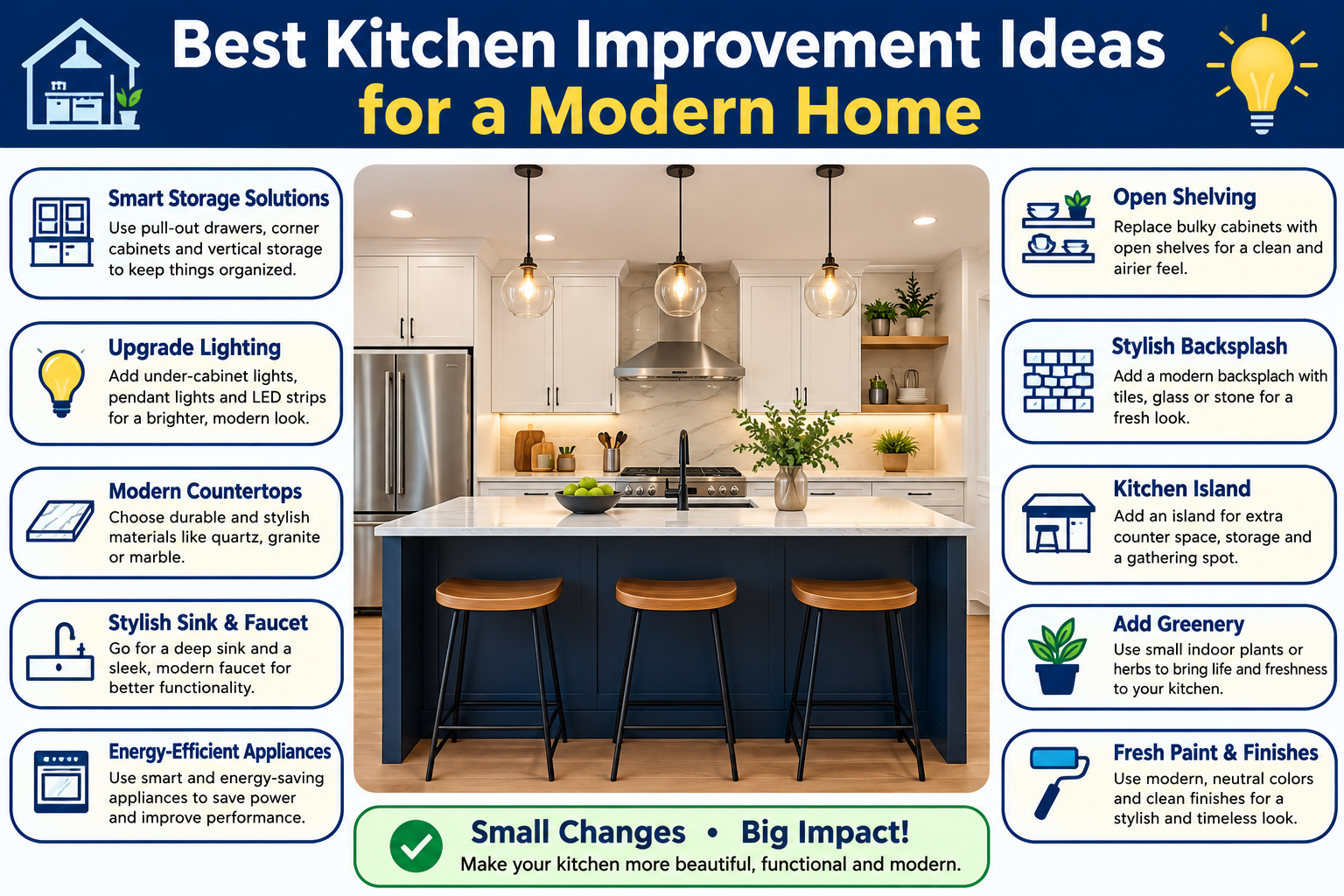
Best Kitchen Improvement Ideas for a Modern Home

Introduction
A modern kitchen is not defined by what it cost. It is defined by how well it functions, how cohesive it looks, and how comfortable it is to spend time in. Some of the most appealing contemporary kitchens are in homes where the cabinetry has not been replaced in years but the lighting, hardware, color, and organization have been approached with genuine intention. Others achieve a current, considered look through a few targeted improvements rather than a complete overhaul.
The best kitchen improvement ideas for a modern home start with understanding what the kitchen already does well and where its real weaknesses are. Color, lighting, storage, materials, layout, hardware, and organization all contribute to how a kitchen feels, and improving any combination of these areas creates a more contemporary and functional result. The specific changes worth prioritizing depend entirely on the existing kitchen, the available space, the household’s daily routines, and the budget.
This guide covers practical kitchen improvements across a range of scales and investments, with the consistent aim of helping ordinary homeowners make genuinely useful changes rather than unnecessary ones.
1. Start With a Practical Kitchen Assessment
Before spending anything or committing to any change, an honest assessment of the existing kitchen identifies where the real problems are and which elements are working well enough to keep. This is the step most homeowners skip and most often regret skipping.
Walk through the kitchen at different times of day and work through a set of straightforward questions. What feels dated or uncomfortable? Is it the cabinet color, the lighting quality, the countertop condition, or something less tangible like the way the space feels when it is in use? Where does clutter consistently build up, and why? Is there nowhere logical to put certain things, or is the available storage not organized effectively?
Is the lighting adequate? Many kitchens have a single overhead fixture providing all the illumination, which creates shadows on work surfaces and makes the room feel flat regardless of the time of day. Is there sufficient task lighting where food preparation actually happens?
Which features are genuinely worth keeping? A kitchen with well-constructed cabinet boxes in good structural condition does not need cabinet replacement if the surface finish and hardware can be addressed for less. A kitchen with a layout that already works logically does not need reconfiguration.
The answers to these questions shape a prioritized list of improvements that address real problems rather than a renovation driven by a general sense that something should change. Spending on improvements that solve the biggest daily frustrations first produces better outcomes than addressing visible details while leaving fundamental issues unresolved.
2. Refresh the Kitchen Color Scheme
The color palette of a kitchen, across walls, cabinets, countertops, backsplash, and flooring, has more influence on how modern and cohesive the space feels than almost any other element. A kitchen where these colors work together as a considered system reads as intentional and current. One where they have been chosen at different times without reference to each other reads as disjointed regardless of the quality of individual elements.
Contemporary kitchen palettes in 2024 and 2025 have moved noticeably away from the all-white, all-gray combinations that dominated for much of the previous decade. Warm neutrals, soft off-whites with cream undertones, earthy shades, sage and olive green, warm blues, and natural wood tones are all prominent in current kitchen design. These are colors that feel settled and liveable rather than clinical.
The practical approach is to start with the fixed elements that are not being changed. If the flooring has a warm tone, the walls and cabinetry should coordinate with that warmth rather than pull against it. If the countertops are a cool gray stone, the overall palette can accommodate cooler tones more successfully.
Cabinet color is often the most significant decision because cabinets occupy the largest surface area. Where cabinetry is being repainted or replaced, the color choice sets the character of the whole room. A warm white or soft off-white kitchen feels clean without the sterility of a bright cool white. A kitchen with lower cabinets in a deeper tone, sage, navy, or warm forest green, and upper cabinets in a lighter complementary shade creates visual interest through contrast without the all-over intensity of a single strong color throughout.
For a broader understanding of how color selection works across all elements of a home, including how to build a cohesive palette that suits existing finishes and lighting conditions, our article on how to choose the right colors for your home covers the practical principles in useful detail.
3. Upgrade Kitchen Lighting
Kitchen lighting is one of the most impactful improvements available and one that is consistently underinvested in relative to its influence on how the space looks and functions. A kitchen with excellent cabinetry and adequate lighting will feel less comfortable than a more modest kitchen with genuinely good layered lighting.
Most kitchens suffer from the same basic lighting problem: a single ceiling fixture providing all the illumination. This creates a flat, evenly distributed light that produces shadows on every work surface directly beneath an overhead cabinet and provides no flexibility across different activities and times of day.
Layered kitchen lighting addresses this systematically. Ambient lighting provides the general background illumination for the room. Task lighting, directed specifically at the surfaces where food preparation and cooking happen, ensures that these areas are well lit without relying on overhead sources that cast shadows from above. Under-cabinet lighting is the most practical and immediately impactful task lighting addition in most kitchens. It illuminates the counter surface directly, makes cutting, reading recipes, and assessing cooking progress significantly easier, and adds a quality to the kitchen that is visible both practically and visually.
Pendant lights above a kitchen island or peninsula, or above a kitchen dining area, serve a dual purpose. They provide focused illumination for those areas and contribute a decorative and design quality that a recessed ceiling fixture cannot. The fixture style should suit the overall kitchen character. A simple industrial-influenced metal pendant works well in a contemporary kitchen. A more textured or natural material pendant suits a warmer, more organic aesthetic.
Natural light deserves to be protected and maximized. Window treatments that can be moved fully clear of the glass during daytime, a window above the sink if the kitchen’s layout allows it, and furniture placement that does not obstruct light from moving through the room all contribute to a kitchen that feels brighter and more pleasant to work in.
4. Improve Cabinet Appearance
Cabinets occupy more visual surface area in a kitchen than any other element, which means their condition and finish disproportionately affects the overall impression of the space. This also means that improving their appearance, even without replacing them, can significantly shift the kitchen’s character.
Updating cabinet hardware is the most immediate and affordable cabinet improvement available. The handles and knobs on a kitchen’s cabinets are touched every time the storage is accessed, and their style and finish communicate the kitchen’s overall aesthetic. Replacing dated hardware with something that better suits a contemporary look costs relatively little and takes an afternoon.
Where the cabinet finish itself is the problem, repainting is worth considering where the cabinet boxes are structurally sound and the doors are in reasonable condition. A well-prepared and properly painted cabinet can look significantly more current than the same cabinet in its original dated finish. This is a project where the preparation quality determines the result. Cabinet surfaces need thorough cleaning, appropriate preparation, and suitable paint for the result to hold well over time.
Internal cabinet organization is worth addressing alongside the external appearance. Cabinets that look well from the outside but are disorganized internally become a daily frustration. Drawer inserts, pull-out organizers, door-mounted storage, and other internal organization additions make the storage genuinely more functional and often reveal usable capacity that was being wasted through poor organization.
The question of open versus closed storage within a kitchen is worth considering carefully. Open shelving can create a more relaxed, accessible quality and contributes to a less fitted, more characterful aesthetic. It also requires ongoing organization to maintain an appearance that improves rather than detracts from the kitchen. Closed storage is more forgiving of normal household reality. A combination of mostly closed storage with one or two open display shelves often provides the visual benefit of open shelving while limiting the maintenance demand.
5. Choose Modern Cabinet Hardware
Cabinet hardware is a detail that deserves more consideration than it typically receives, because it is one of the first things that communicates whether a kitchen feels current or dated. The handles and knobs are seen and touched every day, and their proportion, finish, and style all contribute to the kitchen’s overall character.
Contemporary hardware styles tend toward cleaner, simpler profiles. Long bar pulls in consistent lengths, simple cylindrical knobs, and minimal cup pulls all suit contemporary kitchen aesthetics. Ornate, highly decorative hardware with complex profiles and excessive detail reads as traditional in a context that does not call for it.
Finish choices have expanded considerably. Matte black is a strong contemporary option that works particularly well against lighter cabinet colors. Brushed nickel and satin brass are both current and work with a range of cabinet colors. Warm brass tones suit the warmer, more organic kitchen aesthetic that has become more prominent recently. Polished chrome is less common in kitchen hardware than it once was, though it still suits some very contemporary spaces.
Proportion relative to the cabinet size matters. A long bar pull that is appropriately sized for a wide drawer looks intentional and well-considered. The same pull on a small cabinet door looks out of scale. Matching the hardware size to the door or drawer size it is applied to produces a more polished overall result.
Consistency across the kitchen is important for cohesion. Mixing multiple hardware finishes in a single kitchen is possible when done with genuine intention, but it requires careful thought. Hardware that combines two finishes that genuinely complement each other can add interest. Hardware that mixes multiple finishes without a clear logic looks unsettled.
6. Improve Kitchen Storage
Kitchen storage that genuinely supports daily cooking and household use is the functional foundation of a kitchen that works well. Storage that looks adequate from the outside but frustrates daily use, because items cannot be easily found or accessed, is one of the most common and most resolvable kitchen problems.
The principle most worth applying is proximity. Everyday items should be stored as close to their point of use as possible. Knives and chopping boards near the food preparation area. Pots and pans near the hob or stove. Plates and glasses near where meals are plated or the dishwasher is unloaded. When frequently used items are stored far from where they are used, every cooking session involves unnecessary movement.
Countertop organization is directly connected to storage quality. A countertop covered with appliances and accumulated items is almost always an indication that the available cabinet and drawer storage is not being used effectively, or that there genuinely is not enough storage for the kitchen’s needs. Improving storage organization to accommodate items that currently live on the counter, and relocating infrequently used appliances to cabinet storage, restores the counter to a functional work surface.
Drawer inserts that organize utensils, spices, or other small items create order that makes daily use genuinely easier. Pull-out systems in base cabinets make items at the back of deep cabinets accessible without having to unload everything in front. Door-mounted storage on pantry or larder units uses space that is typically wasted.
Vertical storage within the kitchen, whether through tall cabinets, pantry units, or shelving that extends toward the ceiling, makes more efficient use of the available wall height. Items used infrequently occupy the upper levels. Everyday items occupy the most accessible positions.
7. Refresh the Countertops
Countertops are simultaneously one of the most heavily used surfaces in the home and one of the most visible elements of the kitchen. Their condition and appearance significantly affect how the kitchen reads overall, and their practical qualities affect every meal preparation session.
The considerations for countertop selection are genuinely multidimensional. Durability and maintenance requirements vary considerably between materials and should be matched to the household’s actual use habits. A material that requires regular sealing and careful treatment of acidic foods may be entirely appropriate for a household that is attentive to maintenance and another that suits perfectly a less intensive approach.
Appearance matters in the context of the whole kitchen, not in isolation. The countertop material and color needs to coordinate with the cabinet color, the backsplash, the flooring, and the overall palette. A countertop chosen because it looks striking as a sample may create a visual conflict with the surrounding elements when installed.
Quartz surfaces have become popular in contemporary kitchens partly because they combine a consistent, manufactured appearance with practical durability and relatively low maintenance requirements. Natural stone, including granite and marble, offers visual variation and character that manufactured surfaces cannot fully replicate, alongside specific maintenance and care considerations that are worth understanding before selecting.
Laminate and solid surface countertops have improved considerably in both their appearance and durability compared to earlier versions and can suit contemporary kitchens at a more accessible price point.
Where the existing countertop is structurally sound but visibly worn, stained beyond cleaning, or in a finish that is genuinely inconsistent with the direction of other kitchen improvements, replacement is worth considering as part of a broader update. Where the existing countertop is in reasonable condition, addressing other elements of the kitchen often produces a more meaningful overall improvement per unit of investment.
8. Update the Backsplash
The backsplash occupies the zone between countertop and upper cabinet across much of the kitchen’s perimeter and significantly affects the visual character of the space. It is also an area where personality and material interest can be introduced without the cost or commitment of a larger change.
A backsplash that coordinates with the countertop and cabinet colors without matching them exactly tends to produce the most cohesive result. A countertop in a warm stone tone and a backsplash in a related but distinct tile, perhaps a handmade ceramic with some variation in its glaze, creates a visual relationship that looks considered rather than matched. A backsplash that clashes significantly with the countertop creates a visual tension that is difficult to resolve through other means.
Simple, neutral backsplash tile is often underestimated as a design choice. A well-laid subway tile, a plain limestone-look tile, or a consistent small-format mosaic in a neutral tone provides a clean, versatile backdrop that suits the majority of kitchen color palettes and does not date as quickly as more distinctive pattern choices.
Textured and handmade tiles have become more prominent in contemporary kitchens as part of the broader shift toward warmer, more characterful interiors. A handmade tile with slight surface variation and a matte or satin glaze adds tactile quality and visual interest that standard smooth tile cannot provide. The material cost tends to be higher, but it is often applied over a smaller area than other kitchen surfaces, which makes the overall investment more contained.
Where the existing backsplash is in good condition but visually inconsistent with a refreshed overall palette, painting over ceramic tile is a low-cost option where the tile surface and grout are in genuinely good condition and the right preparation is applied. It is not a permanent solution but can extend the life of the existing installation while other improvements are made.
9. Create a More Functional Kitchen Layout
Kitchen functionality is largely determined by how well the existing layout supports everyday movement, cooking, and storage. Most kitchens benefit from layout analysis before any changes are made, because repositioning items and reorganizing storage often produces meaningful functional improvements without structural changes.
The relationship between the refrigerator, the sink, and the cooking area, often described as the work triangle, represents the most common movement pattern in kitchen use. When these three elements are positioned so that movement between them is clear and direct, everyday cooking is more efficient. When the route between them is interrupted by obstacles, poor storage placement, or excessive furniture, cooking is more effortful than it needs to be.
Counter space near the cooking area deserves particular attention. A clear surface directly beside the hob or stove where food can be plated and where ingredients can be prepared close to the cooking element makes cooking significantly more practical. Countertop space that is permanently occupied by appliances or accumulated items removes this practical working area.
For open-plan kitchens or kitchen-dining spaces, the relationship between the kitchen and the dining area matters for everyday use. Adequate space for comfortable movement between the cooking area and the dining area, without requiring guests or family members to vacate their seats every time food is served, improves the functional quality of both areas.
For homes where the kitchen is part of a broader open living arrangement, our article on how to create a more functional living space covers zone planning, furniture arrangement, and storage across connected living areas, which directly applies to kitchen-living layouts.
10. Add Natural Materials
A kitchen composed entirely of hard, manufactured surfaces can feel practical but somewhat cold. Natural materials introduce visual warmth, tactile quality, and organic character that manufactured alternatives do not fully replicate, and they are part of what distinguishes a kitchen that feels genuinely comfortable from one that simply functions adequately.
Wood is the natural material with the most significant warming effect in kitchen interiors. Open wooden shelves, a wooden butcher block section within the countertop, wooden bar stools, or simple wooden accessories on open shelving all introduce the material’s organic warmth. In a kitchen that is otherwise dominated by stone, ceramic, and painted surfaces, even modest wooden elements shift the overall feeling meaningfully.
Stone in its natural or engineered forms brings material variation and depth that is particularly valuable on surfaces that receive close daily inspection, countertops and backsplash areas especially. The natural variation in stone, the slight irregularity in color and pattern, gives these surfaces a quality that changes in different light conditions throughout the day.
Woven and ceramic materials in the kitchen, a rattan pendant light, a ceramic soap dispenser, a woven basket for storage, contribute smaller but cumulative natural warmth. These are the kinds of additions that are inexpensive individually but whose combined effect on the room’s character is noticeable.
Linen and cotton textiles, a good quality linen tea towel, a simple cotton runner, add softness and color in a space that is otherwise predominantly hard-surfaced. These are changed and washed regularly, which makes them a low-risk way of introducing color or seasonal variation.
11. Choose Appliances With the Overall Design in Mind
Kitchen appliances affect the overall design of the kitchen in two ways: through their visual presence as objects in the space, and through their practical performance in daily use. Both matter, though the practical performance consideration should almost always take precedence over the visual one.
Where existing appliances are functioning well and are not causing practical problems, replacing them solely for appearance is difficult to justify financially. The cost of major kitchen appliances is significant, and appliances that work adequately do not need to be replaced because the aesthetic has shifted around them. Simple visual coordination, ensuring that the fronts of built-in appliances are consistent and that freestanding appliances are positioned to read as part of the kitchen rather than placed haphazardly, achieves much of the visual goal without replacement.
Where appliances are genuinely failing, at the end of their useful life, or creating practical limitations, replacement is worth approaching as a design decision as well as a practical one. Appliance dimensions, the integration options available, the finish of the visible front surfaces, and the relationship to the overall kitchen palette are all worth considering alongside the functional specification.
Integrated appliances, where the appliance is housed behind a cabinet door that matches the surrounding cabinetry, produce the most visually seamless result and are a common feature of contemporary kitchen design. They are also typically among the more expensive options. Semi-integrated and freestanding appliances can work equally well in a kitchen when their placement and finish coordination has been considered.
12. Create a More Open and Uncluttered Look
A kitchen that functions at a high level of visual organization, where the counters are largely clear, the visible storage is consistent, and unnecessary items are contained, feels more spacious and more contemporary than the same kitchen with cluttered surfaces and competing visual elements.
The countertop is the most visible horizontal surface in the kitchen and the one that most directly affects how the space reads. Keeping only genuinely everyday-use items on the counter, and finding proper storage for everything else, is a practical change with a significant visual payoff. The toaster used once a week does not need a permanent countertop presence. The stand mixer used for baking on weekends can live in a deep base cabinet or pantry between uses.
Where open shelving is part of the kitchen design, the organization of those shelves matters considerably to whether they contribute positively to the overall look. Open shelves that are deliberately curated, a consistent set of ceramic bowls, a small plant, a row of related cookbooks, look attractive and intentional. Shelves that accumulate a mixture of unrelated items without organization look cluttered and create visual noise that works against the clean, contemporary impression the kitchen might otherwise achieve.
Coordinating the colors and finishes of visible items, the kettle and toaster in the same color family, or matching containers for everyday staples, reduces the visual complexity of the countertop and makes the kitchen feel more considered.
13. Add a Comfortable Dining or Seating Area
A kitchen with a comfortable seating or dining area becomes a more social and functional space than one dedicated purely to cooking. The character of the seating arrangement should match the available space and the household’s habits.
In kitchens with an island, counter seating with appropriate bar stools creates an informal dining and social area that suits everyday breakfast, working from home, and keeping company with whoever is cooking. The stool height needs to match the counter height, and the stools should be spaced so that there is comfortable room for each person. Stools with backs are generally more comfortable for extended sitting than backless versions, though they require slightly more clearance.
A kitchen with sufficient floor space for a small table and chairs creates a more formal dining option that is particularly useful for everyday meals in homes where the main dining room is reserved for larger occasions. The table and chairs should be scaled to the space. A table that crowds the kitchen reduces the working area and makes the kitchen feel congested. A table appropriate to the space improves both the visual balance of the room and the practical usability of the combined cooking and dining area.
Where neither an island nor a separate table is practical in the available space, a fold-down wall-mounted table or a compact peninsula that extends the counter into a casual seating position can provide the social benefit of kitchen seating without permanently occupying floor space.
14. Bring More Personality Into the Kitchen
A contemporary kitchen does not need to be impersonal. The warmth and character that distinguish a kitchen that feels genuinely good to spend time in from one that is simply functional comes partly from the personal touches that reflect the household’s character and interests.
Plants on a kitchen windowsill or open shelf, appropriately chosen for the available light, add color and life that no decorative object quite replicates. Herbs in particular have both a decorative and a practical function in a kitchen that makes them a genuinely useful addition.
Artwork in the kitchen, where the space allows it and the surface conditions are appropriate, extends the design approach of the rest of the home into a space that is often treated as purely functional territory. A simple framed print, a handmade ceramic piece displayed on a shelf, or a collection of items with personal significance all contribute character without adding visual clutter when chosen and placed with some care.
Cookbooks, displayed on a shelf or accessible in an organized part of the counter, are both decorative and genuinely useful in a kitchen context. A small collection of books that are actually used, rather than an accumulation of impulse purchases, contributes to the organized personal character of the kitchen without creating the visual noise that a cluttered shelf creates.
Textiles, a coordinated set of tea towels, a simple apron hanging on a hook, add color and softness to the kitchen’s predominantly hard-surfaced environment in an accessible and easily changed way.
15. Make a Small Kitchen Feel More Modern
Small kitchens require more deliberate design thinking than larger ones because there is less margin for choices that do not work well. A small kitchen that feels cluttered, dark, or poorly organized is significantly more uncomfortable than a small kitchen that is well-considered in its color, lighting, storage, and organization.
Light colors on walls and cabinets reflect more of the available light and create a sense of visual openness that darker colors do not. This does not mean every small kitchen should be white. A warm cream, a pale sage, or a light neutral gray can all work effectively. The consistent principle is avoiding colors that add visual weight to surfaces in a space where visual weight is already limited by the actual dimensions.
Maximizing natural light in a small kitchen has a disproportionate impact on how the space feels. Window treatments that can be fully cleared from the glass, furniture or appliances that do not block light from moving through the room, and clean windows all contribute to a kitchen that uses its available light effectively.
Vertical storage makes more efficient use of wall height than limiting storage to a conventional range of cabinet heights. Tall pantry units, shelving that extends toward the ceiling, and hooks or rails on backsplash walls all add storage capacity without increasing the kitchen’s floor footprint.
Reflective surfaces, a polished countertop, a glossy backsplash tile, or stainless steel elements, reflect light and create visual depth that matte surfaces do not. In a small kitchen where both light and visual depth are limited, reflective surfaces are a practical design tool rather than purely an aesthetic choice.
16. Modern Kitchen Improvements for Different Budgets
Low Budget
At a low budget, the most impactful improvements are those that address organization, hardware, and the visual presentation of what already exists.
Replacing cabinet hardware throughout the kitchen with something that better suits a contemporary look costs relatively little and makes a clear visual difference. Improving the internal organization of drawers and cabinets, using inserts, pull-out additions, and considered reorganization, makes the storage more functional and often reveals capacity that was being wasted. Improving the lighting by adding a simple under-cabinet LED strip, replacing a central ceiling fixture with something more appropriate, or simply switching to warmer-temperature bulbs throughout the kitchen addresses one of the most common kitchen problems at minimal cost.
Clearing countertops of items that do not need to be there permanently, and finding proper storage for those items, costs nothing and immediately improves how the kitchen reads.
Moderate Budget
At a moderate budget, improvements can extend to more significant lighting upgrades, including pendant lights above an island or a new ceiling fixture, a new backsplash where the existing one is genuinely inconsistent with the updated kitchen direction, and cabinet repainting where the existing finish is the primary visual problem.
Storage additions, pull-out systems in base cabinets, a pantry organization upgrade, or new shelving in a suitable location, address functional limitations at a moderate cost with a clear daily benefit.
Larger Budget
At a larger budget, cabinet replacement, major countertop upgrades, layout reconfiguration, and professional kitchen remodeling become options. These investments are worth considering when the existing kitchen has fundamental problems that cannot be resolved through surface improvements or when the household’s needs have genuinely outgrown what the existing layout can provide.
The principle that applies at any budget level is prioritizing functionality and long-term use over following trends. A kitchen that works well for the household using it every day, and that is designed around genuine use patterns rather than aspirational photographs, will continue to feel right long after any specific trend has moved on.
For a broader perspective on modernizing a home across multiple rooms, including practical advice on what to prioritize first, our article on how to make your home look more modern covers the principles that apply across the whole home.
17. Common Kitchen Improvement Mistakes to Avoid
Choosing style over functionality. A kitchen that looks impressive but does not support comfortable, practical cooking is a daily frustration. Every significant kitchen decision should pass a functionality test alongside an aesthetic one.
Poor lighting. Relying on a single overhead ceiling fixture for all kitchen illumination is the most consistent lighting mistake in residential kitchens. It creates shadows on work surfaces and provides no flexibility across different activities. Layered lighting that includes task lighting at work surfaces is not a luxury improvement in a kitchen. It is a basic functional requirement.
Too many competing finishes. Mixing multiple hardware finishes, countertop materials, and cabinet colors without a clear coordinating logic creates visual noise that makes even a high-quality kitchen feel unsettled. A coherent palette with limited, well-chosen material combinations reads more contemporary than a kitchen with many different finishes competing for attention.
Insufficient storage. A kitchen that does not have adequate storage for the household’s actual needs will always feel cluttered regardless of how good the other design decisions are. Storage needs should be addressed realistically rather than optimistically.
Oversized furniture. An island, a dining table, or bar stools that are too large for the available kitchen space make the kitchen harder to use rather than easier. Scale decisions should be made with accurate room measurements rather than based on what looks proportional in a showroom context.
Following trends too closely. Kitchen improvements involve significant cost and disruption, and the decisions made should serve the household’s needs for years. A kitchen designed primarily around a current trend may feel dated more quickly than one based on enduring functional and material principles.
Ignoring maintenance requirements. Choosing materials, finishes, or features without understanding their maintenance requirements is a common mistake that creates practical problems. A beautiful material that requires care and attention the household cannot realistically provide will look worse than a more modest material that suits the actual use conditions.
Replacing functional items unnecessarily. Appliances, cabinetry, and other expensive kitchen elements that are working well and in reasonable condition do not need to be replaced to improve the kitchen. Targeted improvements to what is genuinely problematic produces better outcomes than wholesale replacement.
Frequently Asked Questions
What is the easiest way to make a kitchen look more modern?
The easiest change with immediate visual impact is updating cabinet hardware throughout the kitchen. New handles and knobs in a style and finish that suits a contemporary aesthetic can shift the character of the kitchen noticeably without touching anything else. Improving the lighting, particularly by adding under-cabinet task lighting, is the second most impactful accessible change. Together, updated hardware and improved lighting address two of the most common reasons a kitchen feels dated or inadequate.
What kitchen improvements are worth the money?
Improvements that solve real functional problems and benefit daily use tend to be worth the investment regardless of their cost level. Better task lighting, improved storage organization, updated hardware, and a refreshed color scheme all improve how the kitchen works and feels every day. Larger investments in countertops or cabinetry are worth the cost when the existing elements are genuinely inadequate or in poor condition. Improvements made primarily to follow a trend or change an element that is already functioning well are harder to justify financially.
What colors make a kitchen look more modern?
Contemporary kitchen palettes have moved toward warmer, more organic color combinations. Warm neutrals, soft off-whites, earthy tones, muted greens and blues, and natural wood tones are all current directions that feel more settled and liveable than the cool grays and stark whites that dominated in recent years. The specific colors that work best depend on the existing fixed finishes, the natural light available, and the overall home palette. The goal is a cohesive combination across cabinets, walls, countertops, and backsplash rather than selecting individual elements without reference to the whole.
How can I update my kitchen without a full renovation?
Several targeted improvements can significantly change a kitchen’s appearance and functionality without full renovation. Updating cabinet hardware, repainting cabinet doors in a contemporary color, improving the lighting including adding under-cabinet task lighting, refreshing the backsplash, improving countertop organization, and introducing natural materials through accessories and textiles all contribute to a more modern and functional kitchen. The specific combination depends on where the existing kitchen’s biggest weaknesses are. Addressing those weaknesses specifically produces better results than making changes across the board.
What type of lighting is best for a modern kitchen?
A modern kitchen needs layered lighting rather than a single source. Ambient lighting provides general illumination for the room. Task lighting, particularly under-cabinet LED strips, illuminates the work surfaces where food is actually prepared. Pendant lights above an island or dining area add design character alongside focused illumination. Natural light should be maximized rather than blocked. Warm white light temperatures, typically in the 2700K to 3000K range, create a more welcoming kitchen atmosphere than cool white or daylight temperatures, though slightly cooler light in task lighting positions can improve visibility for detailed food preparation.
How can I make a small kitchen feel more spacious?
Light, coordinated colors on walls and cabinets reflect more of the available light and reduce visual weight. Maximizing natural light by keeping windows clear and unobstructed makes a significant difference in how a small kitchen reads. Vertical storage that uses wall height efficiently adds storage capacity without increasing the floor footprint. Keeping countertops clear of unnecessary items is particularly important in a small kitchen where every inch of work surface is valuable. Reflective surfaces, polished countertops or glossy tile backsplash, add visual depth through light reflection. Multifunctional furniture that serves more than one purpose reduces the number of separate pieces needed in a limited space.
Are modern kitchens better with open shelving?
Open shelving suits some kitchens and some households better than others. It can create a more relaxed, characterful aesthetic and makes everyday items accessible without opening cabinet doors. It also requires consistent organization and maintenance to look its best. Items stored on open shelves need to be kept organized and attractive because everything is visible all the time. In households where this level of organization is realistic, open shelving works well. Where the kitchen is used intensively and organization is harder to maintain, closed storage keeps the kitchen looking tidy more easily. A combination of mostly closed storage with one or two open display shelves often provides the visual benefit without the full maintenance demand.
How can I make an older kitchen look more contemporary?
The most effective changes for an older kitchen depend on which elements are creating the most dated impression. In many older kitchens, it is the hardware, the light fixtures, and the color palette that communicate the age of the installation more than the cabinetry itself. Updating these elements, along with improving the lighting and introducing natural materials through accessories and textiles, can shift an older kitchen’s character significantly. Where the cabinet doors themselves are dated in style, replacement doors on existing cabinet boxes is a more affordable option than full cabinet replacement. Addressing the most visible elements that communicate datedness specifically is more effective than attempting to change everything.
Final Thoughts
The best kitchen improvement ideas for a modern home consistently share a common thread: they improve how the kitchen works alongside how it looks. A modern kitchen should balance appearance, functionality, comfort, storage, lighting, durability, and personal style in a combination that suits the specific household using it every day.
Homeowners do not need to replace everything to achieve a modern, well-considered kitchen. Thoughtful improvements to the areas that matter most, the lighting that has always been flat, the hardware that has felt dated for years, the storage that has never been organized effectively, can create a more attractive and practical kitchen than a wholesale renovation that does not address the real underlying problems.
Start with the assessment of what genuinely needs to change. Prioritize the functional improvements that will affect daily use most directly. Introduce aesthetic changes that work with the existing kitchen’s character rather than against it. And make investments that suit the household’s actual needs and realistic budget rather than the aspirational version of kitchen design that looks impressive in photographs but serves a different kind of household in a different kind of home.