Summer Home Maintenance Tips to Protect Your Home

Introduction
Summer brings longer days, warmer temperatures, and the perfect conditions for tackling home maintenance tasks that are impossible or impractical during colder months. It is also the season when your home faces some of its greatest challenges. Intense heat stresses your roof, HVAC system, and attic. Summer storms threaten siding, windows, and trees. Increased humidity encourages mold, mildew, and pest activity.
The homeowners who handle these challenges best are not the ones who react when something breaks. They are the ones who stay ahead of problems with a clear, organized summer maintenance routine.
A well-executed summer home maintenance plan helps you identify roof damage before the next storm makes it worse. It keeps your air conditioning running efficiently when temperatures peak. It extends the life of your deck, driveway, and landscaping. Most importantly, it protects the financial investment your home represents.
According to the National Association of Realtors, consistent home maintenance is one of the most reliable ways to preserve and increase property value over time. The U.S. Department of Energy also notes that regular HVAC maintenance and air sealing can reduce cooling costs by as much as 20% during the hottest months of the year.
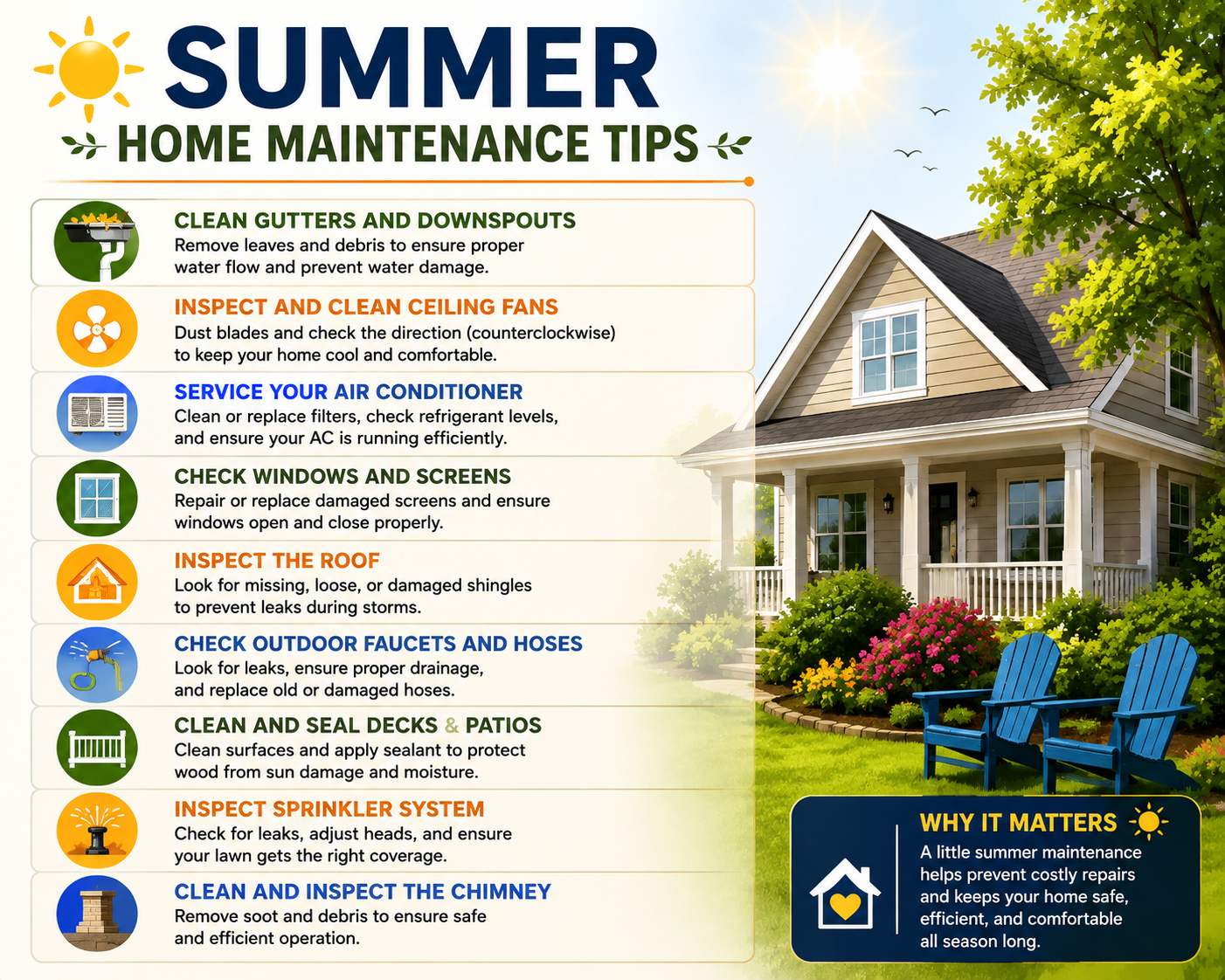
This complete guide covers every meaningful summer home maintenance task with practical, expert-backed advice. Whether your goal is to reduce energy costs, prevent storm damage, or simply keep your home in excellent condition, this checklist gives you everything you need to get it done.
What Is Summer Home Maintenance?
Summer home maintenance is the seasonal practice of inspecting, cleaning, repairing, and preparing your home during the summer months to address the specific demands and risks that warm weather brings.
It encompasses both interior and exterior tasks. Interior work focuses on mechanical systems under peak demand, such as air conditioning, plumbing, and electrical components. Exterior work addresses surfaces and structures exposed to heat, UV radiation, storm activity, and humidity.
Unlike emergency repairs, summer maintenance is planned and proactive. You complete these tasks on your schedule, before problems develop, rather than scrambling after something fails.
Summer is also the season with the longest daylight hours and the most favorable weather for outdoor work. That makes it the ideal time to power wash siding, seal decks, inspect the roof, trim trees, and complete landscaping projects that would be difficult to finish in spring or fall.
A complete summer home maintenance checklist ensures that nothing critical gets missed and that your home enters fall in strong, well-prepared condition. For a full seasonal overview, see our Annual Home Maintenance Checklist, which places summer tasks within a complete 12-month maintenance framework.
Why Summer Home Maintenance Is Important
Heat is harder on homes than most people realize. Sustained high temperatures cause roofing materials to expand and contract, which loosens shingles and accelerates flashing deterioration. Attics that reach 150 degrees Fahrenheit or higher during summer push that heat into living spaces and drive up cooling costs significantly.
Summer storms bring wind, hail, and heavy rain. An unmaintained roof, loose siding panel, or compromised window seal becomes a point of entry for water during every major storm. What starts as a minor gap can result in thousands of dollars in structural damage within a single storm season.
Beyond weather-related risks, summer also brings increased pest activity. Termites, carpenter ants, wasps, and other insects are at their most active during warm months. Identifying and sealing entry points early prevents infestations that are far more costly and disruptive to address after they are established.
Energy costs are another pressing reason to maintain your home in summer. The U.S. Energy Information Administration reports that residential electricity consumption peaks in summer due to air conditioning demand. A well-maintained HVAC system, properly sealed home envelope, and adequate attic ventilation all contribute directly to lower monthly bills.
Benefits of a Summer Home Maintenance Routine
Committing to a consistent summer home maintenance routine delivers benefits that extend well beyond a single season.
- Reduces energy costs by keeping your HVAC system efficient and minimizing heat transfer through the building envelope
- Prevents storm damage by addressing roof, siding, and window vulnerabilities before severe weather arrives
- Extends the life of exterior surfaces including decking, siding, fencing, and driveways through timely cleaning and sealing
- Protects property value by maintaining curb appeal, structural integrity, and mechanical system performance
- Improves indoor comfort by addressing attic ventilation, air leaks, and HVAC performance during peak cooling demand
- Reduces pest-related damage through proactive prevention rather than reactive extermination
- Minimizes repair costs by catching small problems while they are still inexpensive to fix
- Prepares your home for fall so winter weatherization tasks are simpler and your home enters the cold season in strong condition
Complete Summer Home Maintenance Checklist
Work through these tasks in order of priority. Start with safety and structural items, then move to mechanical systems, and finish with exterior and cosmetic projects.
Inspect the Roof for Heat and Storm Damage
Summer thunderstorms can damage your roof with little visible evidence from the ground. After any significant storm, walk the perimeter of your home and use binoculars to scan the entire roof surface. Look for lifted or missing shingles, cracked sections, and damaged flashing around chimneys, vents, and skylights.
Also check your gutters for granule deposits after storms. A significant amount of granules in the gutter channel indicates that shingles have taken impact damage and may be nearing failure. If you see widespread granule loss or physical damage, schedule a professional roof inspection before the next storm system arrives.
Heat also causes asphalt shingles to soften and become more vulnerable to wind uplift during the hottest summer weeks. Addressing loose shingles promptly prevents water intrusion during the next heavy rain event.
Clean Gutters and Downspouts
Many homeowners clean gutters only in fall, but summer brings its own debris. Cottonwood seeds, seed pods, insect nests, and wind-blown debris accumulate in gutters throughout summer and reduce drainage capacity significantly.
Check your gutters at least once during summer, especially after a major storm. Clear all debris and flush with a garden hose to confirm that water flows freely through the entire system and discharges properly at downspout outlets. Confirm that downspouts extend water at least six feet from your foundation.
Service Your Air Conditioning System
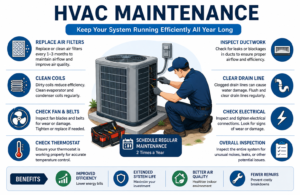
If you did not schedule a professional AC tune-up in spring, do it now before your system is running at full capacity during the hottest weeks of summer. A qualified HVAC technician will clean the condenser coils, check refrigerant levels, test electrical connections, inspect the blower motor, and verify overall system performance.
An inefficient air conditioner does not just cost more to run. It also fails more frequently and has a shorter overall service life. The cost of a professional tune-up is modest compared to the expense of an emergency repair call on a 95-degree day when HVAC technicians are in high demand across the region.
Keep the area around your outdoor condenser unit clear of vegetation, mulch, and debris. Maintain at least two feet of clearance on all sides to allow adequate airflow through the unit.
Replace or Clean HVAC Filters
Your air conditioning system runs almost continuously during peak summer heat. That high-demand operation pulls large volumes of air through your filter, which means filters clog faster in summer than in any other season.
Check your HVAC filter every 30 days during summer and replace it whenever it appears gray or visibly clogged. A restricted filter forces your blower motor to work harder, reduces cooling efficiency, and allows particles to pass into your ductwork and living spaces.
Standard fiberglass filters need replacement every 30 days. Quality pleated filters typically last 60 to 90 days under normal conditions, but high-demand summer operation may shorten that interval. See our guide on How to Replace an HVAC Filter for a step-by-step walkthrough including filter sizing and installation tips.
Inspect Windows and Doors for Air Leaks
Air leaks around windows and doors are year-round problems, but their impact on cooling costs during summer is especially significant. Warm outdoor air infiltrating a cooled home forces your air conditioner to run longer and work harder to maintain the set temperature.
Check every exterior window and door on a warm day by holding your hand a few inches from the frame while someone inside runs a hair dryer along the same frame from the interior. Any warm air you feel from outside confirms an infiltration point that needs sealing.
Replace worn weatherstripping on door edges and thresholds. Re-caulk any cracked or separated caulking around exterior window and door frames. These simple, low-cost repairs deliver measurable energy savings throughout the cooling season.
Check Exterior Siding and Paint
Walk the perimeter of your home and examine all siding surfaces carefully. Look for cracks, gaps, warped or buckled sections, and areas where paint is peeling or blistering. Peeling paint on wood siding is often a sign of moisture trapped behind the surface rather than simple paint failure.
Re-caulk any open gaps at seams, corners, and wall penetrations. Fill small cracks in wood or fiber cement siding with an appropriate exterior filler before repainting. Addressing siding damage in summer, when warm, dry conditions support proper curing, produces better results than attempting the same repairs in wet or cold weather.
Pressure Wash the Exterior
Summer is the ideal time for thorough exterior cleaning. Power wash your home’s siding to remove mold, mildew, algae, pollen, and accumulated grime that built up through spring. These biological contaminants actively degrade paint and siding materials when left in place, so removing them annually is genuinely protective rather than merely cosmetic.
Clean your driveway, walkways, deck, fences, and retaining walls as well. Always match pressure settings to the surface being cleaned. Vinyl siding, wood decking, and painted surfaces require lower pressure than concrete or brick. Use a wide-angle nozzle and work in overlapping passes to achieve even, consistent results.
Inspect the Foundation for Cracks
Summer heat and dry conditions can cause soil to shrink and shift around your foundation, creating new stress points and widening existing cracks. Walk the entire perimeter of your home after the first prolonged dry spell of summer and look for changes in the foundation surface.
Minor surface cracks in poured concrete are generally cosmetic and can be sealed with hydraulic cement. However, horizontal cracks in block or brick foundations, stair-step cracks at corners, or any crack that has grown since your last inspection should be evaluated by a structural engineer. Addressing foundation concerns early is always less expensive than managing the consequences of deferred structural repairs.
Check Outdoor Faucets and Irrigation Systems
Test every outdoor hose bib and confirm that water flows properly and that no drips are present around the valve body or handle. A dripping outdoor faucet that runs unattended all summer wastes significant water and can indicate pipe damage from the previous winter that worsened over time.
Run your irrigation system through a complete zone-by-zone test. Look for heads that are tilted, blocked by summer plant growth, producing uneven spray patterns, or showing signs of physical damage. Adjust coverage patterns to avoid spraying onto siding, walkways, or other hardscaped areas. The EPA’s WaterSense program estimates that inefficient irrigation systems waste nearly 50% of outdoor water used. Proper irrigation system maintenance addresses this waste directly.
Inspect the Deck, Patio, and Railings
Decks absorb intense UV radiation, heat, and summer rain throughout the season. Inspect every board for surface cracking, cupping, splinting, or early signs of soft spots that indicate rot. Press a screwdriver into any board that looks suspect. Healthy wood resists firm pressure. Rotted wood yields immediately and must be replaced before it becomes a structural or safety concern.
Apply firm lateral pressure to every railing section and confirm there is no movement. A railing that shifts or wobbles represents a genuine safety hazard for anyone leaning against it. Inspect post bases and connection hardware for rust, corrosion, or loosening. Check the ledger board where the deck meets the house for secure attachment and no signs of water intrusion or pest damage.
Seal Decks and Wooden Surfaces
Summer is the best time of year to apply deck sealant or stain because warm, dry conditions allow the product to penetrate and cure properly. Test whether your existing finish still protects the wood by sprinkling a small amount of water on the surface. If the water beads up, the current sealant is still effective. If it absorbs immediately, the wood is unprotected and needs a fresh application.
Clean the deck thoroughly before sealing and allow it to dry completely. Apply a quality exterior deck sealant or penetrating stain in thin, even coats. Two thin coats always outperform one thick application in terms of adhesion, penetration, and longevity.
Trim Trees and Shrubs
Summer storm season makes tree maintenance genuinely urgent rather than merely cosmetic. Overhanging branches can cause serious roof damage, take out gutters, and fall onto vehicles or structures during high-wind events. Trim any branch that extends within 10 feet of your roofline and remove all dead or visibly weakened limbs.
Keep shrubs trimmed back from siding and foundation walls. Dense vegetation in contact with exterior surfaces holds moisture, restricts airflow, and creates protected habitat for termites, carpenter ants, and other wood-damaging pests. Maintaining clearance between plants and the structure is one of the simplest pest prevention measures available to homeowners.
Lawn Care and Landscaping Tips
Healthy summer lawn care is about working with heat and drought conditions rather than against them. Raise your mowing height to three to four inches during summer. Taller grass shades the soil, reduces water evaporation, and develops a deeper root system that handles heat stress better than closely cropped turf.
Water deeply but infrequently. The goal is to wet the soil to a depth of six inches and then allow it to dry partially before watering again. This approach encourages roots to grow downward in search of moisture rather than remaining shallow and vulnerable to surface heat. The best time to irrigate is early morning, before heat causes evaporation losses.
Inspect Driveways and Walkways
Check your driveway and all walkways for new cracking, surface deterioration, or heaved sections that create tripping hazards. Summer heat causes asphalt to soften and become more susceptible to rut formation under heavy vehicle weight. Concrete expands significantly in heat, which can widen existing cracks or create new ones at stress points.
Fill concrete cracks with a flexible repair compound designed for exterior use. Re-apply driveway sealer to asphalt surfaces if the previous application has faded or begun to show surface erosion. Sealing protects the subsurface from water infiltration and heat-related breakdown, extending the functional life of your driveway significantly.
Clean Outdoor Furniture
Outdoor furniture takes heavy use throughout summer and benefits from mid-season cleaning and inspection. Wash all pieces with a mild soap and water solution. For aluminum or resin furniture, a soft brush removes dirt from textured surfaces effectively. For teak and other hardwoods, use a cleaner formulated for outdoor wood and reapply a protective oil or sealant.
Inspect all hardware, hinges, and adjustable components for corrosion or failure. Replace worn fabric straps, frayed cushion covers, or broken structural components before they create a safety hazard. Furniture that is maintained properly lasts significantly longer and avoids the cost of premature replacement.
Check Fences and Gates
Summer is an excellent time to walk your entire fence line and make repairs while the weather supports working outdoors. Look for posts that have shifted or begun to lean, boards or panels that have warped, cracked, or come loose, and hardware that has rusted or failed.
Wood fences that have not been treated in the past two to three years benefit from cleaning and a fresh coat of exterior sealant or paint. Apply during dry weather and allow full curing time before exposure to rain. Check all gate latches, hinges, and self-closing mechanisms, particularly on pool enclosures where proper gate function is a legal safety requirement.
Inspect the Attic for Heat and Ventilation
An attic without adequate ventilation can reach temperatures well above 150 degrees Fahrenheit during summer. This extreme heat degrades shingles from below, drives up cooling costs by radiating heat into living spaces, and shortens the lifespan of your roof structure.
Access your attic on a hot afternoon and assess the temperature and air movement. If it feels like an oven with no discernible airflow, ventilation is likely inadequate. Confirm that all intake vents at the eaves and exhaust vents at the ridge or gable ends are clear and unobstructed. The U.S. Department of Energy recommends a minimum ventilation ratio of 1 square foot per 150 square feet of attic floor space. Adding a powered attic ventilator or additional ridge venting can significantly reduce cooling costs in poorly ventilated homes.
Test Smoke and Carbon Monoxide Detectors
Testing safety detectors is a task that belongs on every seasonal checklist without exception. Press the test button on every smoke detector and carbon monoxide detector in the home. Confirm that the alarm sounds clearly and at full volume. Replace batteries in any device that sounds weak or fails to respond.
The U.S. Fire Administration reports that working smoke detectors reduce the risk of dying in a home fire by more than 50%. Replace any detector that is more than ten years old, as sensor components degrade over time and older units may not respond reliably even when they appear functional.
Inspect Electrical Outlets and Outdoor Wiring
Summer outdoor living increases the use of outdoor electrical outlets, extension cords, and lighting fixtures. Inspect every outdoor outlet for proper weatherproof covers and GFCI protection. Test GFCI outlets by pressing the test and reset buttons and confirming proper function.
Check all extension cords used outdoors for cracked or damaged insulation. Replace any cord that shows physical damage rather than attempting to repair it with tape. Inspect string lights, post-mounted fixtures, and any permanent outdoor wiring for loose connections, exposed wires, or signs of heat damage. If you find wiring concerns you cannot identify or resolve confidently, contact a licensed electrician for evaluation.
Check Plumbing for Leaks
Summer humidity makes slow plumbing leaks more difficult to detect because condensation on pipes can mimic the appearance of a leak. Look under every sink and around every toilet base for actual water staining, warped cabinet floors, or visible drips rather than surface moisture.
Check the water supply line connections behind refrigerators with ice makers, under washing machines, and at your dishwasher. Inspect the area around your water heater for moisture or rust. Outdoor irrigation connections and hose bib connections are also common summer leak points that should be verified during any routine plumbing inspection.
Maintain the Water Heater
Summer is a good time to perform annual water heater maintenance because demand is lower than in winter and working near the unit is more comfortable. Flush the tank to remove sediment buildup at the bottom. Sediment insulates the heating element from the water above it, reducing efficiency and forcing longer heating cycles.
Confirm the temperature setting is at 120 degrees Fahrenheit per U.S. Department of Energy guidelines. Inspect the anode rod if the unit is more than three years old and replace it if it is heavily corroded. An intact anode rod is what prevents the steel tank walls from rusting internally.
Pest Prevention Tips for Summer
Summer is peak season for termites, carpenter ants, wasps, spiders, mosquitoes, and a range of other pests. Prevention is far more cost-effective than treatment once an infestation is established.
Eliminate standing water sources in your yard, including clogged gutters, low-lying areas, and containers that collect rainwater. Mosquitoes require only a bottle cap of standing water to breed. Seal all visible gaps in your home’s exterior, including around pipes, utility lines, vents, and where siding meets the foundation. Stack firewood away from the house and off the ground. Keep mulch at least six inches from foundation walls to reduce termite access.
If you have not had a professional pest inspection in the past year, summer is the right time to schedule one.
Prepare for Summer Storms
Summer storm preparation is not reactive planning. It is a set of proactive steps that significantly reduces damage when severe weather arrives. FEMA recommends that homeowners identify and address structural vulnerabilities before storm season peaks rather than scrambling after a weather event.
Clear your yard of any objects that could become projectiles in high winds. Secure or store outdoor furniture, planters, decorative items, and anything that is not fixed to the ground. Know where your main water shut-off, electrical panel, and gas shut-off are located and confirm that all household members know how to operate them. Keep a charged weather radio in your emergency kit and maintain current batteries in all safety devices.
Organize the Garage and Storage Areas
Summer is the ideal time to clear out garage clutter and reorganize storage in a way that supports both safety and utility. Remove flammable materials like paint, solvents, and gasoline containers that should never be stored in an attached garage during summer heat.
Inspect stored power equipment including lawnmowers, trimmers, and pressure washers for any service needs before they are used at full frequency. Store seasonal items from spring in labeled containers and make summer equipment accessible and organized. Check the garage floor for new cracking or moisture staining that may indicate drainage or foundation issues.
Indoor Summer Home Maintenance Checklist
Use this checklist as a quick reference for all interior summer tasks:
- Replace HVAC filters every 30 days during peak cooling season
- Schedule professional AC system service if not completed in spring
- Test all smoke detectors and carbon monoxide detectors
- Check all GFCI outlets in kitchens, bathrooms, and garage
- Inspect under-sink plumbing and appliance water connections
- Flush water heater and check temperature setting
- Inspect attic for heat buildup, mold, and ventilation issues
- Check all ceiling fans for proper summer counterclockwise rotation
- Clean refrigerator condenser coils for efficient operation
- Inspect basement or crawl space for moisture and mold activity
- Deep clean kitchen exhaust hood and replace grease filters
- Check washing machine hoses for bulging or cracking
- Test garage door auto-reverse safety function
Outdoor Summer Home Maintenance Checklist
Use this checklist as a quick reference for all exterior summer tasks:
- Inspect roof after every significant storm
- Clean gutters and flush downspouts
- Keep AC condenser unit clear of vegetation and debris
- Inspect exterior siding for cracks, gaps, and paint failure
- Re-caulk around windows, doors, and wall penetrations
- Pressure wash siding, deck, driveway, and walkways
- Inspect deck boards, railings, posts, and ledger board
- Seal or stain deck and wooden surfaces as needed
- Trim all branches within 10 feet of the roofline
- Remove dead or damaged tree limbs
- Test all outdoor hose bibs for leaks
- Run irrigation system zone test and adjust heads
- Inspect driveways and walkways for cracking and heaving
- Walk fence perimeter and complete repairs
- Check and repair gate hardware and latches
- Clean outdoor furniture and inspect for structural damage
- Seal gaps in exterior walls to prevent pest entry
- Organize garage and remove improperly stored flammables
- Secure outdoor items in advance of storm season
Summer Home Maintenance Calendar
| Month | Priority Level | Key Tasks |
|---|---|---|
| June | Critical | AC system service, HVAC filter replacement, smoke and CO detector testing, roof inspection, gutter cleaning, attic ventilation check, outdoor electrical inspection |
| July | High | Pressure washing, deck inspection and sealing, irrigation system test, plumbing leak check, water heater maintenance, pest prevention, storm preparation |
| August | Medium to High | Siding and paint inspection, fence and gate repairs, driveway sealing, tree trimming, outdoor furniture cleaning, garage organization, lawn care adjustment for late summer heat |
Summer Home Maintenance Schedule
| Task | Recommended Frequency | Best Month | Importance |
|---|---|---|---|
| HVAC filter replacement | Every 30 days in summer | June, July, August | Critical |
| Smoke and CO detector test | Monthly | June | Critical |
| AC system service | Annually | June | Critical |
| Roof inspection | After every major storm | June–August | Critical |
| Gutter cleaning | At least once in summer | June–July | High |
| Attic ventilation check | Annually | June | High |
| Deck inspection and sealing | Annually | June–July | High |
| Irrigation system test | Annually, adjust monthly | June | High |
| Pressure washing | Annually | June–July | Medium |
| Plumbing leak inspection | Annually | July | High |
| Water heater maintenance | Annually | July | High |
| Pest inspection | Annually | June–July | High |
| Driveway sealing | Every 2–3 years | July–August | Medium |
| Fence inspection and repair | Annually | July–August | Medium |
| Outdoor wiring inspection | Annually | June | High |
Essential Summer Home Maintenance Tools
| Tool | Purpose | Recommended Use | Estimated Cost |
|---|---|---|---|
| Pressure washer | Cleaning siding, driveway, deck, and walkways | June–August | $100–$400 |
| Extension ladder | Roof inspection, gutter cleaning, attic access | June–July | $80–$300 |
| HVAC filter set | Monthly AC filter replacement | June, July, August | $10–$30 per filter |
| Caulking gun | Sealing exterior gaps around windows and doors | June–August | $10–$30 |
| Gutter scoop | Removing summer debris from gutters | June–July | $10–$20 |
| Deck brush and applicator | Cleaning and sealing deck surfaces | June–July | $20–$60 |
| Voltage tester | Checking outdoor outlets and wiring safely | June | $15–$40 |
| Moisture meter | Detecting rot, wet wood, and water intrusion | June–August | $20–$80 |
| Cordless drill | Deck repairs, fence repairs, general maintenance | Year-round | $60–$150 |
| Garden hose with nozzle | Irrigation testing and general outdoor cleaning | June–August | $25–$60 |
| Binoculars | Ground-level roof inspection after storms | June–August | $20–$80 |
| Pest caulk and foam | Sealing pest entry points in exterior walls | June–July | $10–$30 |
DIY vs Professional Summer Home Maintenance
| Task | DIY Friendly | Professional Recommended | Primary Reason |
|---|---|---|---|
| HVAC filter replacement | Yes | No | Simple task requiring no tools or training |
| AC system service | No | Yes | Refrigerant handling requires EPA certification |
| Roof inspection | Ground-level visual only | Yes for any repair work | Roof access without training creates serious fall risk |
| Gutter cleaning | Yes | Optional | Manageable with proper ladder safety practices |
| Deck sealing | Yes | Optional for large decks | Straightforward DIY with correct products |
| Exterior caulking | Yes | No | Basic skill with minimal preparation required |
| Pest inspection | Partial | Yes for termite inspection | Termites require professional detection equipment |
| Electrical wiring inspection | No | Yes | Shock risk and code compliance require licensed electrician |
| Foundation crack assessment | Minor surface cracks | Yes for structural concerns | Growing or horizontal cracks need professional evaluation |
| Tree trimming near roof | No for large branches | Yes | High branches near rooflines require professional arborist |
| Attic ventilation improvement | No | Yes | Proper sizing and placement requires professional assessment |
| Water heater flush | Yes | Optional | Straightforward with basic plumbing instructions |
| Irrigation system adjustment | Yes | Yes for installation | Adjusting heads is DIY-friendly; full system service benefits from professional startup |
Common Summer Home Maintenance Mistakes
Even experienced homeowners make avoidable errors during summer maintenance. Knowing what they are helps you sidestep the most costly ones.
Ignoring post-storm roof inspections. Many homeowners assume that if the ceiling is not leaking, the roof is fine. Storm damage is often not visible from inside the home until significant structural damage has already occurred. Make post-storm roof inspections a standard practice regardless of perceived severity.
Running AC continuously without filter checks. Summer is when HVAC filters clog fastest. Skipping monthly filter checks during peak cooling season forces the blower motor to work under increased strain and reduces system efficiency significantly.
Applying deck sealant to dirty or wet wood. Sealing a deck without thoroughly cleaning and drying it first traps moisture and contaminants beneath the finish, which causes premature peeling and does not protect the wood as intended.
Overwatering in summer heat. More water does not always mean a healthier lawn. Overwatering promotes shallow root systems, increases disease susceptibility, and wastes a significant amount of water. Deep, infrequent irrigation is more beneficial than frequent shallow watering.
Storing gasoline and flammables in an attached garage. Summer heat dramatically increases the evaporation and ignition risk of stored fuels. Store gasoline in an approved container in a detached shed or garage with proper ventilation, never attached to your living space.
Skipping pest prevention. Summer pest activity peaks significantly, but many homeowners only call for treatment after a problem is visible. Proactive sealing of entry points and elimination of moisture sources prevents infestations before they require professional remediation.
Trimming trees without storm risk assessment. Removing only healthy branches while leaving visibly dead or damaged limbs in place misses the actual storm hazard. Prioritize removal of dead, cracked, or structurally compromised limbs before trimming for shape or clearance.
Money-Saving Summer Home Maintenance Tips
Smart summer maintenance does not require a large budget. These practical strategies help you protect your home cost-effectively.
- Replace HVAC filters yourself rather than paying a service company for the task during maintenance visits
- Use a programmable or smart thermostat to reduce AC runtime during the hottest parts of the day when the home is unoccupied
- Rent equipment you use only once per season, such as pressure washers and aerators, rather than purchasing them outright
- Schedule professional services like AC tune-ups, pest inspections, and roof assessments together when possible to reduce per-visit travel charges
- Purchase deck sealants, caulks, and exterior cleaners in bulk at the start of summer when seasonal pricing is favorable
- Plant shade trees on the south and west sides of your home to reduce direct sun exposure on exterior walls and reduce cooling loads over time
- Check with your utility provider for summer energy efficiency rebates that may offset the cost of HVAC upgrades, smart thermostats, or attic insulation improvements
- Address small exterior repairs immediately. A tube of caulk used now costs a fraction of what water damage inside a wall costs later
The U.S. Department of Energy’s Energy Saver program offers free resources on cost-effective home improvements that improve energy efficiency, many of which are directly relevant to summer maintenance tasks.
Summer Home Safety Tips
Summer activities and maintenance work introduce specific safety risks. These recommendations keep your family protected throughout the season.
- Never work on a roof without proper footwear, fall protection, and clear weather conditions
- Keep a fire extinguisher mounted in the kitchen and one in the garage, and verify both are fully charged
- Test all GFCI outlets in wet areas before summer increases use of outdoor water features and garden equipment
- Inspect and secure all deck railings before hosting gatherings that increase deck traffic and loading
- Keep pool and water feature gates latched at all times. Self-closing mechanisms should engage every time without manual assistance
- Store all pesticides, herbicides, and cleaning chemicals in a locked cabinet away from children and pets
- Turn off the main electrical breaker to outdoor circuits before inspecting or replacing any outdoor wiring or fixtures
- Keep a charged weather radio accessible and monitor severe weather forecasts during active storm season
- Confirm that your household emergency plan is up to date, and review it with all family members before peak storm season
FEMA recommends maintaining a home emergency supply kit with at least 72 hours of food, water, medications, flashlights, and communication equipment. Review and restock this kit every summer before storm season peaks in your region.
When You Should Hire a Professional
Knowing the boundary between DIY-appropriate tasks and professional work is one of the most important skills a homeowner can develop. These situations always require a licensed professional.
Call a licensed professional when:
- Roof damage from storm impact is widespread, affects the decking, or involves significant flashing failure
- Foundation cracks are horizontal, stair-stepped, or actively growing since your last inspection
- Your air conditioning system fails to cool effectively, makes unusual sounds, or trips the breaker repeatedly
- You detect any burning odor, unusual warmth, or discoloration near your electrical panel
- Outdoor wiring shows signs of damage, corrosion, or incorrect installation
- A pest inspection reveals signs of active termite infestation, which requires specialized treatment
- Tree branches near your roofline are large, damaged, or require work that requires climbing
- Attic mold is present in significant quantities, which requires professional remediation rather than surface cleaning
- Water intrusion is occurring behind siding, under flooring, or through the foundation wall
Attempting complex repairs without the appropriate training, tools, or licensing creates safety risks, potential code violations, and costs that almost always exceed professional fees.
Expert Recommendations
The homeowners who get the most from their summer maintenance efforts share a few consistent habits that are worth adopting regardless of where you are in your maintenance journey.
Start outdoor work early in the morning during summer. The combination of heat and physical exertion in the afternoon hours creates real health risks. Plan roof inspections, pressure washing, deck work, and landscaping for the cooler morning hours and save indoor tasks for the heat of the day.
Think in terms of systems rather than individual tasks. Your roof, gutters, downspouts, and foundation drainage all work together as a water management system. Address all of them together rather than in isolation, and you will see better results from each individual task.
Document everything you complete during summer maintenance. Photographs of your roof, foundation, deck, and siding before and after repairs create a valuable baseline for comparison in future seasons and provide useful documentation if an insurance claim becomes necessary.
Do not treat storm preparation as optional. Every summer season includes severe weather. The homeowners who take 30 minutes to secure outdoor furniture, clear debris from around the house, and confirm their emergency kit is stocked before storm season peaks consistently experience less damage and stress than those who do not.
Frequently Asked Questions
How often should I change my HVAC filter in summer?
During summer when your air conditioning system runs continuously, check your HVAC filter every 30 days without exception. Standard fiberglass filters need replacement monthly regardless of visible condition. Quality pleated filters can last 60 to 90 days under normal conditions, but the increased runtime during peak summer heat often shortens that interval. Homes with pets, allergy sufferers, or multiple occupants benefit from more frequent changes. A clogged filter during summer strains your blower motor, reduces cooling efficiency, and can cause your evaporator coil to freeze, which shuts the system down entirely at the worst possible time.
What is the most important summer home maintenance task?
Servicing your air conditioning system ranks as the highest-priority summer maintenance task for most homeowners because it directly affects comfort, energy costs, and system longevity during the season when it matters most. However, post-storm roof inspections are equally critical from a property protection standpoint. A damaged roof that goes unaddressed through an active storm season can result in tens of thousands of dollars in interior water damage. Combining regular AC maintenance with consistent post-storm roof checks covers the two most consequential summer maintenance priorities for the majority of single-family homeowners.
How do I know if my attic needs better ventilation?
The clearest sign of inadequate attic ventilation is extreme heat when you access the space on a hot afternoon. A properly ventilated attic should feel warm but tolerable, with noticeable airflow between intake and exhaust vents. If it feels unbearably hot with no air movement, ventilation is insufficient. Other indicators include higher-than-expected cooling bills, rooms on the top floor that are consistently warmer than lower floors, and shingles that are deteriorating faster than their rated lifespan. The U.S. Department of Energy recommends a minimum of one square foot of net free ventilation area per 150 square feet of attic floor space.
Can I pressure wash my home’s siding myself?
Yes, pressure washing siding is a manageable DIY task for most homeowners with the right equipment and technique. The key is using the appropriate pressure setting for your specific siding material. Vinyl siding requires relatively low pressure, typically between 1,200 and 1,500 PSI with a 25-degree or wider nozzle. Wood siding and painted surfaces need even lower settings to avoid surface damage. Always work from top to bottom and at a slight downward angle to prevent water from being forced up behind panels. Test a small hidden area first before cleaning larger sections, and never direct pressure at window caulking, vents, or electrical fixtures.
How do I prepare my home for summer storms?
Effective storm preparation starts well before severe weather is in the forecast. Clear your yard of all loose objects that could become wind-driven projectiles, including furniture, planters, tools, and decorations. Inspect and trim any tree branches near your home that are dead, cracked, or overhanging the roofline. Confirm that your gutters are clean so heavy rain drains properly. Know the locations of your main water shut-off valve, electrical panel, and gas shut-off and verify that all household members know how to operate them. Maintain a 72-hour emergency supply kit and keep a battery-powered weather radio accessible and charged throughout storm season.
What are the best pest prevention strategies for summer?
The most effective pest prevention combines eliminating entry points, removing attractants, and addressing moisture sources that draw insects. Seal all gaps in your home’s exterior, including around pipes, utility penetrations, vents, and where different building materials meet. Eliminate standing water in gutters, plant containers, low-lying yard areas, and any outdoor vessel that collects rainfall. Keep firewood stacked at least 20 feet from the house and elevated off the ground. Trim vegetation away from siding and foundation walls. Schedule a professional termite inspection if your home has not had one recently, as termites cause an estimated $5 billion in property damage annually according to the National Pest Management Association.
How do I tell if my deck needs resealing or replacing boards?
The water bead test is the most reliable method for assessing sealant effectiveness. Sprinkle a small amount of water onto the deck surface. If water beads up and rolls off, the current sealant is still functioning. If water absorbs into the wood immediately, the surface is unprotected and needs cleaning and a fresh sealant application. For individual boards, look for surface cracking, significant cupping or warping, discoloration, or soft spots when pressed firmly. A screwdriver inserted with moderate force into a healthy board should not penetrate more than a fraction of an inch. Boards that yield easily are rotted and need replacement before the affected area spreads to adjacent boards.
Should I water my lawn differently in peak summer heat?
Yes. The approach that works in spring and early summer needs adjustment as heat peaks in July and August. Water deeply and infrequently rather than lightly and often. Aim to wet the soil to a depth of six inches and then allow the top few inches to dry before the next irrigation cycle. This trains roots to grow deeper, which improves drought resistance. Water in the early morning hours, ideally between 4 AM and 9 AM, to minimize evaporation losses and reduce the risk of fungal disease from moisture sitting on grass blades overnight. Raise your mowing height to three to four inches to shade the soil and reduce heat stress on the turf.
What should I check on my outdoor electrical outlets in summer?
Inspect every outdoor electrical outlet for a properly installed weatherproof cover that closes fully when the outlet is not in use. All outdoor outlets should be GFCI-protected. Test each one by pressing the test button, confirming the outlet loses power, and then pressing reset to restore it. Outlets that fail to trip or reset need immediate replacement. Check that all cover plates are sealed against the wall surface with no gaps where water could enter. Inspect any extension cords used for outdoor lighting or tools for cracked insulation, bent prongs, or damaged connectors. Replace damaged cords rather than repairing them, and never use indoor-rated extension cords in outdoor applications.
How do I maintain my irrigation system throughout summer?
Run each irrigation zone individually once a month during summer and observe the full cycle. Look for heads that are not popping up fully, spraying asymmetrically, or producing excessive mist rather than distinct water droplets, which indicates low pressure or a clogged nozzle. Adjust head direction and arc coverage as plants grow and block spray patterns. Check all zone valves and connection points for leaks after each run cycle. If you use a timer, verify that the schedule reflects current watering needs, since peak summer heat may require more frequent irrigation than early summer conditions did. Clean or replace clogged nozzles rather than increasing water pressure to compensate for reduced flow.
Conclusion
Summer home maintenance is not just seasonal upkeep. It is an investment in the long-term health, safety, efficiency, and value of your most important asset.
Every task in this guide serves a clear purpose. Servicing your air conditioner keeps you cool and controls your energy costs. Inspecting your roof after storms prevents minor damage from becoming major water intrusion. Sealing your deck extends its life by years. Trimming trees reduces storm risk. Together, these tasks build a home that is resilient, efficient, and well-protected through the most demanding season of the year.
Start with the highest-priority tasks in June and work systematically through the checklist over the course of the summer. Use the tables and calendars in this guide to stay organized and on track. Keep records of every inspection, repair, and service completed, and do not defer anything that affects safety or structural integrity.
A well-maintained home handles whatever summer delivers. The effort you invest now pays dividends not just this season, but in every season that follows.