Best Ways to Improve Your Home’s Curb Appeal

Introduction
The exterior of a home forms an impression before anyone has stepped inside. Whether that impression is positive or negative is shaped by dozens of small details working together, the condition of the landscaping, the color and finish of the front door, the lighting along the path, the visible tidiness of the entry, and the overall sense that the property is cared for.
Improving curb appeal does not require a complete exterior renovation. Thoughtful, targeted changes to landscaping, lighting, color choices, entryway presentation, and exterior details can make a noticeable difference to how a property reads from the street. Some of the most effective improvements cost very little. Others require a more meaningful investment but address visible weaknesses that genuinely affect first impressions.
What works well depends on the home’s architecture, the surrounding neighborhood, the local climate, and the existing exterior palette. A Victorian terrace and a contemporary suburban house require quite different approaches to look their best. This guide covers the improvements that have the most consistent impact, with enough practical context to help you identify what matters most for your specific property.
1. Start With a Clean and Well-Maintained Exterior
Before considering any new purchases or additions, the condition and tidiness of what already exists sets the foundation for every other curb appeal improvement. A property with strong landscaping and an attractive entry area that is surrounded by visible clutter, dirty surfaces, or disorganized outdoor items will not read as well as it should.
Removing unnecessary items from the visible exterior is the most immediate and cost-free improvement available. Accumulated items near the entrance, garden tools left out, unused containers, deteriorating outdoor furniture that is not in use, and similar accumulation all contribute to an impression of disorder that no amount of new planting can fully overcome.
Pathways benefit from being kept clear and presentable. Overgrown edges where lawn or planting encroaches on a path, debris that has accumulated in corners, or weeds growing through pathway material all reduce the visual quality of an otherwise adequate exterior.
Visible exterior surfaces that are dirty or stained, including driveways, garden walls, the base of exterior walls, and pathways, can often be improved significantly through cleaning. The difference between a stained concrete driveway and a clean one is noticeable from the street, and the improvement requires nothing more than effort and appropriate cleaning equipment.
Organizing outdoor items so that functional storage areas look deliberate rather than accumulated makes a clear practical difference. Garden equipment stored neatly in an appropriate location, bins positioned consistently, and outdoor furniture arranged in a way that looks intentional rather than temporary all contribute to an impression of an actively maintained property.
2. Improve the Front Entrance
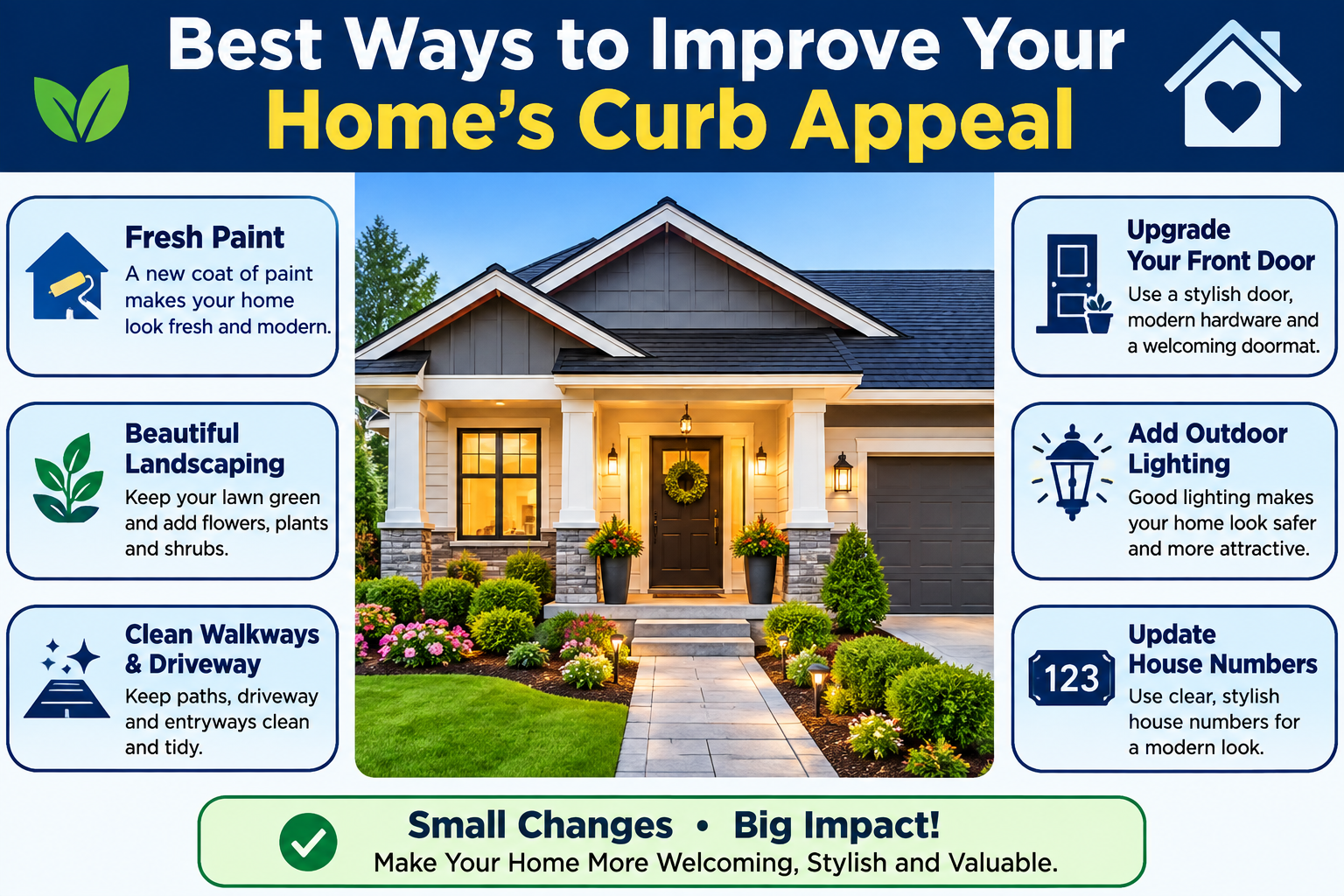
The front door and the immediate area surrounding it are the visual focal point of most residential exteriors. They are where the eye naturally moves when looking at a property from the street, and they communicate more about the home’s character and upkeep than almost any other element.
A front door in good condition, painted or finished in a color that complements the exterior palette and suits the home’s architecture, creates a strong positive impression. A door that is faded, peeling, or in a color that conflicts with the rest of the exterior does the opposite regardless of how well maintained everything else is.
Color choice for a front door deserves genuine thought rather than a default decision. The door color should work with the main exterior color, the trim color, and any other accent colors visible on the front elevation. Deep, confident colors, a classic navy or black on a white or gray house, a warm terracotta on a natural stone property, or a sage green on a cream render, tend to create a stronger, more finished impression than pale or neutral door colors that disappear visually.
Hardware on the front door, the handle, knocker, letter plate, and any other visible fittings, should be in good condition and consistent in finish. Mismatched, corroded, or visibly worn hardware undermines an otherwise good door. Replacing door hardware is an inexpensive improvement with a clear visual payoff.
House numbers should be clearly legible from the street, in good condition, and consistent in style with the overall exterior. Oversized, illegible, or obviously dated house numbers are a small detail that registers subconsciously as part of the overall impression the property makes.
Planters positioned symmetrically on either side of the entrance, or a single well-chosen planter to one side, add color and softness to the entry without the expense of structural changes. Plant selection in planters should reflect the amount of sunlight the entrance receives and the level of maintenance the household can realistically commit to. A well-maintained planter with a single species planted confidently usually looks better than an overplanted container in a mixture of struggling plants.
A good quality welcome mat suited to the scale of the entrance completes the entry area without significant cost.
3. Refresh the Landscaping
Landscaping is one of the most visible components of curb appeal and one where the difference between a well-maintained and a neglected property is immediately apparent. It is also an area where improvements do not necessarily require significant spending. Attention to what already exists often produces better results than adding new planting on top of existing problems.
The most impactful basic landscaping improvement is simply keeping existing planting controlled. Overgrown shrubs that have encroached on pathways, windows, or the front elevation of the house create a sense of neglect more strongly than the absence of any planting at all. Bringing existing shrubs and hedges back to a shape that suits their position improves the overall exterior significantly.
Lawns that are cared for, edged where they meet pathways or planting beds, and free from visible patches or weeds read as well-maintained even when they are modest in size. Lawn care quality is visible from the street and forms part of the overall impression the property makes.
Mulch in planting beds performs both a practical and a visual function. Fresh mulch suppresses weeds, retains moisture, and creates a consistent, neat appearance in beds that might otherwise look patchy or untidy. The visual consistency it provides across a planting bed is disproportionate to its cost.
New planting should be chosen with the local climate and the specific conditions of the planting position in mind. Plants that are well-suited to their environment establish themselves more quickly, require less intervention to maintain, and look better over time than plants chosen purely for their appearance without regard to whether they will thrive where they are placed.
Seasonal planting in defined areas, rather than throughout the whole garden, provides color and interest that changes with the year without creating a maintenance burden across the entire exterior.
4. Add Exterior Lighting
Exterior lighting improves the appearance of a property in two distinct ways. During daylight hours, well-chosen fixtures contribute to the overall design of the exterior. In the evening, the quality and positioning of lighting determines how the property looks at night, which matters both for daily use and for the impression made on visitors arriving after dark.
Pathway lighting that marks the route from the street or driveway to the front entrance makes the property feel more welcoming and ensures safe movement after dark. Solar-powered pathway lights are an accessible low-cost option where running power to pathway locations is not practical.
Entry lighting, the fixture or fixtures beside or above the front door, should be sufficient to illuminate the entrance clearly without creating harsh or unflattering light. The fixture style should coordinate with the overall exterior design. A traditional lantern-style fixture on a period property and a simpler contemporary fitting on a modern house both work well when they suit their context. A fixture that is clearly mismatched with the home’s character reads as an oversight.
Wall lights positioned alongside garage doors, on garden walls, or flanking secondary entrances extend the quality of the property’s lighting beyond the main entrance and contribute to a more complete and finished exterior appearance.
Landscape lighting that highlights a feature tree, a planting bed, or an architectural element of the house adds depth to the exterior’s appearance in the evening and creates a different character from the daytime view.
Any exterior lighting that requires new electrical wiring should be installed by a qualified electrician. Solar and low-voltage LED systems offer practical alternatives where running new wiring is not appropriate.
5. Improve the Front Walkway
The front walkway is the physical route visitors take from the street to the entrance, and its condition and visual character contributes meaningfully to how the arrival at the property feels. A clear, well-defined path in good condition reads as welcoming. A narrow, poorly defined, or deteriorated walkway creates a less positive first impression.
The surface of the walkway matters both practically and visually. Whether the existing material is concrete, paving slabs, brick, gravel, or another material, its condition should be assessed. Cracked slabs, sunken sections, significant staining, or widespread weed growth through joints all detract from the overall impression and are worth addressing.
The edges of the walkway define its visual boundary. Where the path meets a lawn, clean edges that separate the two materials clearly look more intentional and well-maintained than blurred boundaries where grass has encroached onto the path surface. Where the path meets a planting bed, the planting should be positioned to frame the path rather than overhang it.
Lighting along or beside the walkway, as discussed in the previous section, extends both the usability and the visual appeal of the path into the evening.
The width of the walkway relative to the entrance it leads to is worth considering when any substantial changes are being planned. A very narrow path leading to a generous entrance creates a slightly awkward proportion. Where practical, a path that is wide enough for two people to walk side by side creates a more welcoming approach.
6. Choose Exterior Colors Carefully
The overall color palette of a home’s exterior, comprising the main body color, the trim, the door, the roof, and any accent elements such as shutters or railings, works as a system. When these elements are coordinated, the exterior reads as cohesive and considered. When they compete or conflict, the exterior looks disorganized regardless of how good any individual element might be.
A straightforward approach is to work with three color levels. The main exterior color covers the largest surface area and sets the overall character of the property. A complementary secondary color appears on trim, window reveals, fascias, and similar architectural details. An accent color, typically the strongest or most distinctive, appears on the front door and occasionally on smaller accent elements.
The relationship between these three levels needs to account for the fixed colors that cannot be easily changed, the roof tone, any natural stone, brick, or render, and the surrounding environment. A brick property has the brick color as a fixed part of the exterior palette that any painted or stained elements need to coordinate with.
Light affects exterior colors significantly and differently from how it affects interior paint. Exterior surfaces receive direct sun, shade, morning light, and evening light across the day in ways that interior walls do not. Colors chosen for exterior surfaces should be evaluated in natural daylight against the actual property context rather than from a paint chip in a shop.
If you are considering updating your home’s interior and exterior together, our article on how to choose the right colors for your home covers color selection principles in detail, including how to build a cohesive palette that works across different light conditions and existing finishes.
7. Make Windows Look More Attractive
Windows are a significant part of the exterior elevation of most homes, occupying a substantial proportion of the visible facade and contributing to the overall character of the property. Their condition, proportions, and the way they relate to the surrounding exterior all affect the overall curb appeal.
The condition of window frames is the starting point. Peeling paint, visibly deteriorated timber, or frames that are clearly in need of attention undermine the exterior’s overall impression regardless of what else is improved around them. Freshly painted or finished window frames in a color that coordinates with the trim palette make a clear visual difference.
Shutters, where they are architecturally appropriate to the property’s style, add character and definition to the window openings. They should be properly proportioned to the window and mounted in a way that looks functional rather than simply decorative. Shutters that are clearly too small for the window they are meant to frame, or positioned too far from the window edges, look out of place and draw attention to themselves for the wrong reasons.
Window boxes and planters beneath windows add color and life to the exterior elevation. Like entrance planters, they work best when planted with appropriate species for the light levels and maintained in good condition. A well-planted window box with healthy plants makes a strong positive visual contribution. A poorly maintained one with struggling plants does not.
Clean windows are a basic but genuinely impactful detail. Visible grime on exterior glass is noticeable from outside the property and contributes to an overall impression of a less well-maintained exterior.
8. Upgrade House Numbers and Small Exterior Details
The small details of a home’s exterior register cumulatively. No single small element transforms curb appeal on its own, but when several small details are in good condition, appropriate to the property’s character, and consistent in their style and finish, the overall exterior has a more polished and finished quality.
House numbers are visible from the street and form part of the first impression the property makes. Numbers that are legible, in a style that suits the home’s character, and in good condition contribute to a finished appearance. Numbers that are too small to read from the street, in a style inconsistent with the exterior’s character, or in deteriorated condition detract from it.
The mailbox, where it is part of the visible exterior, should be in good condition and appropriate to the property. A deteriorated or visibly temporary mailbox draws the eye in a way that is not beneficial to the overall impression.
Exterior light fixtures, as discussed earlier, should be in good condition and coordinated in style with the overall exterior. Fixtures with visibly oxidized or damaged finishes, or of clearly mismatched character to the home’s style, are worth replacing as part of an overall exterior update.
Any railings visible from the street, on steps, balconies, or boundary features, should be in sound condition and in a finish that coordinates with the overall exterior palette. Deteriorated paint or obvious rust on visible railings detracts from the surrounding improvements.
9. Improve the Front Yard Without Overdoing It
A well-improved front yard looks intentional and balanced rather than simply having more things in it than before. One of the most consistent mistakes in exterior improvement is adding elements without removing or reducing others, resulting in a busier exterior that does not read more attractively than the original.
Creating a clear focal point in the front yard, whether that is a well-chosen specimen plant, a defined planting bed with a considered color scheme, or a feature like a garden wall or defined border, gives the eye somewhere purposeful to go. Without a focal point, the exterior can feel visually scattered even when the individual elements are reasonable.
The relationship between hard landscaping, driveways, pathways, walls, and soft landscaping, planted areas, lawns, borders, should feel balanced. A front yard that is primarily hard-surfaced benefits from planted softening. One that is heavily planted benefits from clear defined edges that organize the planting visually.
Scale matters in planting. Plants chosen for the front garden should be considered at their eventual mature size, not only their current size at planting. A shrub that is appropriately scaled now but will grow to obscure windows or the front elevation within a few years is a problem being deferred rather than avoided.
The overall character of the front garden should be consistent with the home’s architecture and the neighborhood context. A formal, symmetrical arrangement suits a period property with a strong central entrance. A more relaxed, naturalistic planting suits a contemporary house with an informal character. Working with the property’s existing character rather than against it produces more coherent results.
10. Create a More Welcoming Porch or Entry Area
Where a property has a porch, covered entry, or defined arrival area, making that space genuinely welcoming adds significant curb appeal value. The porch or entry area is the transition point between the exterior and interior of the home, and its character contributes both to how the property reads from the street and to how arrival at the home feels.
Appropriate outdoor furniture, proportional to the porch size and in good condition, gives the entry area a furnished quality. A single chair and a small side table, or two chairs flanking the entrance, suggests that the space is used and enjoyed rather than simply existing as a structural feature. Oversized furniture that crowds a small porch has the opposite effect.
Plants in this area should be chosen for the specific light conditions of the porch, which may be quite different from the more open areas of the front garden. Many porches receive limited direct sunlight, which restricts the plant selection to shade-tolerant species. Well-chosen plants that thrive in the available conditions look far better than struggling plants chosen without regard to the environment.
An outdoor rug appropriate to the porch scale and material, in a color and pattern that coordinates with the overall exterior palette, adds comfort and visual warmth to the entry area. It should be suitable for outdoor use and the weather conditions the porch experiences.
Seasonal touches, a wreath on the door, seasonal planting in the entry planters, or small appropriate decorative elements that reflect the time of year, add character and make the home feel actively maintained. These should be restrained rather than elaborate and should complement the existing exterior rather than competing with it.
For more ideas on how to transform this transitional space, see our article on how to create a more welcoming entryway, which covers both the interior and exterior of the arrival experience with practical suggestions for different home types.
11. Make the Garage and Driveway Look More Presentable
In many homes, the garage and driveway occupy a significant proportion of the visible front elevation. When these areas are in poor condition or poorly maintained, they detract from everything else that has been improved on the exterior.
The driveway surface condition is visible from the street and contributes to the overall impression. Significant cracking, persistent staining, or weed growth through joints all read as deferred maintenance. Cleaning the driveway surface, filling small cracks where appropriate, and addressing persistent weed growth makes a clear difference to the driveway’s visual quality without the expense of full resurfacing.
The garage door, where it faces the street, is often one of the largest visible elements of the front elevation. A garage door that is clean, in good condition, and in a color or finish that coordinates with the overall exterior palette contributes positively to the front elevation. One that is visibly deteriorated, in an inconsistent finish, or cluttered with visible equipment through its windows does the opposite.
Landscaping around the driveway edges and along the side of the garage softens what can otherwise be a predominantly hard-surfaced portion of the front garden. Defined planted borders alongside the driveway, or planted beds between the driveway and the property boundary, provide a visual transition that reduces the dominance of the hard surface in the overall exterior.
Garage interior organization is worth considering where the garage is visible when the door is open. A cluttered and disorganized garage interior is visible from the street and contributes to the overall impression of the property.
12. Add Seasonal Curb Appeal
The exterior of a home changes character with the seasons, and making small seasonal adjustments to the exterior presentation keeps the property looking maintained and current throughout the year without requiring a complete redesign.
In spring, fresh planting in entrance containers and window boxes, a seasonal wreath, and bringing outdoor furniture back from winter storage all signal that the property is being actively cared for.
Summer is typically when the landscaping is at its most visible and when the exterior is most closely observed from the street. Well-maintained lawns, controlled and healthy planting, and clean exterior surfaces are the foundation of good summer curb appeal. Outdoor furniture in the entry area or garden, visible from the street, signals that the outdoor spaces are enjoyed.
Autumn brings opportunities for seasonal planting with different character from summer, including ornamental kales, heathers, and seasonal decorative elements that reflect the time of year without tipping into excessive decoration.
In winter, when deciduous planting has lost its leaves, the architectural quality of the exterior and the quality of the hard landscaping become more prominent. Evergreen plants in entrance containers maintain visual interest through the colder months. External lighting, which is more visible during the longer evenings, becomes a more important element of the exterior’s appearance.
The key principle across all seasons is restraint. Seasonal decoration should complement the exterior’s permanent character rather than competing with or concealing it. A single well-chosen seasonal wreath or a tasteful planting change signals seasonal awareness without the excess that can look distracting.
13. Curb Appeal Ideas for Different Budgets
Low Budget
At a low budget, the highest-impact improvements are those that address cleanliness, organization, and condition rather than requiring purchases or installations.
Clearing clutter from the visible exterior costs nothing and produces an immediate improvement. Cleaning the driveway, pathway, and visible exterior surfaces is a low-cost task with a noticeable visual payoff. Edging the lawn where it meets pathways or planting beds requires only basic tools and time. Weeding planting beds and maintaining existing plants in a controlled condition similarly costs very little.
Small purchases at this level, new house numbers in an appropriate style, a replacement welcome mat, fresh paint for the front door, updated door hardware, all address visible details that disproportionately affect the overall impression for modest cost.
Moderate Budget
At a moderate budget, improvements can extend to exterior lighting additions or replacements, new or improved entrance planters, landscaping improvements including fresh mulch and selective new planting, and an outdoor rug or furniture update for a porch area.
Updating the exterior paint on the front door, window frames, and trim, where the existing paint is visibly worn or in a color that is not working with the rest of the exterior, is a meaningful improvement at a moderate cost.
Larger Investment
Larger investments in curb appeal typically involve professional landscaping, exterior repainting of a larger portion of the property, replacement of a significantly deteriorated front door, or more substantial improvements to hard landscaping including the driveway or pathway.
Where the property’s exterior has specific weaknesses that require professional involvement, such as significantly overgrown established planting that requires a professional landscaper, or exterior surfaces that need preparation and painting by a specialist, the investment addresses the most visible problems in a way that genuinely improves the property’s overall presentation.
If a larger investment is being considered alongside broader exterior modernization, our article on how to make your home look more modern covers both interior and exterior updates that work together to improve the overall character of the property.
Prioritize improvements that address the most visible weaknesses in the existing exterior rather than adding new elements on top of unresolved problems.
14. Common Curb Appeal Mistakes to Avoid
Too many decorations. A front garden with an accumulation of ornaments, statues, signs, flags, and seasonal decorations in competing styles and scales looks visually chaotic regardless of how much effort went into each individual addition. Restraint consistently produces better results than abundance in exterior presentation.
Mismatched colors. Exterior colors that have been chosen at different times without reference to each other, or that reflect previous owners’ preferences applied over the existing palette, can create a visually inconsistent exterior. Addressing the overall color scheme as a system rather than element by element produces more cohesive results.
Overgrown landscaping. Planting that has been allowed to grow beyond the space it was intended to occupy creates an impression of neglect that is among the most visible curb appeal problems. Established overgrown planting often needs professional attention to bring it back to a managed condition.
Poorly sized plants. Plants positioned too close to the house, too close to pathways, or in positions where their mature size will create problems are both a maintenance issue and a visual one. Appropriate plant selection for the available space is more important than the quantity of planting.
Excessive lighting. Pathway and garden lighting that is too dense, too bright, or in conflicting styles creates a visual complexity at night that is not more attractive than a simpler, more considered approach.
Blocking architectural features. Planting or other elements that obscure the property’s windows, architectural detailing, or key features reduce the visual quality of the exterior by hiding what makes the property distinctive.
Ignoring the home’s existing style. Improvements that are inconsistent with the architectural character of the property look out of place even when they are individually attractive. The exterior improvements should enhance and complement the home’s existing character rather than imposing a different style onto it.
Choosing trends without considering the property. Design trends for exterior materials, colors, and features may not suit every property type and architectural period. Applying a trend without considering whether it is appropriate for the specific home can produce an uncomfortable clash between old and new elements.
Frequently Asked Questions
What is the easiest way to improve curb appeal?
The easiest improvements are those that address cleanliness and organization without requiring any purchases. Clearing clutter from the visible exterior, cleaning the driveway and pathway surfaces, edging the lawn, weeding planting beds, and keeping existing planting in a controlled condition all make an immediate and noticeable difference. After these basic improvements, small purchases, a fresh front door color, updated house numbers, and a new welcome mat, address the most visible details quickly and affordably.
What adds the most curb appeal to a house?
The improvements with the most consistent visual impact are those that affect the most prominent elements of the exterior. The front door, the quality of the landscaping, the condition of the driveway and pathways, the consistency of the exterior color palette, and the quality of the exterior lighting all significantly affect how a property reads from the street. Addressing the most visible weaknesses in these areas, rather than adding new elements on top of existing problems, tends to produce the most meaningful improvement in overall curb appeal.
How can I improve curb appeal on a budget?
The most cost-effective curb appeal improvements focus on condition and maintenance rather than new additions. Cleaning, weeding, edging, and organizing the existing exterior costs very little but makes a significant difference. Small targeted purchases, fresh door paint, updated house numbers, new door hardware, entrance planters with appropriate plants, and an improved welcome mat, address visible details for minimal cost. The principle is to improve what already exists before spending on new additions.
Does landscaping improve curb appeal?
Yes, significantly. Landscaping is one of the most visible components of a property’s exterior, and the difference between well-maintained and neglected planting is immediately apparent from the street. The most impactful landscaping improvements are often maintenance-focused rather than addition-focused: controlling existing planting, edging lawn areas, refreshing mulch in beds, and removing overgrown or failing plants. New planting adds value when it is appropriate to the space, suited to the local climate and light conditions, and maintained in good health.
What colors make a house look more attractive?
Exterior colors work as a system. The main body color, trim, door, and any accent elements should be chosen to complement each other and to suit the home’s architecture and the fixed elements that cannot be easily changed. Generally, a balanced combination of a considered main color, a complementary trim color, and a confident door accent color creates a more finished and attractive exterior than a single overall color without variation or contrast. The specific colors that work best depend on the property’s architecture, the surrounding neighborhood, the existing roof and masonry tones, and personal preference.
How can I make my front entrance more welcoming?
The front entrance benefits from being a clear visual focal point rather than a confused collection of elements. A well-painted door in an appropriate accent color, consistent and clean hardware, clear and legible house numbers, one or two well-maintained planters, and adequate entry lighting create a welcoming entrance without requiring significant expenditure. The entrance area should be uncluttered, clearly defined, and proportionate. A single well-chosen plant on each side of the door is more welcoming than multiple competing containers of varying quality.
Does exterior lighting improve curb appeal?
Yes, in two ways. During daylight hours, appropriate exterior lighting fixtures contribute to the overall design quality of the exterior elevation. In the evening, the quality and positioning of lighting determines how the property appears at night and creates the impression of a welcoming, actively inhabited home. Pathway lighting that marks the route to the entrance, adequate entry lighting at the front door, and any landscape lighting that highlights planting or architectural features all improve the property’s appearance after dark.
What curb appeal improvements should I prioritize before selling?
The improvements with the most consistent influence on first impressions for prospective buyers are those that affect the most visible and most immediately assessed elements of the exterior. Cleanliness and maintenance, including a clean driveway, controlled landscaping, and an organized exterior, are the foundation. The front door and entry area, including door condition and color, hardware, and house numbers, are assessed directly by every visitor. Overall exterior paint condition and the quality of the landscaping are typically visible from the moment of arrival. Addressing the most visible weaknesses in these areas tends to have the most practical impact on how a property is perceived before anyone steps inside.
Final Thoughts
The best ways to improve your home’s curb appeal share a common principle: creating a clean, balanced, welcoming, and cohesive exterior that reads as actively maintained and considered. No single element achieves this on its own. The front door, the landscaping, the lighting, the color palette, the condition of the hard surfaces, and the small details all contribute to the overall impression the property makes.
The most practical approach is to start by honestly assessing the most visible weaknesses in the existing exterior and addressing those first rather than adding new elements on top of unresolved problems. A property with a freshly painted door and new planters, surrounded by overgrown landscaping and a stained driveway, will not read as well as one where the landscaping is controlled and the surfaces are clean, even if the door and planters are more modest.
Work through the exterior systematically, beginning with the most prominent elements: the entrance, the landscaping, the driveway, and the overall color coherence. Improvements that address real visible problems tend to produce more meaningful results than additions that increase the complexity of the exterior without resolving its weaknesses.
Prioritize improvements that enhance what makes the property distinctive rather than imposing an aesthetic that does not suit its character. The goal is an exterior that looks genuinely well-maintained, appropriately designed for the home it belongs to, and welcoming to anyone who approaches it.