How to Improve Home Security With Better Locks

Introduction
A lock on an exterior door provides reassurance, but not all locks are equal, and even a well-chosen lock cannot do much if the door frame is soft, the strike plate is held in place by short screws, or the door itself does not sit properly in its opening. Residential door security is a system, and every component of that system needs to be sound for the overall result to be meaningful.
Many homeowners focus on the lock cylinder itself when thinking about security improvements and overlook the surrounding hardware, the door condition, the frame integrity, and their own access management habits. A high-quality deadbolt installed with the appropriate strike hardware in a sound door frame, on a well-fitted door, with controlled key management, is significantly more effective than any individual component improved in isolation.
This guide covers how to improve home security with better locks from a practical, whole-system perspective. It explains what to look at before buying anything, how to understand the options available, how to evaluate quality standards rather than relying on marketing language, and how to make sensible improvements across different budgets without overspending.
1. Start by Inspecting Your Existing Door Locks
Before purchasing any new hardware, spending time examining what is currently in place at each exterior entrance provides the information needed to make good decisions. In some cases, the existing lock may be adequate and the problem lies elsewhere in the door assembly.
Work through each exterior door and assess the following.
The age and condition of the lock itself. A lock that has been in place for many years, shows visible corrosion, operates with difficulty, or has accumulated enough wear that the mechanism feels loose or sticky may warrant replacement regardless of its original quality.
Whether the exterior doors have an appropriate deadbolt. A keyed-entry knob or lever alone is generally not considered adequate for an exterior entrance. A properly installed single-cylinder deadbolt provides meaningfully more resistance to forced entry than a spring-loaded knob lock.
The condition and quality of the strike plate. This is the metal plate recessed into the door frame where the bolt extends when the lock is engaged. The strike plate and the screws holding it in place are critical elements that are frequently inadequate in standard residential construction. Short screws that only penetrate the trim layer of the frame rather than the structural framing behind it provide very limited resistance.
The door alignment. A door that does not sit squarely in its frame, that requires lifting or pressure to operate the lock, or that shows visible gaps around the edges has an alignment problem that should be addressed. A new lock installed on a misaligned door may not function reliably.
The condition of the door frame itself. Cracked, soft, or deteriorated framing material around the lock area reduces the security of the entire door regardless of the lock’s quality. This is something a homeowner can often assess visually and by feel, but a professional evaluation may be appropriate where the frame shows significant deterioration.
2. Understand the Different Types of Residential Locks
Residential door locks are available in several basic configurations, each with different intended applications and security characteristics.
Deadbolts
A deadbolt is a lock where the bolt is moved manually, by key from the outside or thumb turn from the inside, rather than spring-loaded. Because the bolt does not retract automatically when pressure is applied, a properly installed deadbolt provides significantly more resistance to forced entry than a spring-latch lock. Single-cylinder deadbolts, operated by key from the outside and thumb turn from the inside, are the most common configuration for residential exterior doors. Double-cylinder deadbolts require a key from both sides, which has implications for emergency egress that homeowners should understand and consider carefully before choosing this configuration.
Keyed-Entry Locksets
Keyed-entry knobs and levers include a spring-loaded latch as their primary locking mechanism. They provide basic security for interior doors and can be part of an exterior door assembly when used alongside a deadbolt, but are generally not considered adequate as the sole security mechanism on an exterior door.
Lever and Knob Locks
Interior privacy locks, including bathroom and bedroom levers with push-button or turn mechanisms, are designed for privacy rather than security. They are not appropriate for exterior use.
Keypad Locks
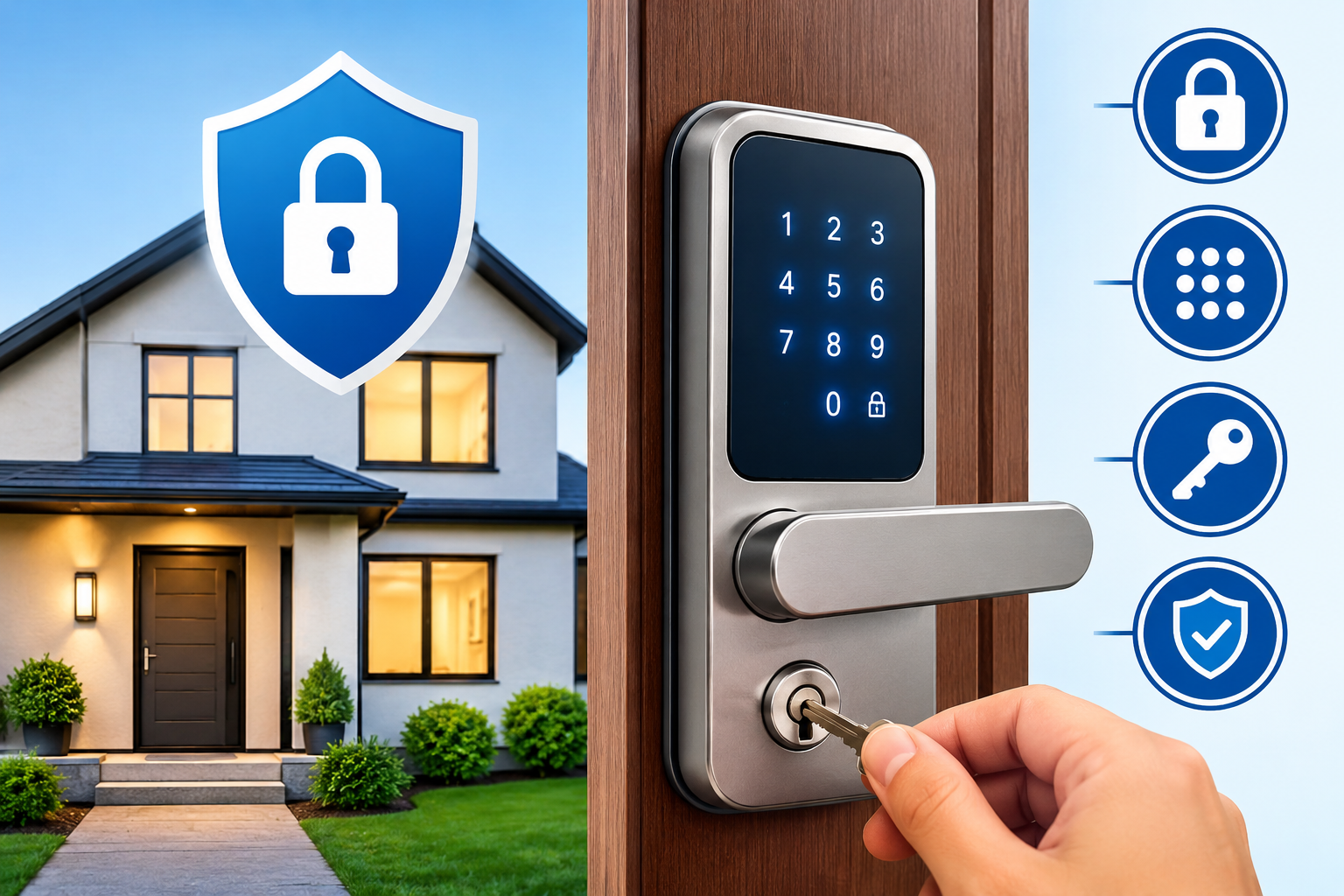
Keypad locks use a numbered code rather than a physical key. They eliminate the concerns associated with lost or copied keys and allow temporary access codes to be set and changed. The underlying locking mechanism still matters for security purposes. A keypad lock should have a mechanically sound locking bolt appropriate for the entrance it is used on.
Smart Locks
Smart locks add electronic connectivity to keypad or keyed functionality, typically allowing remote operation, monitoring, temporary code creation, and integration with home automation systems. The physical lock mechanism in a smart lock varies between products. Smart features do not automatically equate to stronger physical security.
Retrofit Smart Locks
Retrofit smart locks are designed to attach to the interior side of an existing deadbolt, replacing the thumb turn with a motorized mechanism controlled electronically. They allow smart-lock functionality while preserving the existing exterior keyed cylinder.
3. Look for Recognized Security Standards
When evaluating residential lock hardware, marketing language from manufacturers, terms like “heavy duty,” “commercial grade,” or “high security,” is not a reliable guide to a product’s actual security performance. These terms have no standardized meaning and appear on products across a very wide range of quality.
In the United States, the American National Standards Institute and the Builders Hardware Manufacturers Association jointly publish performance standards for residential and commercial door hardware. These are commonly referred to as ANSI/BHMA standards. Residential deadbolts are addressed under ANSI/BHMA A156.30, which covers high-security locks, and A156.36, which covers auxiliary locks including deadbolts, among other relevant standards.
Under these standards, residential deadbolts are graded based on performance testing that covers factors including security, durability, and finish. Grade 1 represents the highest level for residential applications, Grade 2 represents a medium level, and Grade 3 is the entry level. A lock that has been independently tested and certified to a recognized grade standard has been evaluated against defined performance criteria, not simply described by its manufacturer.
Homeowners should verify that a product actually carries the relevant certification rather than simply using grade language in its marketing. Established hardware certification programs and recognized testing organizations provide independent verification of product ratings. The Builders Hardware Manufacturers Association maintains certification programs for hardware that has been independently tested against ANSI/BHMA standards, and this information can be verified through their published certified products listings.
When a lock does not carry any recognized independent certification, marketing descriptions alone should be treated with appropriate caution.
4. Choose the Right Deadbolt for an Exterior Door
A deadbolt appropriate for a residential exterior door should combine a mechanically sound locking bolt with adequate construction quality and installation in a compatible door and frame.
Construction quality is relevant throughout the lock mechanism and cylinder. Better-quality cylinders incorporate features intended to resist common forms of attack, including hardened inserts or anti-drill pins in the cylinder face, anti-pick and anti-bump pin configurations, and cylinder collars designed to resist torque attacks. These features are more likely to appear in products certified to higher security grades, though their presence is not universally guaranteed by a grade rating alone.
The length of the deadbolt throw, the distance the bolt extends into the frame when locked, affects how much resistance the bolt provides when the door is under pressure. Most residential deadbolts throw approximately one inch. A bolt that does not extend adequately into the receiving hardware provides less resistance.
Door compatibility matters for installation quality. A deadbolt needs to be compatible with the door’s thickness, the backset distance (the distance from the door edge to the center of the borehole), and the door material. Installing a lock intended for a solid wood door on a hollow-core door, or on a material the lock was not designed for, produces a result that may look complete but provides limited resistance.
Installation quality is a factor that the lock itself cannot compensate for. A deadbolt installed with inadequate fasteners, on a misaligned door, or with strike hardware that is not properly anchored into the structural framing behind the door jamb will perform well below its potential.
Price alone is not a reliable guide to security performance. A product with recognized grade certification at a moderate price may provide better documented performance than a more expensive product whose marketing is stronger than its verified testing.
5. Consider Smart and Keypad Locks
Smart and keypad locks have become genuinely practical residential security options with a range of useful convenience features. Understanding both their benefits and their limitations helps homeowners decide whether they are appropriate for a particular entrance and household.
The practical convenience benefits are meaningful. Temporary access codes can be created for housekeepers, contractors, family members visiting temporarily, or short-term rental guests, and removed when that access is no longer needed. This eliminates the need to cut new keys and remove old ones when access arrangements change. Remote monitoring can allow homeowners to verify that a door is locked, receive notification when it is accessed, and lock or unlock it remotely where network connectivity allows.
The limitations are equally worth understanding. Smart locks depend on battery power. A dead battery at an inconvenient moment requires a workaround, which may be a physical key override or an external power supply method depending on the specific product. Most quality smart locks include low-battery warnings with meaningful advance notice, but battery maintenance is a responsibility that does not exist with purely mechanical locks.
Connectivity introduces its own considerations. A smart lock connected to a home network and operated through a manufacturer’s application is subject to the security of that application, the associated account, and the network it uses. Keeping the lock’s firmware updated, using strong account passwords, enabling two-factor authentication where the system offers it, and being aware of the manufacturer’s privacy practices are all relevant considerations for a connected device.
Smart features vary significantly between products. Some smart locks use strong physical locking mechanisms that meet recognized residential security standards. Others prioritize the electronic features over the physical lock’s quality. Evaluating the physical security grade of a smart lock separately from its electronic features provides a more accurate picture of what it actually offers.
Critically, the physical security performance of the door assembly, the frame, the strike hardware, and the installation quality, applies to smart locks in exactly the same way it applies to mechanical locks. A smart lock does not compensate for a weak door or inadequate strike hardware.
6. Don’t Ignore the Strike Plate and Door Frame
The strike plate, the reinforcing hardware on the door frame where the deadbolt engages, is consistently one of the most underappreciated elements of residential door security. In standard residential construction, strike plates are frequently installed with screws too short to reach the structural framing behind the door jamb’s trim layer. These short screws may hold adequately for everyday use but provide limited resistance when the door is under significant lateral force.
Longer screws, of appropriate specification for the frame material and depth, that reach through the jamb trim and into the underlying structural framing, substantially improve the holding strength of the strike hardware. This is a straightforward improvement that typically costs very little and requires only basic tools.
Strike plates vary in their construction as well. Standard residential strike plates are typically a thin metal plate with a relatively small area of contact between the plate and the jamb. Extended strike plates, sometimes called security strike plates or door reinforcement plates, distribute the load over a larger area of the frame and use multiple fastening points. Their effectiveness depends on being installed with appropriate fasteners into sound structural framing.
The door frame material itself sets a limit on what any strike hardware can provide. A frame in good condition, with sound wood or composite material and adequate depth for fastener penetration, allows strike hardware to be installed in a way that is genuinely effective. A frame that is damaged, has deteriorated material around the strike area, or lacks sufficient depth for proper fastener engagement cannot provide adequate support regardless of the strike plate’s quality.
Homeowners who are uncertain about the condition of their door frame or the adequacy of their current strike installation should consider having a qualified locksmith or carpenter assess the installation rather than assuming that the visible hardware represents the full picture.
7. Check the Condition of the Exterior Door
The door itself is a fundamental part of the security assembly, and a door in poor condition limits what any lock can provide regardless of its quality.
Solid core and solid wood exterior doors provide substantially more physical resistance than hollow-core doors. Hollow-core doors, which are more commonly found as interior doors but occasionally appear in less carefully constructed homes on secondary exterior entrances, offer limited resistance to physical force. If an exterior door sounds hollow when knocked on, its suitability for use as a secured exterior entrance is worth evaluating.
A door that has significantly warped, swollen, or shrunk so that it no longer fits its frame properly creates alignment problems that affect both the door’s day-to-day operation and its security. A visible gap between the door and frame when closed, a door that requires significant force to operate the lock, or hardware that has repeatedly worked loose all suggest that the door or its installation deserves professional attention.
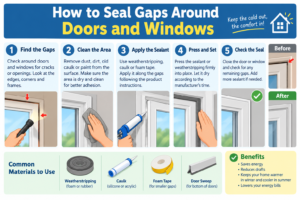
Glazed panels near the lock are worth considering in the context of the overall entrance design. Our guide on how to install weather stripping covers door sealing and fit maintenance that also relates to keeping an exterior door in good working condition over time.
Where a door shows signs of significant damage to the material around the lock or hinges, a structural assessment before lock replacement is appropriate. Installing new hardware on a compromised door produces a result that looks improved without genuinely being more secure.
8. Secure More Than Just the Front Door
It is easy to focus improvement efforts on the front door while leaving other exterior entrances in their existing condition. Secondary exterior doors, back doors, side entrances, and doors between an attached garage and the home interior deserve the same security consideration as the main entrance.
Back and side doors frequently have less visible-quality hardware than front doors, partly because they receive less attention during construction and renovation and partly because homeowners sometimes assume that their location makes them less relevant to security. The hardware condition on these doors is worth assessing with the same criteria applied to the front door.
The door between an attached garage and the home interior is particularly worth evaluating. Garages frequently have multiple points of access, including the main garage door, pedestrian side doors, and sometimes windows. The interior garage-to-home door should be treated as an exterior security door rather than an interior one, with appropriate hardware including a properly installed deadbolt.
Sliding glass doors used as patio or rear entrances use a different type of hardware from hinged doors and require specific security considerations appropriate to their operating mechanism. A qualified locksmith or home security professional can advise on appropriate security improvements for sliding door configurations.
The practical approach is to conduct the same inspection at every exterior entrance that is appropriate for the front door, assessing the lock, strike hardware, door condition, and frame integrity at each location before deciding where improvements are most needed.
9. Improve Key and Access Management
The physical quality of a lock is only part of the access security picture. Who has keys, access codes, or other credentials for the home’s exterior locks is equally important, and this is an area where practical habits make a significant difference.
Moving into a new home, whether purchased or rented, presents an access management decision that is worth addressing promptly. The previous occupants had keys. Their family members, contractors, and anyone else who was given a key at any point during the previous occupancy potentially has a copy. The most direct way to address this is to rekey or replace the exterior locks, which ensures that all existing key copies are rendered inactive.
Rekeying, which changes the lock cylinder’s internal configuration so that existing keys no longer operate it, is typically less expensive than full lock replacement and achieves the same access management objective when the existing hardware is in otherwise good condition. A qualified locksmith can advise on whether the existing locks are suitable for rekeying.
Key distribution deserves ongoing attention rather than only being considered when moving in. Knowing who currently has physical keys to each exterior entrance, and reviewing that list when circumstances change, such as when a tenant moves out, a contractor relationship ends, or keys go missing, keeps access control current rather than reflecting historical arrangements.
For smart and keypad locks, the equivalent practice is reviewing active codes regularly, removing codes that are no longer needed, and updating credentials when circumstances change. Temporary codes with defined expiry periods, where the lock system supports them, are a more controlled approach than codes that remain active indefinitely.
Spare keys stored outside the home in predictable locations represent a meaningful access vulnerability. Where a spare key arrangement is genuinely necessary, a lockbox with a combination code provides significantly more control than a key left under a doormat or in a standard outdoor rock-style container.
10. Consider the Needs of Your Household
Lock selection is not purely a security decision. The day-to-day usability of a lock matters for every member of the household who uses the entrance regularly, and a lock that creates consistent inconvenience is likely to be used incorrectly or bypassed.
Children who come home independently need to be able to operate the lock reliably without adult assistance. The mechanism type, the key management approach, and the physical operation of the lock should suit the youngest household member who will use it independently. Keypad locks are sometimes more practical for households with children because they eliminate the key management complexity.
Older adults and household members with limited hand strength, dexterity, or grip may find some lock mechanisms more difficult to operate than others. Lever handles are generally more accessible than knobs. Electronic locks that operate without physical key manipulation may provide better usability where this is a relevant consideration. Accessibility needs should be a genuine factor in lock selection rather than an afterthought.
Rental properties introduce specific considerations around key management and the frequency with which access arrangements change. Keypad and smart locks that allow codes to be changed without rekeying can be more practical and cost-effective than physical key-based locks in rental contexts, though the physical security quality of the lock mechanism remains equally important.
Where caregivers, regular service providers, or other recurring visitors need access to a home, a system that allows controlled, trackable, and revocable access, such as a smart lock with a dedicated temporary code, provides more control than distributing physical keys.
11. Rekeying vs. Replacing a Lock
The choice between rekeying an existing lock and replacing it entirely depends on the condition and quality of the current hardware and the reason for the change.
Rekeying changes the lock cylinder’s internal pin configuration so that existing keys no longer operate it and a new key is cut to the updated configuration. It is faster and typically less expensive than full replacement. It is the appropriate choice when the existing lock is in good condition, is of adequate quality for the application, and the only reason for the change is access management, such as moving into a new home or losing keys.
Rekeying is not appropriate when the existing lock is worn, damaged, of inadequate quality for the application, or when the lock type itself is not suitable for the entrance it is securing. In these cases, replacement is the right approach.
A qualified locksmith can assess whether existing locks are suitable for rekeying, can perform the rekeying process accurately, and can advise on replacement options where rekeying is not appropriate. They can also address situations where multiple exterior locks need to be keyed alike, so that one key operates all exterior entrances, which requires that all locks use compatible cylinder configurations.
Where a homeowner is uncertain about the quality or condition of existing hardware, a locksmith’s professional assessment before deciding between rekeying and replacement is a sensible step. The assessment typically costs relatively little and provides a reliable basis for the decision.
12. Common Mistakes Homeowners Should Avoid
Choosing a lock based only on appearance. A lock that looks solid and substantial may or may not provide the performance its appearance suggests. Evaluating construction quality, certification, and appropriate application alongside the visual impression produces better decisions.
Assuming an expensive lock is automatically more secure. Price and marketing presentation are imperfect proxies for security performance. A lock with recognized independent certification at a moderate price may have better documented performance than a more expensive product with strong marketing but no verifiable grade certification.
Ignoring the door frame and strike hardware. Upgrading the lock without addressing inadequate strike hardware or frame condition is one of the most common and consequential oversights in residential lock improvement.
Using inappropriate hardware on exterior doors. Interior privacy locks or spring-latch knob locks used as the sole security mechanism on exterior doors are not adequate for that application. Exterior doors should have a properly installed deadbolt alongside any keyed-entry hardware.
Forgetting secondary entrances. Improving the front door while leaving back doors, side doors, and the garage-to-home interior door in their existing condition creates an inconsistent security profile.
Leaving old keys or access codes active. Keys cut for previous occupants and access codes created for former caregivers or tenants remain active until deliberately revoked. Periodic review of who has active access is an important practice.
Ignoring smart-lock software updates. Smart locks, like other networked devices, receive firmware and software updates that address security vulnerabilities and improve functionality. Not applying available updates leaves a connected device in a potentially more vulnerable state than its manufacturer intends.
Choosing convenience without considering actual security needs. A lock that is easy and convenient but provides inadequate security for the entrance may create a false sense of security. The right balance depends on the specific household and property.
13. How to Choose Better Locks on Different Budgets
Basic Budget
At a basic budget level, the most impactful improvements are typically addressing the most significant gaps in the existing security assembly rather than upgrading to premium products across the board.
If the existing exterior doors lack a deadbolt, installing a deadbolt of at least Grade 2 or better ANSI/BHMA certification is a priority. Replacing existing deadbolts that are worn, corroded, or of clearly poor quality with a Grade 2 or Grade 1 certified replacement at a moderate price provides a meaningful documented improvement.
Replacing short strike-plate screws with longer screws that reach into the structural framing is a very low-cost change that improves the holding strength of the existing strike hardware and is appropriate at any budget level.
Moderate Budget
At a moderate budget, a Grade 1 certified deadbolt provides the highest residential security grade with independent testing documentation. The additional cost over Grade 2 options is typically modest.
Extended or reinforced strike hardware, properly installed with appropriate fasteners, completes the mechanical security improvement at a reasonable cost.
A keypad lock at the moderate budget level provides practical access management benefits without requiring the ongoing connectivity and maintenance of a full smart lock.
Higher Budget
At a higher budget, smart locks from established manufacturers with documented security grades provide both the mechanical security of quality hardware and the access management convenience of electronic operation. The investment is warranted when the convenience features, remote monitoring, temporary access codes, activity logs, represent genuine value for the household’s specific access management needs.
A professional security assessment from a qualified locksmith or home security professional can provide a complete picture of the property’s security profile across all exterior entrances, identify the most important areas for improvement, and recommend specific hardware and installation approaches appropriate to the property. This assessment can direct a higher-budget improvement investment more effectively than buying premium products without a clear picture of where the real gaps are.
14. When to Hire a Locksmith or Professional
A qualified locksmith brings knowledge of lock mechanisms, door hardware compatibility, installation requirements, and security standards that goes beyond what most homeowners can reliably self-assess. There are several specific situations where professional involvement is the appropriate choice.
When moving into a new home and the history of key distribution is unknown, a locksmith can assess the existing hardware and advise on whether rekeying, replacement, or other improvements are appropriate for each entrance.
When the existing door or frame shows signs of damage or deterioration around the lock area, a professional assessment is appropriate before installing new hardware. A locksmith or carpenter can advise on whether the frame condition is adequate or needs repair before new hardware is fitted.
When multiple exterior locks need to be keyed alike so that one key operates all entrances, a locksmith can manage the cylinder configurations and key cutting necessary to achieve this reliably.
When a smart lock installation involves compatibility questions, unusual door configurations, or integration with a broader home security system, professional installation ensures that the hardware is correctly configured and properly secured.
When the lock mechanism itself is damaged or seized rather than simply worn, a locksmith can assess and resolve the problem in a way that an untrained replacement attempt may not.
Accessibility requirements, where a household member needs specific hardware features or operating mechanisms to use an entrance reliably, may also benefit from professional advice on the appropriate products and installation.
Frequently Asked Questions
What type of lock is best for an exterior door?
For most residential exterior doors, a deadbolt is the appropriate primary security lock, used alongside a keyed-entry lockset for everyday convenience. A deadbolt certified to ANSI/BHMA Grade 1 or Grade 2 under relevant residential standards, properly installed with appropriate strike hardware in a sound door and frame, provides the documented performance level that residential security guidance generally recommends. Keypad and smart locks can provide additional access management convenience, but the underlying locking mechanism’s quality and certification matter regardless of the operating method.
Are deadbolts more secure than standard door locks?
As a general principle, yes, for exterior applications. A spring-loaded latch, as used in standard knob and lever locksets, retracts when lateral pressure is applied to the bolt. A deadbolt’s bolt moves only when manually operated by key or thumb turn and does not retract under lateral pressure. This mechanical difference means that a properly installed deadbolt provides significantly more resistance to forced entry than a spring-latch lock used alone. Most residential security guidance recommends a deadbolt on exterior doors as a result. The quality of the installation, strike hardware, and door frame remain important factors regardless of the lock type.
Are smart locks safe for home security?
Smart locks from reputable manufacturers can be appropriate for residential security when selected carefully. The physical lock mechanism’s quality matters independently of the smart features. A smart lock should have a documented security grade for its physical mechanism, not only for its electronic features. Smart locks introduce considerations that purely mechanical locks do not, including battery maintenance, firmware updates, account security, and connectivity reliability. A smart lock with a strong physical mechanism, properly configured account security, and maintained firmware can provide both adequate physical security and useful access management features. Smart features alone are not a substitute for evaluating the physical lock’s documented performance.
Should I replace my locks after moving into a new home?
Rekeying or replacing the exterior locks when moving into a new home, whether purchased or rented, is a sensible access management practice. The previous occupants had keys. Anyone who received a key at any point during the previous occupancy, contractors, family members, neighbors with a spare, may still have a copy. Rekeying changes the internal configuration so those copies no longer work. Full replacement is appropriate when the existing hardware is in poor condition or of inadequate quality. A qualified locksmith can assess the existing hardware and advise on whether rekeying is suitable or whether replacement makes more sense for specific locks.
Does a better lock make a door more secure?
A better lock is one component of a more secure door entry system. Its contribution is limited by the condition and quality of the other components. A high-quality deadbolt installed with inadequate strike hardware, or in a door frame that is damaged or soft, provides less protection than the lock’s own rating would suggest. Conversely, a sound door and frame with appropriate strike hardware significantly enhance the effectiveness of a quality lock installation. Evaluating and, where necessary, improving all elements of the door assembly alongside the lock produces a meaningfully better result than upgrading the lock alone.
Should I upgrade the door frame along with the lock?
Upgrading the strike hardware installation, specifically using longer screws that reach the structural framing, is a low-cost improvement that is appropriate alongside any lock upgrade and worth doing even if the lock itself is not being changed. Whether the frame itself needs repair or reinforcement depends on its condition. A frame in good condition with adequate structural depth for proper fastener penetration does not need further work to support a quality lock installation. A damaged, deteriorated, or structurally inadequate frame should be repaired before new hardware is installed, because new hardware in a compromised frame cannot perform as intended.
How often should home locks be replaced?
There is no universal replacement schedule for residential locks. The relevant considerations are the condition of the lock, whether it operates reliably, whether there has been a change in who has access to it, and whether it meets the security requirements of the entrance it secures. A lock that operates smoothly, shows no signs of significant wear or damage, carries appropriate security certification, and is installed in a sound door assembly does not need replacement on a schedule. A lock that operates poorly, shows corrosion or damage, or was installed without adequate supporting hardware deserves evaluation and potential replacement regardless of its age.
Is rekeying better than replacing a lock?
Rekeying is the better choice when the existing lock is in good condition and of adequate quality for the application, and the reason for the change is access management, such as moving into a new home or losing keys. Replacing is the better choice when the existing hardware is worn, damaged, of inadequate security grade, or of a type not appropriate for the entrance. Rekeying is typically faster and less expensive than replacement and achieves the same access management outcome when the existing hardware is suitable. A qualified locksmith can assess which approach is appropriate for specific locks and explain the options clearly.
Final Thoughts
Improving home security with better locks is a genuinely worthwhile investment for most homeowners, and the practical approach is to evaluate the complete door assembly rather than focusing only on the lock cylinder. The lock, the door, the frame, the strike hardware, the installation quality, and the access management habits of the household all contribute to the actual security of an exterior entrance.
The goal should be a practical balance between security, reliability, convenience, and everyday usability. An entry system that is appropriately secure, reliably operated by the household members who use it every day, and maintained in good working condition over time serves its purpose effectively. An entry system that prioritizes security features beyond what the door and frame can support, or that is technically secure but inconvenient enough to be used carelessly, does not.
Start by inspecting every exterior entrance with honest attention to the full assembly. Identify the weakest points, whether that is worn hardware, inadequate strike installation, secondary entrances with less consideration than the front door, or access management practices that have not been updated when circumstances changed. Address those weaknesses in order of practical importance rather than spending on premium products where the foundation they would be installed on is not sound.
Where uncertainty exists about the right approach for a specific entrance, a qualified locksmith’s assessment is a sensible and typically affordable first step that produces better-informed decisions than shopping for hardware without a clear picture of what the property actually needs.